


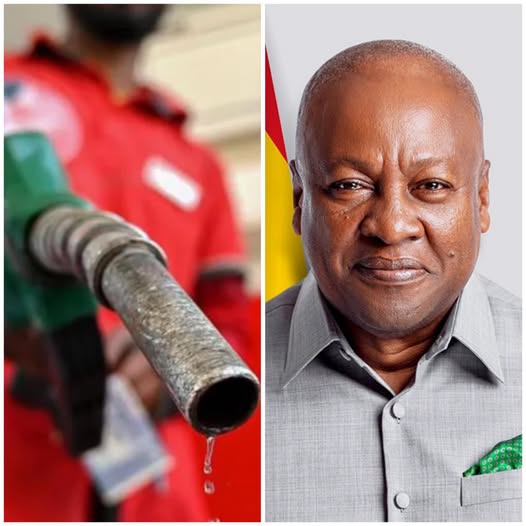
The government has announced a temporary GH¢2 reduction in the regulatory margin on diesel, a move expected to lower pump prices by nearly 12 per cent and shield consumers from rising fuel costs amid mounting inflationary pressures.
The directive, issued by President John Dramani Mahama, takes effect from Tuesday, August 4, 2026, and will remain in force for one month. According to the government, the intervention forms part of broader efforts to cushion households and businesses against the impact of increasing global fuel prices while safeguarding the country’s economic recovery.
The announcement was made by the Presidential Spokesperson, Felix Kwakye Ofosu, in Accra following a Cabinet decision to implement the temporary relief measure. Government said the intervention follows the success of a similar initiative introduced in April this year, which helped moderate fuel prices and ease pressure on consumers. In a statement, the Presidency explained that the reduction is intended to “cushion consumers, prevent transport fare hikes, contain inflationary pressures, and mitigate the pass-through effect of higher fuel prices on the cost of living.”

The measure is expected to significantly reduce the retail price of diesel, providing immediate relief to commercial transport operators, businesses that rely heavily on diesel-powered machinery, and individual motorists. Executive Secretary of the Chamber of Petroleum Consumers (COPEC), Duncan Amoah, described the government’s intervention as a substantial relief for diesel users.
Speaking in an interview with the Daily Graphic, Mr Amoah estimated that the reduction would bring the average pump price of diesel down from GH¢19.26 per litre to approximately GH¢17.26 per litre, representing a reduction of almost 12 per cent. “For consumers of diesel, the government seems to have done something quite significant to ensure you don’t pay in excess of GH¢19 for a litre of diesel,” he said.
He noted that the reduction could play a crucial role in stabilising transport fares over the coming weeks, particularly as transport operators have recently indicated plans to increase fares in response to rising fuel prices. According to Mr Amoah, the intervention provides an opportunity for government to engage transport unions, including the Ghana Private Road Transport Union (GPRTU), to maintain current fares and avoid additional pressure on commuters.

The COPEC Executive Secretary, however, observed that the temporary relief does not extend to petrol users.
“For users of petrol, the government intervention was pretty silent. That means between GH¢14 and GH¢15 a litre will be a stable feature for the next two-week period,” he stated. Despite welcoming the diesel price reduction, Mr Amoah cautioned that fuel prices remain relatively high compared to levels recorded at the beginning of the current administration.
He recalled that when President Mahama assumed office in January 2025, fuel prices averaged about GH¢14.90 per litre, arguing that any price above GH¢15 should still be considered expensive by historical standards. Mr Amoah also pointed to previous instances when declining fuel prices resulted in reductions in transport fares.
He said transport unions had agreed to reduce fares by about 15 per cent when fuel prices fell to around GH¢12 per litre, demonstrating that lower fuel costs can translate into direct benefits for the travelling public. “Clearly, there has been a spike, and that ultimately could have led to some transport fare adjustment. But the transport operators have been magnanimous, and I think that has been good,” he remarked.

While the intervention is expected to ease pressure on consumers, it comes at a fiscal cost to the state. Mr. Amoah estimated that government would forgo between GH¢200 million and GH¢225 million in revenue over the one-month period as a result of the reduced regulatory margin. He nevertheless argued that the economic benefits of containing transport costs and preventing widespread increases in the prices of goods and services would outweigh the immediate revenue loss.
“I think it is a good bargain or a good trade-off for the likely economic impact we would have had if the government had not taken this intervention decision,” he said.
According to him, allowing the funds to remain in circulation instead of collecting them through fuel levies effectively injects liquidity into the economy, helping households and businesses cope with rising living costs while supporting economic activity. Despite praising the government’s response, Mr. Amoah warned against relying on temporary subsidies whenever fuel prices increase, describing such interventions as financially unsustainable over the long term.

“These interventions should not be viewed as something the government can consistently avail itself of,” he cautioned. “If prices increase further, what else is the government going to throw in? That seems a very unsustainable thing to do,” he added.
Instead, he called for the establishment of a robust strategic petroleum reserve programme to provide a more sustainable mechanism for managing future fuel price shocks. Mr. Amoah noted that BOST Energies currently does not maintain strategic petroleum reserves, a situation he believes should be addressed urgently. He proposed the introduction of a strategic reserve margin within the existing fuel tax structure to enable government to purchase petroleum products when international prices are low and store them for use during periods of price volatility.
“If you study the trends, you will know in which seasons prices are likely to go down and which months prices are likely to go up. Anytime prices go down, the government buys some to store, so that when prices are going up, the government can use what it bought and stored to cushion the market,” he explained.

He argued that such a system would offer a more predictable and sustainable means of stabilising domestic fuel prices while reducing the need for repeated fiscal interventions that place additional strain on public finances. Government, for its part, has indicated that it will continue to monitor developments in the petroleum market and introduce additional measures where necessary to protect consumers, maintain macroeconomic stability and support the country’s ongoing economic recovery.
Philbert Amiba Ayuusah