


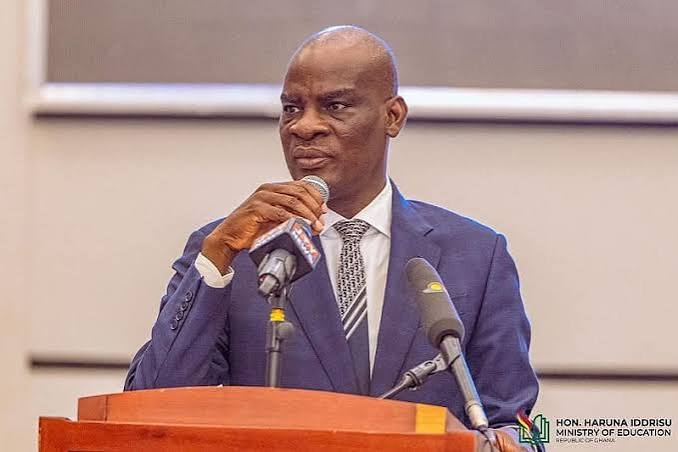
Kindergarten and primary school pupils in Ghana will soon have the opportunity to study chinese as part of a newly revised national curriculum aimed at equipping learners with 21st-century skills, strengthening foundational learning and promoting ethical values.The revised curriculum, developed by the National Council for Curriculum and assessment (NaCCA) introduces Chinese as an optional foreign language from Primary One, marking one of the most significant changes to Ghana’s basic education system in recent years.
The curriculum, which covers Kindergarten to Primary Six was presented to the Minister of Education, Haruna Iddrisu, in Accra on Wednesday by the Director-General of NaCCA, Prof. Samuel Ofori Bekoe who chaired the curriculum review committee.Following the presentation, the Education Minister directed the Ghana Education Service (GES) to review the curriculum within one week and ensure it is fully prepared for implementation while meeting strict quality standards before its rollout in classrooms nationwide.
The revised curriculum features 13 subject area designed to strengthen foundational literacy and numeracy while preparing pupils for an increasingly technology-driven world.

For primary schools, the subjects include Ghanaian Language, English Language, Chinese, Arabic, French, Religious and Moral Education, Mathematics, Physical Education and Health, Creative Arts, Citizenship Education, Computing, and Science with Agriculture integrated as a strand.According to Prof. Ofori Bekoe, the review was undertaken after an evaluation of the existing curriculum revealed learning gaps, particularly in Mathematics, English Language, and the teaching of Ghanaian culture, values and civic responsibility.
He explained that NaCCA assembled 160 education experts and a technical working group to redesign the curriculum in line with emerging national priorities and the government’s manifesto commitment to improve education outcomes.Among the major reforms is the reintroduction of Citizenship Education as a standalone subject to consolidate the teaching of civic values, history, ethics and national identity instead of spreading these themes across multiple subjects.
The curriculum also incorporates computational and quantitative thinking into Mathematics and Computing, introducing learners to concepts such as coding, automation and artificial intelligence (AI) from the basic level.

In another structural adjustment, Agriculture has been integrated into Science rather than being taught as a separate subject, a move intended to reduce subject overload while preserving agricultural education.Assessment methods have also been overhauled, with a shift towards task-based and formative assessment. Teachers will assess pupils using three performance levels—basic, attained and deeper—to better identify learning gaps and provide targeted support.
On language education, Prof. Ofori Bekoe announced that foreign language instruction would now begin in Primary One instead of Primary Four to improve proficiency at an earlier age.He said Arabic had been standardised across Primary One to Six, while Chinese had been introduced as an optional language. As part of the rollout, the Confucius Centre has offered to pilot the Chinese language programme in 10 school using three trained teachers.
Prof. Ofori Bekoe added that ethics and values had been deliberately embedded throughout the curriculum to ensure that learners not only acquire academic knowledge but also develop strong moral character.

Describing the curriculum review as the most important achievement of his tenure, Education Minister Haruna Iddrisu said the reform would shape future generations by producing ethically responsible citizens equipped with critical thinking and problem-solving skills.
“My legacy should be measured by the moulding of character and the production of ethically responsible citizens with problem-solving minds,” he said.
The minister also reaffirmed government’s decision to make Ghanaian language the medium of instruction from Kindergarten to Basic Three, with English taught as a subject during the early years to strengthen literacy development.He explained that teaching children first in their mother tongue would improve cognitive development, reading comprehension and ultimately enhance the acquisition of English and other languages.
“Learners at this level will be taught to read in a Ghanaian language. English Language will be taught as a subject with an explicit emphasis on play-based oral activity,” Mr. Iddrisu stated.

Welcoming the inclusion of citizenship education, ethics and cultural values, the minister urged schools to focus more on assessment for learning rather than rote memorisation.He further directed the Ghana Education Service to prioritise the recruitment of Ghana language teachers during its next recruitment exercise, following appeals from traditional authorities, particularly in the Greater Accra Region.
Beyond Chinese, the minister praised NaCCA for expanding pupils’ exposure to international languages, noting that learners would also have opportunities to study French, Arabic, Spanish, Italian, German, a move he said would better prepare Ghanaian children to compete in an increasingly interconnected global economy.
Philbert Amiba Philbert