

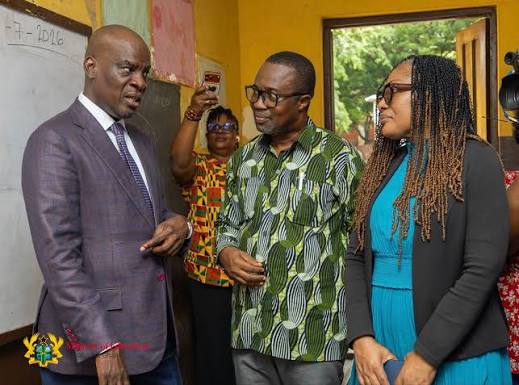
The government is set to introduce a cohort-based learning assessment model to monitor the academic progress of pupils throughout their basic education, a move aimed at improving learning outcomes and strengthening accountability across the education sector.The Minister of Education, Haruna Iddrisu, announced the new policy on Tuesday during a visit to Osu St Peter’s Roman Catholic Basic School and Osu Salem 1 Kindergarten and Primary School in Accra, where he observed this year’s National Standardized Test.
Under the proposed model, pupils will be assessed at different stages of their educational journey, beginning from Primary Two and continuing through Primary Four, Primary Six and Junior High School Two before they sit for the Basic Education Certificate Examination (BECE).

According to the minister, the approach will enable the Ministry of Education to track the progress of the same group of learners over time instead of relying on a single assessment to determine academic performance.”It will allow us to understand whether interventions introduced in our schools are genuinely improving learning outcomes,” Mr Iddrisu said.
He explained that the system would provide a clearer picture of how pupils develop academically while enabling schools and education authorities to evaluate the effectiveness of reforms and interventions introduced within the basic education system. Mr. Iddrisu said the cohort-based assessment would also enhance accountability by giving schools a reliable framework to monitor learners’ progress and helping policymakers identify areas where additional support or policy adjustments were needed.

He noted that the National Standardized Test had already become an important tool for assessing the state of foundational learning across the country, providing valuable data to identify learning gaps and guide targeted interventions. During his interaction with pupils, the minister observed that while many learners correctly identified Ghana’s first President, Dr Kwame Nkrumah, some were unable to state the year Ghana attained independence.
He described the outcome as an indication that greater attention should be given to the teaching of history at the basic school level.”My takeaway from today is that we have to improve the teaching of history in our basic schools. The question is not simply how learners perform today but how much this same group of learners improves over time,” he said.

He stressed that Ghana must renew its commitment to strengthening foundational education, particularly literacy, describing it as the cornerstone of a child’s educational success.”Ghana needs to realign and reinvest in basic foundational learning. When the child gets literacy right, it measures the success of that child throughout the education level,” he added.
This year’s National Standardized Test is being administered to approximately 16,000 learners nationwide, comprising 2,500 Kindergarten Two pupils, 4,500 Primary Two pupils, 4,500 Primary Four pupils and 4,500 Primary Six pupils. The assessment forms part of the government’s broader education reform agenda under the Ghana Accountability for Learning Outcomes Project (GALOP), which seeks to improve the quality of teaching and learning in basic schools.

Introduced in 2021, the National Standardised Test measures foundational literacy and numeracy skills among pupils and provides evidence to support policy decisions aimed at improving learning outcomes across Ghana’s education system.
Philbert Amiba Ayuusah