


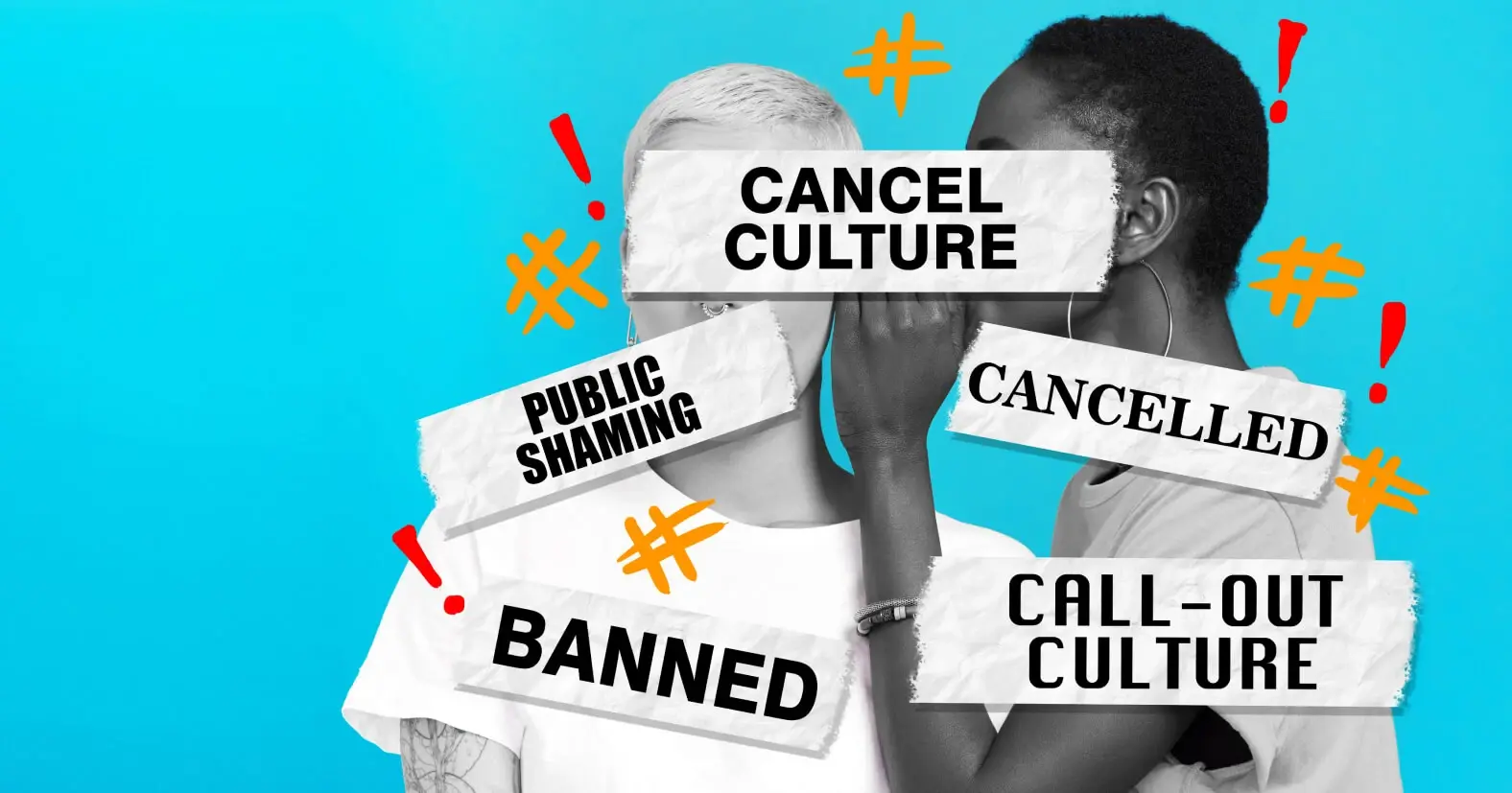
There is a particular sequence that has become familiar to anyone paying attention to Ghanaian social media over the past few years. Someone says something, does something, or is accused of something. The post appears. The quote tweets accumulate. The trending topic forms. The pile-on begins, with a momentum that moves faster than any verification process could keep pace with, drawing in people who have varying degrees of familiarity with the original incident and uniformly strong opinions about it. The subject of the attention is branded with a label that will now follow them across platforms and search results. And then, relatively quickly, the crowd moves on to the next thing, leaving behind a person whose reputation has been significantly altered and a question that rarely gets asked with sufficient honesty: was that justice, or was it something else?
Cancel culture, the practice of collective social withdrawal and reputational damage directed at individuals judged to have violated community norms, is not a Ghanaian invention. It arrived here through the same global social media architecture that delivered it everywhere else, shaped by dynamics that were developed primarily in American cultural contexts and then exported with the algorithms that carried them. But it has taken on specifically Ghanaian textures, operating within the communal dynamics, the class politics, the gender tensions, and the specific moral architecture of Ghanaian public life in ways that deserve examination on their own terms.
The legitimate case for accountability
Before examining the pathologies of cancel culture, the legitimate function it sometimes serves deserves honest acknowledgment, because the dismissal of the phenomenon as purely mob behaviour frequently functions to protect the powerful from consequences that they have evaded through more traditional channels.

Ghana’s formal accountability mechanisms have significant limitations. The legal system is slow, expensive, and inaccessible to most people. Professional regulatory bodies are inconsistently effective. Institutional hierarchies protect their own. The individual who has been harassed by an employer, abused by a person with social status, defrauded by a public figure, or silenced by an institution with more resources than they have, frequently has no realistic recourse through formal channels. Social media accountability, for all its problems, represents a genuinely democratised mechanism for consequence in a landscape where consequence has historically been distributed very unequally.
The Ghanaian woman who names her harasser on social media and is believed and supported by her community has accessed a form of justice that the formal system would likely have denied her. The public figure whose financial misconduct is documented and shared has been held to a standard that their institutional position would otherwise have exempted them from. The brand whose product caused harm and whose response was inadequate has faced the market consequence of public knowledge in a way that private complaint channels would not have produced. These are not trivial outcomes. They represent real accountability that would not otherwise have existed.
Research on social accountability mechanisms in contexts where formal institutions are weak has found that community-based accountability, including social media accountability, fills a genuine gap and produces deterrent effects that formal systems alone cannot achieve. The awareness that misconduct may be publicly documented has measurable effects on behaviour in professional and social contexts, particularly for individuals whose social reputation is central to their livelihood.
Where accountability becomes something else
The difficulty is that the mechanism that sometimes produces genuine accountability also sometimes produces something that resembles accountability without actually being it, and the difference is not always easy to identify in the heat of a trending topic.
The first corruption of the process is the replacement of evidence with accusation. The viral call-out post that makes a serious allegation without documentation relies on the emotional impact of the allegation to produce the social consequence. Once the allegation is moving at scale, the question of whether it is accurate becomes secondary to the social dynamics of the pile-on. The person who asks for evidence is frequently treated as a defender of the accused rather than as someone applying a standard of intellectual honesty that the accountability claim requires. The result is that the mechanism that is supposed to produce truth-based consequence can instead produce reputation damage based on unverified claims, and the damage is done before any verification is possible.
The second corruption is disproportionality. The severity of the social consequence produced by a cancellation has almost no reliable relationship to the severity of the conduct that triggered it. A clumsy or insensitive statement made years ago, in a different context, with a different level of public visibility, can produce a consequence equivalent to or greater than genuinely serious misconduct, because the viral dynamics that determine consequence are not calibrated to severity. They are calibrated to outrage, and outrage is not a reliable proxy for harm.
Research on online pile-on dynamics found that the emotional intensity of collective social media criticism escalates beyond what the original trigger would justify in the majority of cases studied, driven by the social rewards of participation, the competitive dynamic of demonstrating moral seriousness, and the deindividuation effects of crowd behaviour that reduce individual members’ capacity for proportionate response. The pile-on produces its own momentum that is largely independent of the original incident once it reaches sufficient scale.
The third corruption is the absence of redemption pathways. Genuine accountability processes, whether legal, therapeutic, or restorative, are designed around the concept of consequence followed by the possibility of repair, of restoration, and in some framework, of return to standing. Cancel culture as it typically operates has no formal redemption pathway. The cancelled person is expected to apologise, but the apology is frequently used as further fuel rather than as the beginning of resolution. The sincerity of the apology is questioned. The timing is criticised. The wording is parsed for inadequacy. The result is that the formal gesture of accountability produces no actual accountability outcome, because the community conducting the cancellation has no mechanism for receiving the accountability it demanded and no agreement on what resolution would look like.

The Ghanaian class and gender dimensions
Cancel culture in Ghana does not operate in a social vacuum. It operates within existing structures of power, class, and gender that shape who gets cancelled, for what, and with what consequence, in ways that are worth examining directly.
The pattern observable in Ghanaian social media accountability culture is that consequence distributes unequally across social positions. The emerging public figure, the young artist, the small-scale influencer, the person without institutional backing, is significantly more vulnerable to cancellation consequences than the established figure, the person with institutional affiliation, the individual whose network includes people with the ability to manage narrative and provide platform support. The powerful are not immune to cancellation, but they have resources for managing it that the less powerful do not, and the consequence, when it arrives, tends to be shorter-lived.
The gender dynamics of Ghanaian cancel culture are particularly pronounced. Women who make accusations against men with social standing frequently find the cancellation dynamic reversed: the accusation becomes the subject of interrogation rather than the conduct being accused. The woman’s past, her character, her motivations, and her credibility become the terrain of the public conversation rather than the man’s alleged behaviour. This reversal reflects the same gender power structures that make formal accountability difficult for women to access. Social media accountability is not exempt from those structures. It operates within them.

Conversely, women who attract cancellation attention for violations of gendered social expectations, for expressing views about sexuality, for relationship conduct that violates community norms, or for the kind of assertiveness that reads differently on women than on men, frequently face a severity of pile-on that their male equivalents do not encounter for equivalent conduct. The gendered double standard in formal accountability spaces is reproduced, and sometimes amplified, in social media accountability spaces.
The psychology of the pile-on participant
An honest examination of cancel culture requires looking not only at the subject of the cancellation but at the people participating in it, because the dynamics of collective moral condemnation are psychologically specific and worth understanding.
Participation in a pile-on produces a distinct set of psychological rewards. The sense of moral clarity that a clear villain provides is genuinely satisfying in a world that usually presents ethical complexity. The social belonging that comes from being on the right side of a community judgment is real and immediate. The competitiveness around demonstrating the most uncompromising moral position, the most cutting criticism, the most devastating observation, produces social status within the pile-on community that has its own motivational pull.
Research on moral grandstanding, defined as the use of moral talk to impress others with one’s moral credentials, found that it was significantly associated with online moral condemnation behaviour, with participants motivated substantially by the social rewards of being seen to hold the right position rather than by genuine concern for the harm being addressed. The researchers noted that moral grandstanding was distinct from genuine moral concern and that the two could not be reliably distinguished from the outside of the behaviour, which is part of what makes pile-on dynamics so difficult to interrupt from within.

None of this means that every participant in a cancellation is acting in bad faith. Many people who join accountability pile-ons are genuinely concerned about the conduct being called out and genuinely motivated by the harm they believe it represents. But the dynamics of collective condemnation are such that genuine concern and performative outrage are mixed in proportions that no one in the crowd can accurately assess, which means the aggregate behaviour of the pile-on reflects neither pure accountability nor pure bullying but something more complex and less comfortable than either frame accommodates.
When it becomes bullying
The line between accountability and online bullying is not always clear, but there are markers that shift the category unambiguously.
When the target of collective criticism is a private individual rather than a public figure, and the criticism has no public interest justification beyond the satisfaction of the crowd, the accountability frame is not credible. The private person who said something ill-advised in a limited social context and finds it amplified to a public audience of thousands has not been held accountable. They have been hurt by a crowd that had no legitimate interest in their conduct.
When the criticism includes personal details about the target’s family, physical appearance, private relationships, or circumstances unrelated to the original conduct, it has moved from accountability to harassment. The conduct being called out does not license the full exposure and public humiliation of the person who committed it, and the conflation of the two is a feature of pile-ons rather than a feature of genuine accountability processes.
When the criticism continues after any reasonable accountability purpose has been served, when the apology has been made and dismissed, when the professional consequence has been applied and the crowd continues, when the target is a private person who has been named, located, and harassed across multiple platforms, the activity is no longer accountability. It is cruelty that has borrowed the language of accountability to avoid describing itself accurately.

What a more honest accountability culture would look like
The alternative to cancel culture is not the absence of accountability. It is a more honest and more effective form of accountability that the current dynamics undermine rather than support.
It would distinguish consistently between public figures exercising public power and private individuals making private mistakes, applying significantly different standards of proportionality to each. It would require evidence before consequence rather than treating allegation as sufficient for reputational damage. It would have a framework for resolution, for what accountability looks like when it has been genuinely offered and genuinely received, rather than treating the process as indefinitely open regardless of what the subject of the criticism does.
It would also require the willingness to apply its standards consistently rather than selectively, to be as rigorous about the conduct of people on the same political or social side as it is about those on the opposite side, to be as willing to extend nuance to the less powerful as it is to demand accountability from the more powerful. Consistency is the test of whether an accountability norm is genuinely principled or merely tactical, and the Ghanaian social media accountability culture, like its equivalents everywhere, frequently fails that test.
The underlying question that cancel culture forces, about who is accountable to whom and through what mechanisms in a society where formal accountability is inadequate, is an important one. The digital mob is a poor answer to that question, not because accountability is wrong but because the mob is not a reliable instrument for producing it. What Ghana needs is not the absence of accountability demand but the development of accountability mechanisms that are rigorous enough to produce genuine consequence where it is warranted and restrained enough not to destroy people where it is not.
That is harder work than a trending topic. It is also the only kind of work that produces the outcome the trending topic claims to want.
Comedian Funny Face joins Ignite Media Group as part of comeback to mainstream media