

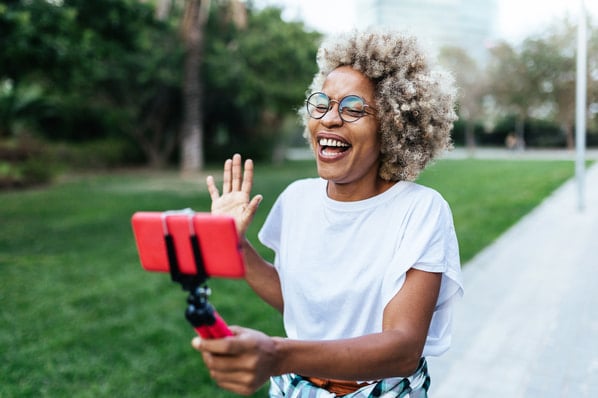
There is a particular kind of content that performs extremely well on Ghanaian social media, and its grammar is consistent enough to have become almost a genre. The aesthetic morning routine in a well-lit apartment. The laptop on a café table in a neighbourhood that communicates arrival. The outfit that is casual in the way that only expensive things can be casual. The caption that implies abundance without stating it directly: grateful, blessed, aligned. The numbers underneath: thousands of likes, hundreds of comments from people who want to know where the bag is from, how the skin got that way, what the morning actually looks like.
What the numbers do not show, and what the content is carefully constructed not to show, is the rent situation behind the well-lit apartment, the monthly income that the laptop actually generates, the number of outfits that were tried on and discarded before the casual one was selected, the gap between the curated morning and the actual one. This is not a moral failing of the people creating the content. It is the operating logic of a medium that rewards presentation over reality and penalises the disclosure of difficulty in ways that make honesty structurally irrational for anyone whose livelihood depends on the performance.
The question of what is actually fake in influencer culture is worth asking with more precision than the general scepticism typically applied to it, because the answer is not as simple as everything or nothing, and the distinction matters for the people consuming the content and calibrating their own lives against it.

What the medium does to reality
Before assigning individual fault, it is worth understanding what social media platforms do to reality structurally, because the distortion is not primarily a function of individual dishonesty. It is a function of the medium’s architecture.
Every platform that rewards engagement over accuracy has built into its fundamental design a pressure toward the performance of life rather than the documentation of it. The post that shows a difficult day, a financial struggle, a relationship conflict, or a professional failure generates significantly less engagement than the post that shows success, beauty, abundance, or aspiration. This is not because audiences are shallow. It is because the emotional response to aspiration, the mixture of inspiration, envy, and vicarious pleasure, drives the specific behaviours, likes, shares, saves, that the algorithm rewards. The algorithm is not neutral. It is optimised for engagement, and aspirational content generates more engagement than honest content in almost every tested context.
The creator who responds rationally to these incentives produces aspirational content. The creator who attempts to be consistently honest about difficulty and failure generates less engagement, reaches fewer people, and earns less money from the platform activity. The medium has built a financial structure that makes the performance of a better life than the one being lived the economically rational choice for anyone trying to sustain an audience.
Research on social media content and psychological wellbeing has found that the ratio of positive to negative content on most platforms significantly exceeds the ratio in real life, and that this imbalance creates systematic upward social comparison for users who consume the content without accounting for the selection effects that produced it. The user who sees a feed of curated success is receiving a systematically biased sample of reality, not a representative one, but the emotional processing of social comparison does not automatically correct for this bias.

The specific fictions of Ghanaian influencer culture
Ghanaian influencer culture has developed its own specific set of conventions around what is shown and what is not shown, and these conventions track the specific anxieties and aspirations of the Ghanaian middle-class imagination in ways worth mapping.
The apartment that suggests a living situation that the rent does not support is among the most common. A significant proportion of Ghanaian lifestyle content is shot in spaces that are not the creator’s primary residence, in borrowed apartments, in hotel rooms, in the homes of friends with better-located or better-furnished spaces. The content implies a domestic reality that is not the domestic reality. The viewer in their own more modest space receives the implication as information about where they should be, which generates the aspiration that drives engagement, which serves the creator’s metrics without serving the viewer’s actual interest.
The travel content that omits the financial engineering behind it is another. The Ghanaian influencer photographed in Dubai, in London, in New York, in Bali, is frequently not travelling the way the content implies. Press trips, brand collaborations, hosted visits, and the careful aggregation of very limited travel budgets into maximally photographable experiences account for a significant proportion of travel content that reads as casual global mobility. The implication that this person simply goes to these places the way other people take trotro to work is a fiction that the content is designed to maintain.
The financial independence narrative that does not show its arithmetic is perhaps the most consequential fiction for its audience. The content that presents a life of flexible working, passive income, and location independence without disclosing the income figures, the working hours, the periods of financial instability, or the external support that the lifestyle depends on is not lying in any single statement. It is creating a false impression through strategic omission, which is the most effective form of misleading because it has no specific falsehood that can be identified and challenged.
A study examining the income disclosure practices of social media influencers found that a significant majority did not disclose their actual earnings from content creation, and that the gap between implied and actual income was substantial in most cases examined. The researchers noted that the presentation of influencer lifestyle as a financially viable primary career path for most entrants significantly overstated the actual earnings distribution, which was highly concentrated among a small proportion of creators while the majority earned amounts that would not sustain the lifestyle their content implied.

What is not fake
Intellectual honesty requires acknowledging what is genuine in influencer culture rather than dismissing it entirely, because the wholesale cynicism applied to it is as inaccurate as the uncritical acceptance it sometimes receives.
The skill and labour that goes into content creation is real and should not be minimised. The Ghanaian creator who produces consistent, high-quality content, who has developed a visual aesthetic, a voice, a community, and a commercial understanding of their platform, is doing genuinely skilled work that has genuine market value. The presentation of influencing as an effortless life rather than a demanding and highly uncertain profession is a fiction, but the work itself is real.
The aspirational dimension of the content also serves a genuine function that scepticism sometimes obscures. The young person in a small town who sees a Ghanaian creator living a life that looks different from what their immediate environment presents as possible is receiving information that their direct experience is not providing: that a different kind of life is achievable, that the world is larger than the one immediately visible to them, that beauty and comfort and interesting work are not reserved for a narrow category of people. This is not nothing. Aspiration, even when its specific content is mediated by commercial interests, can be a genuine motivating force toward genuine change.
The community that forms around some Ghanaian creators is also real in ways that matter. The comment sections of creators who have built genuine relationships with their audiences, who respond to messages, who acknowledge difficulty, who treat their followers as people rather than metrics, contain evidence of genuine connection and mutual support that is not reducible to performance. Community is not fake simply because it formed on a digital platform.

The harm that the fakeness actually causes
The reason the question of what is fake matters is not aesthetic. It is that the consistent consumption of aspirational content that misrepresents the conditions under which the presented life is achievable produces real harm in the people consuming it.
The most direct harm is the calibration of expectations against a standard that is not what it appears to be. The young Ghanaian who is measuring the adequacy of their own life against the implied life of their favourite creator is measuring against a fiction, and the inadequacy they feel as a result is manufactured rather than real. They are not behind. They are being compared to a performance, and performances are designed to exceed reality.
Research on social comparison and mental health among social media users has found consistent associations between heavy consumption of lifestyle content and increased rates of anxiety, depression, body dissatisfaction, and financial stress, with the effect mediated significantly by upward social comparison. Importantly, the effect was not reduced by general awareness that social media is curated, suggesting that intellectual knowledge of the curation does not fully protect against its emotional impact during consumption.
The financial harm is also real and specifically documented. The consumer who spends money they do not have to approximate the lifestyle they see in content, who takes on debt to fund the appearance of the life they are aspiring toward, is making financial decisions driven by a benchmark that does not represent what it claims to represent. The creator who is also financing their lifestyle through debt, through family support, through brand deals that will end, while presenting it as self-generated abundance, is providing a benchmark that the viewer has no way of accurately assessing.

What more honest content would look like
The solution is not the demand that all influencer content be documentary rather than aspirational, which would misunderstand what the medium is and what its audience is seeking from it. People watching lifestyle content are not primarily seeking journalistic accuracy. They are seeking entertainment, inspiration, and the pleasures of vicarious experience, which are legitimate things to seek and legitimate things to provide.
What more honest influencer content looks like is the occasional, genuine disclosure that punctures the fiction enough to give the audience a realistic anchor. Not the performative vulnerability of a carefully produced difficult moment that is ultimately as curated as the aspirational content, but the actual acknowledgment of the gap between the presentation and the reality. The creator who says plainly that a particular trip was a press trip, that they are renting rather than owning, that the month was difficult, that the income from content is not what the lifestyle implies, is not undermining their brand. They are building a relationship with their audience that is more durable and more honest than the one sustained by consistent performance.
Some Ghanaian creators have found that this kind of honesty, offered without the performance of honesty, actually builds stronger audience relationships than the aspirational content it sits alongside. The audience that knows a creator is being straight with them is more loyal, more trusting, and more resistant to the disillusionment that follows the inevitable moment when the performance becomes visible.
What the audience owes itself
The final responsibility in this dynamic lies not only with creators but with the people consuming the content. The emotional processing of social comparison is not fully under conscious control, but the decisions about what to consume, how long to consume it, and what frameworks to apply when interpreting it are.

The viewer who follows ten accounts presenting a version of life that makes their own feel inadequate, who spends two hours a day consuming content that systematically triggers upward comparison, and who then wonders why they feel consistently deficient, is participating in the production of their own distress in ways that awareness can interrupt.
The practical tools are not complicated: auditing follows for accounts that consistently produce the feeling of inadequacy rather than genuine inspiration or entertainment, actively seeking out creators who disclose the conditions behind their content, and developing the habit of asking when the content is consumed what the fiction is hiding rather than accepting the presentation as documentation.
The influencer lifestyle is a product. Like all products, it is designed to be appealing, and the appeal is not accidental. It is engineered. The person who consumes it knowing that is not protected from its effects, but they are better positioned than the person who has not yet asked what is actually being sold, and by whom, and at whose expense.