

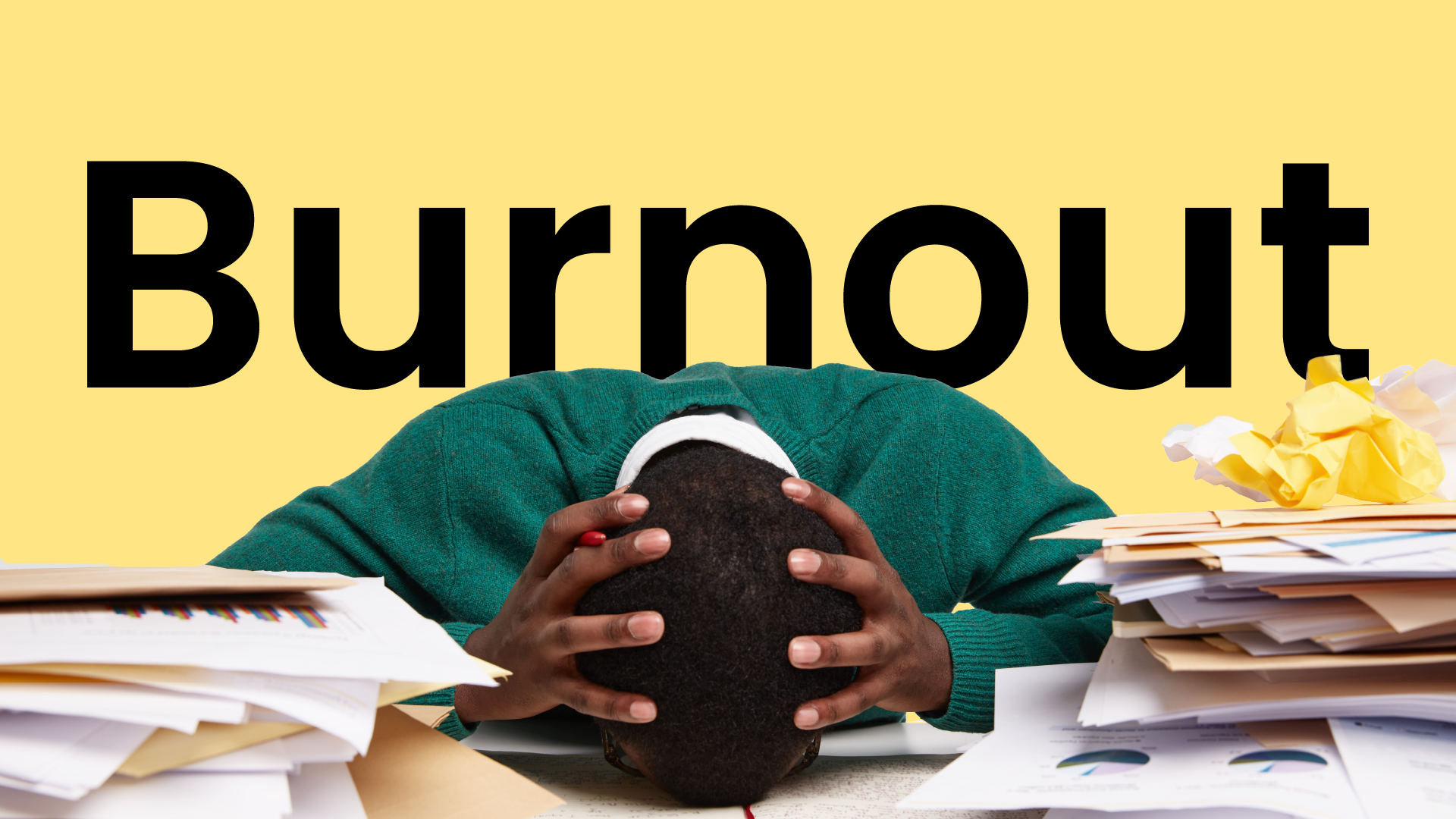
There is a particular kind of tiredness that does not announce itself with a collapse or a crisis. It does not produce the dramatic breakdown that would at least be legible, that would at least explain to the people around you why you are not okay. It produces something quieter and in many ways more difficult to address: the continuation of function without the presence of the person doing the functioning. The emails get answered. The family obligations get met. The face that needs to be shown in public is shown. And underneath all of it, at a level that the performance of competence keeps carefully covered, something is running on empty in a way that has been running on empty for longer than the person can now clearly remember.
This is burnout as most young Ghanaians are currently experiencing it, not the cinematic version but the operational one, the version that does not stop you from showing up because showing up is not optional and has never been optional and the people depending on you did not get the memo about your depletion. It is the version that makes showing up cost more than it should, that makes ordinary tasks feel like feats of endurance, that hollows out the interior of a life that from the outside continues to look functional and from the inside feels like it is being run by someone who is very tired of pretending.
What burnout actually is
The clinical definition of burnout, developed primarily by psychologist Christina Maslach across decades of research, identifies three core dimensions: emotional exhaustion, the depletion of emotional resources that leaves a person feeling drained and unable to recover between demands; depersonalisation or cynicism, the development of a detached, indifferent, or negative orientation toward work, relationships, and obligations that were previously meaningful; and reduced personal accomplishment, the sense that one’s efforts are not producing meaningful outcomes and that the capacity to contribute effectively has diminished.

Research on burnout has consistently found that it is not primarily a function of working too many hours. It is a function of chronic exposure to a specific set of stressors, including role overload, lack of control over one’s work, insufficient recognition and reward, breakdown of community, perceived unfairness, and values conflicts, any of which alone can contribute to burnout and whose combination accelerates it significantly. The World Health Organisation officially recognised burnout as an occupational phenomenon in 2019, defining it as a syndrome resulting from chronic workplace stress that has not been successfully managed.
The profile of burnout stressors maps with disturbing precision onto the life conditions of the young Ghanaian navigating work, family, economic pressure, and the specific demands of the current moment.
The specific stressors producing Ghanaian burnout
Role overload is perhaps the most structurally embedded source of burnout for young Ghanaians, and the one that is least acknowledged because it is culturally framed as a virtue rather than a risk.
The young Ghanaian who is working a full-time job, building a side income, managing extended family financial obligations, and maintaining the relational and social commitments that communal culture requires is not managing an unusual set of demands. They are managing the standard set of demands that their social position generates. The eldest child who has become the family’s primary financial resource does not experience the role as optional or as something that can be renegotiated when it becomes too heavy. They experience it as the natural consequence of having become capable, which is what they were educated and encouraged to become.
The economic conditions that have produced the cost of living crisis, including utility tariff hikes, rapidly rising rents, and inflation that outpaces income growth, have intensified the financial pressure on young Ghanaians in ways that have directly increased the demands being placed on those who are earning. When the cost of maintaining a household rises faster than income, the person providing for that household must work harder, take on more, or reduce the standard of living they are providing, each of which represents a form of stress with a specific burnout contribution.
The lack of control dimension of burnout is equally salient. Youth unemployment in Ghana exceeded 30% among individuals aged 15 to 24 in 2025, with overall unemployment at approximately 14.5%. For the significant proportion of young Ghanaians who are employed but underemployed, working in positions that do not use their qualifications or compensate them adequately, or working in the informal economy where income is unpredictable and rights are limited, the experience of professional life is characterised by a chronic low-grade absence of control over fundamental conditions that should be controllable. This is not a personality response to difficult circumstances. It is the predictable psychological consequence of structural conditions that the individual cannot change through effort or attitude alone.
The insufficient recognition dimension has a specifically Ghanaian texture. The cultural norm of not speaking too loudly about your own achievements, of not appearing to seek praise, of performing humility even when the work being done is genuinely excellent, means that many young Ghanaians are doing significant work in environments that provide very little explicit acknowledgment of its value. The internal experience of doing good work that is not seen, of contributing significantly to outcomes that are attributed to others or to the organisation, and of having no culturally sanctioned language for naming the under-recognition without appearing self-promotional, is a quiet but consistent drain.
Why they keep showing up anyway
The question at the heart of silent burnout is why the person experiencing it continues to show up, and the answer is not simply about financial necessity, though financial necessity is real and significant.

Showing up is identity for a generation that has been formed by a cultural emphasis on resilience as a primary virtue. The Ghanaian who does not show up, who acknowledges publicly that they cannot continue at the current pace, who rests visibly when rest is not officially sanctioned, is not merely taking a break. They are violating an identity that their community, their family, and their own internal narrative have built around the capacity to endure. The showing up is not only a financial calculation. It is a self-concept maintenance, and for many young Ghanaians the self-concept of someone who endures is so deeply embedded that ceasing to endure feels like ceasing to be the person they have understood themselves to be.
There is also the accountability architecture of communal life. The young Ghanaian who is paying school fees for a sibling, contributing to rent for a parent, funding the education of a cousin, cannot frame the decision to stop showing up as a personal health decision without its immediate and visible human consequences being apparent to the people who depend on them. The luxury of burnout recovery, in the form that Western wellness culture prescribes, which involves rest, reduced demands, and the space to rebuild, assumes a level of financial and social independence that the communal obligations of Ghanaian life often do not permit.
Research on burnout among high-obligation populations, specifically people managing simultaneous work and significant family care responsibilities, found that the continuation of functioning despite burnout was significantly more common in contexts where the costs of stopping were immediately visible and personally attributed than in contexts where systems existed to absorb the impact of an individual stepping back. The Ghanaian young professional who is the financial anchor of an extended family network is in exactly the high-obligation, low-substitutability position that the research identifies as most resistant to the kind of withdrawal that burnout recovery conventionally requires.
What the silent part costs
The silence around burnout, the cultural and practical imperatives that keep the exhaustion invisible, has specific and compounding costs that deserve to be named rather than simply absorbed.
The first cost is the quality of the showing up itself. The person performing function from a depleted state is not providing the same quality of presence, thinking, or contribution that they would provide from a replenished state. The work suffers. The relationships suffer. The decisions made from chronic exhaustion have a specific pattern of error: they are shorter-term in their thinking, more reactive and less strategic, less creative, and more likely to optimise for immediate relief of pressure rather than genuine long-term outcome. The performance of capability during burnout is a poor substitute for actual capability, and over time the gap between the two becomes visible in ways that the performance was supposed to prevent.
The second cost is the physical one. Research on the physiological consequences of chronic burnout has found significant associations with cardiovascular disease, immune suppression, metabolic disruption, and accelerated aging at the cellular level. The stress hormones that sustain function during burnout, primarily cortisol and adrenaline, produce adaptive physiological effects in the short term and damaging ones in the long term. The person who has been running on cortisol for two years is not merely tired. They are accumulating physiological damage that will be expressed in health outcomes over the subsequent decade.
The third cost is the progressive narrowing of the inner life. Burnout does not only deplete energy. It deplete meaning. The work, the relationships, the goals that were once sources of genuine motivation progressively lose their motivational charge as the depletion deepens. The person in advanced burnout is not simply tired. They have lost access to the experience of caring, which is the most insidious and the most difficult to recover from of the burnout’s effects. The cynicism that Maslach identified as a core burnout dimension is not a character failing. It is the mind’s protective response to a level of demand that has exceeded its capacity to continue caring about the outcome.

What actually helps
The wellness industry response to burnout, built primarily around individual self-care practices, is inadequate to the structural dimensions of the problem that Ghanaian burnout reflects. Bubble baths and meditation apps do not address role overload produced by economic conditions that make multiple income streams necessary. Mindfulness does not renegotiate the family financial obligations that the eldest child carries. The individualisation of a structural problem is itself a form of gaslighting, suggesting that the problem is in the person’s management of their circumstances rather than in the circumstances themselves.
That said, some individual-level interventions are genuinely useful, not as solutions to the structural problem but as maintenance practices that reduce the rate of depletion while structural conditions are what they are.
Sleep is the most evidence-supported and most consistently under-prioritised intervention available. The person who is managing depletion by reducing sleep to create more productive hours is accelerating the very burnout they are trying to function through. Research on recovery from burnout has consistently identified sleep restoration as the foundational requirement, preceding all other recovery interventions in both temporal and causal priority. The depleted person who sleeps adequately before implementing any other recovery practice recovers faster than the person who implements multiple recovery practices while remaining sleep-deprived.
The deliberate protection of at least one activity that is intrinsically rewarding, that exists entirely outside the economy of obligation and performance, is not a luxury. It is a maintenance requirement. The depletion of burnout is specifically the depletion of the motivated, engaged self, and activities that re-engage that self, even briefly and even in circumstances that make sustained engagement difficult, slow the rate of depletion more than equivalent rest does.
Honest communication about limits, with the people in the position to respond to the information, is both the most difficult and the most consequential intervention available. The family member who does not know that the person they depend on is approaching a wall cannot adjust their demands. The employer who has no information about the unsustainable pace being maintained cannot intervene. The silence that burnout requires for its maintenance is also the silence that prevents the conditions of burnout from being changed by anyone with the power to change them.
The structural conversation that needs to happen
Beyond the individual level, the silent burnout of young Ghanaians is a public health and economic issue that deserves structural attention proportionate to its scale.
The mental health infrastructure in Ghana remains significantly under-resourced relative to the documented need. Ghana has approximately 1.7 psychiatrists per 100,000 people, compared to a recommended ratio of 3 per 100,000, and the distribution heavily favours urban areas, leaving the majority of the population without accessible specialist mental health support. The mental health budget represents less than 1% of the total health budget, a figure that has not kept pace with the growing documented burden of mental health conditions.

Workplace culture, in both the formal and informal sectors, has not developed the language or the structures for engaging with employee burnout as a management responsibility rather than an individual failing. The organisation that runs its people into depletion and then wonders why productivity, creativity, and retention are problems is managing a consequence of its own culture rather than a random human resources challenge. The development of workplace cultures that treat sustainable performance as a legitimate organisational objective, rather than treating the extraction of maximum effort as the primary management goal, is not merely a welfare improvement. It is a productivity argument.
The broader economic conditions that make multiple income streams necessary, that have compressed the time and energy available for rest and recovery, and that have placed the weight of family financial provision on a generation that did not create the economic conditions it is managing, are the deepest layer of the burnout problem and the one that requires the most sustained policy attention. A generation that is quietly burning out while continuing to show up is not a sustainable human resource. It is a warning that the system is extracting more than it is returning, and that the bill for that extraction will arrive in forms that are more expensive to address than the conditions that produced it.
The young Ghanaian who is exhausted but still showing up is demonstrating something remarkable about human resilience and communal commitment. They deserve more than the acknowledgment of their endurance. They deserve the conditions in which endurance is not perpetually required, in which showing up does not cost everything, and in which the interior of a life can be as full as its exterior performance suggests it is.
From Newark to Accra: How KrisVerie is Making Car Buying Stress-Free Across Africa