

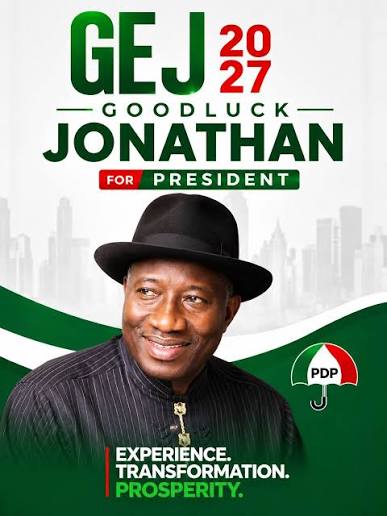
The Peoples Democratic Party (PDP) has reportedly affirmed former President Goodluck Jonathan as its presidential candidate for the 2027 general elections, marking a dramatic political development ahead of Nigeria’s next electoral cycle.
Multiple reports indicate that the decision followed internal processes within a faction of the party led by the Kabiru Turaki–led Interim National Working Committee, which has been pushing forward Jonathan’s return as the party’s flagbearer.
According to details emerging from party communications and political sources, Jonathan was cleared after a screening exercise and subsequently adopted as the party’s candidate in what has been described as an affirmation process within the faction. The development has been linked to internal restructuring efforts and renewed positioning within the opposition party ahead of the 2027 elections.

However, the situation within the PDP remains complex, as the party is currently experiencing internal divisions over leadership legitimacy and candidate selection processes. Some factions within the party have publicly supported Jonathan’s emergence, while others have distanced themselves from the announcement, insisting that their structures do not recognise such nominations.
Reports suggest that one faction of the PDP has already moved to present Jonathan as its presidential candidate, while rival groups maintain that their official nomination processes are still ongoing or have produced different outcomes.
Jonathan’s reported return to the political frontline has sparked widespread debate across Nigeria’s political landscape. The former president, who led the country between 2010 and 2015, remains a significant national figure due to his historic role as the first incumbent Nigerian president to concede defeat in an election and peacefully transfer power.
Political analysts say his potential candidacy could reshape the dynamics of the 2027 race, especially given his continued influence in the Niger Delta region and his established national profile. Supporters argue that Jonathan brings experience, political stability, and international recognition, while critics question whether he represents continuity or a return to past governance challenges.

Within the PDP, the development has also intensified discussions about zoning, regional balance, and internal democracy. Some party members believe Jonathan’s emergence could strengthen the PDP’s chances against the ruling All Progressives Congress in 2027, while others warn that ongoing factional disputes could weaken the party’s overall electoral strategy.
Outside the party, reactions have also been mixed. Some political commentators describe the move as a strategic comeback attempt by the PDP to leverage a familiar national figure, while others argue that it reflects deeper struggles within the opposition to unify around a fresh candidate.
There has also been controversy over the legitimacy of the factional process that led to Jonathan’s affirmation. Reports indicate that rival PDP groups have questioned whether the body that announced his candidacy is officially recognised under Nigeria’s electoral framework, raising concerns about potential legal and procedural challenges.

Despite the political uncertainty, Jonathan himself has not publicly issued a detailed statement accepting or rejecting the nomination at the time of reporting, leaving room for further speculation about his intentions.
The 2027 Nigerian general elections, scheduled for January 16, 2027, are expected to be highly competitive, with major political parties already positioning themselves for what is anticipated to be a tightly contested race.
As political realignments continue to unfold, analysts say the coming months will be crucial in determining whether Jonathan’s reported candidacy becomes a unified PDP position or remains a factional declaration within an already divided party structure.

What is clear, however, is that his name has once again returned to the centre of Nigeria’s national political conversation, setting the stage for an unpredictable and closely watched election season.
Rebranded United Party Seen as Strategic Move to Woo Disgruntled NPP Members