

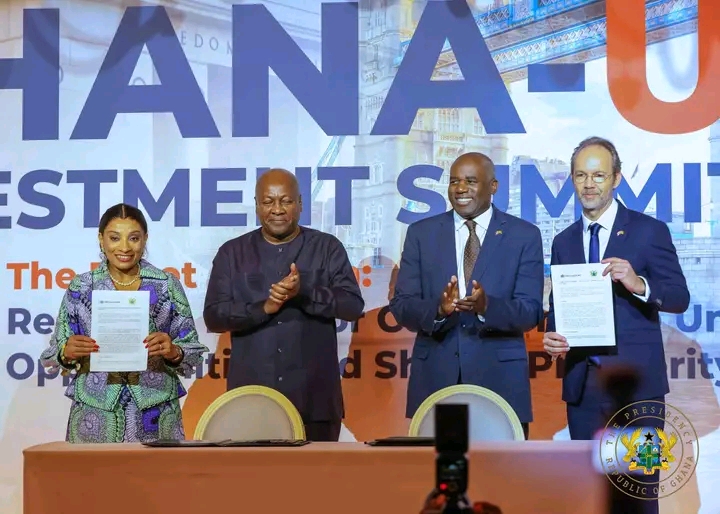
Ghana and United Kingdom have unveiled a major growth pact backed by approximately $272 million in investment, marking a renewed push to deepen economic cooperation, drive job creation, and accelerate infrastructure development.
The agreement, announced at the Ghana–UK Investment Summit 2026, signals a strategic effort by both countries to strengthen trade and investment ties at a time when Ghana is repositioning its economy to attract long term capital and diversify growth sectors.
The investment package, originally valued at £215 million, is expected to support projects across key sectors including infrastructure, energy, agriculture, and industrial development. Government officials say the initiative is designed to unlock new opportunities for businesses while addressing structural challenges that have slowed economic transformation.

At the summit, John Dramani Mahama outlined his administration’s vision for what he described as the “New Economy,” a comprehensive framework set to be formally unveiled in the 2027 national budget. The policy direction aims to reposition Ghana as a competitive investment destination by focusing on value addition, industrialization, and strategic sector growth.
According to the President, the New Economy agenda will prioritize commercial agriculture, mining value addition, energy expansion, and large scale infrastructure development. These sectors have been identified as critical to boosting productivity, increasing export earnings, and reducing reliance on raw commodity exports.
The pact with the United Kingdom aligns with this broader vision by providing financial backing and technical partnerships to accelerate project implementation. British investors are expected to play a key role in financing and executing initiatives that support Ghana’s industrial and economic ambitions.
Officials emphasized that the partnership is not only about capital inflows but also about fostering sustainable development outcomes. By targeting job creation and infrastructure expansion, the agreement seeks to deliver tangible benefits to local communities while improving the overall business environment.

Economic analysts say the deal reflects Ghana’s continued efforts to rebuild investor confidence following recent macroeconomic challenges, including inflationary pressures, currency volatility, and debt restructuring. Strategic partnerships with established economies like the United Kingdom are seen as essential in restoring stability and attracting foreign direct investment.
The focus on infrastructure is particularly significant, as inadequate transport networks, energy supply gaps, and logistical inefficiencies have long constrained economic growth. Investments under the pact are expected to improve connectivity, reduce operational costs for businesses, and enhance productivity across multiple sectors.
In agriculture, the initiative aims to shift Ghana from subsistence farming to large scale commercial production, with an emphasis on processing and value addition. This approach is intended to increase export competitiveness and create employment opportunities, especially in rural areas.
The mining sector is also set to benefit from policies that encourage local processing of minerals, rather than exporting raw materials. By developing downstream industries, the government hopes to capture more value within the country and reduce dependence on volatile global commodity prices.
Energy remains another critical pillar of the partnership, with plans to expand generation capacity and improve reliability. Stable energy supply is considered a prerequisite for industrial growth, particularly in manufacturing and processing industries.
The announcement that the New Economy framework will be detailed in the 2027 budget suggests a long term policy commitment aimed at sustaining growth beyond short term interventions. Investors are expected to closely monitor how these policies are implemented and whether regulatory reforms will accompany the investment push.

The partnership also highlights Ghana’s broader strategy of positioning itself as a regional hub for investment in West Africa. By leveraging its political stability, strategic location, and growing market, the country aims to attract multinational companies seeking entry into the African market.
For the United Kingdom, the agreement represents an opportunity to strengthen economic ties with a key African partner while supporting development initiatives that align with its international investment strategy.
As both countries move forward with the implementation of the growth pact, the success of the initiative will depend on effective coordination, transparent governance, and the ability to translate investment commitments into measurable outcomes.
The launch of the $272 million Ghana–UK growth pact therefore marks a significant step in Ghana’s economic transformation journey, reinforcing its message to global investors that it is open for business and ready to drive inclusive and sustainable growth.
Ghana school infrastructure funding: JOBerg invests GHS 2.25m