

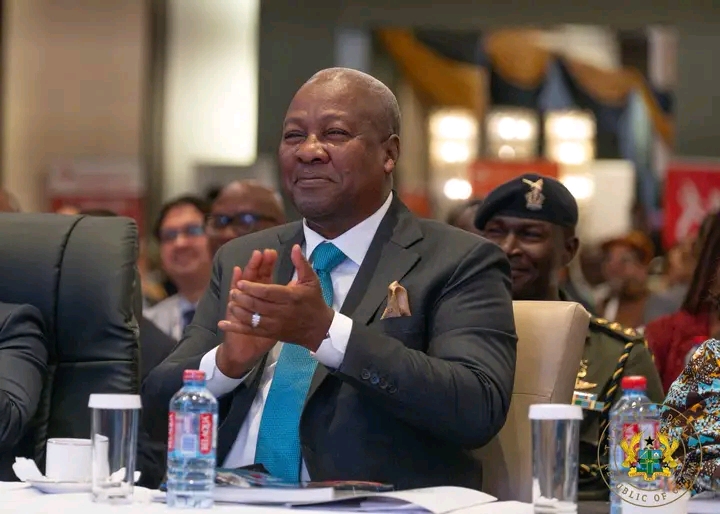
President John Dramani Mahama has launched the CEO-Government Compact 2026, a new framework aimed at strengthening collaboration between the public and private sectors to accelerate Ghana’s economic transformation.
The initiative is designed to enhance mutual accountability between government and business leaders while ensuring that policy decisions translate into measurable economic outcomes, including job creation, investment growth and improved national productivity.
According to the Presidency, the Compact will serve as a structured engagement platform that brings together government officials, chief executives and key industry stakeholders to jointly monitor progress on national development priorities. It is also expected to provide a mechanism for tracking implementation challenges and aligning private sector contributions with government policy direction.


Speaking at the launch, President Mahama reiterated that Ghana’s economic progress must not only be reflected in macroeconomic indicators but must also be felt in the daily lives of citizens. He stressed that sustainable transformation depends on strong cooperation between the state and the private sector, noting that businesses remain central to job creation and economic expansion.
He further emphasised that when businesses thrive, government revenue improves and national development becomes more achievable, reinforcing the need for predictable policies and a stable business environment.
The CEO-Government Compact 2026 builds on previous engagement efforts between government and the private sector, but introduces a more structured framework for monitoring commitments and evaluating outcomes. It is expected to include periodic review sessions, performance tracking tools and direct engagement channels between policymakers and business leaders.

Government officials say the initiative will also help reduce policy uncertainty, improve investor confidence and support long-term planning for both local and foreign investors operating in Ghana.
At the launch event, key figures from the business community and public sector institutions were present, highlighting the importance of cross-sector collaboration in addressing economic challenges and unlocking growth opportunities.
The Compact is expected to align with broader national development strategies focused on industrialisation, agribusiness expansion, infrastructure development and digital transformation.
Analysts say the success of the framework will depend on how effectively both government and the private sector commit to implementation, transparency and sustained dialogue, particularly in areas such as taxation, regulatory reforms and access to finance.

The initiative comes at a time when governments across Africa are increasingly turning to structured public-private partnership models to address fiscal constraints and stimulate growth in key sectors of their economies.