

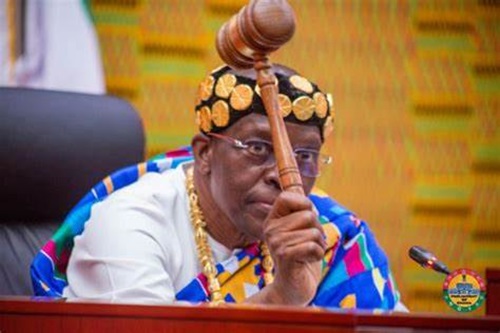
Speaker of Parliament Rt.Hon. Alban Sumana Kingsford Bagbin has reaffirmed that security agencies in Ghana do not require the permission of the Speaker before arresting a Member of Parliament, a statement that has reignited national debate on parliamentary immunity, constitutional authority, and the limits of political protection in the country’s democracy.
Bagbin’s clarification comes at a time when public interest in the relationship between Parliament and state security institutions has been rising, particularly in cases involving investigations of public officials. His position is grounded in Ghana’s 1992 Constitution, which establishes that all citizens are equal before the law and subject to the jurisdiction of the courts and law enforcement agencies, regardless of political or institutional position.
According to constitutional interpretation widely supported by legal experts, Members of Parliament enjoy limited immunity, mainly to protect their legislative functions and freedom of speech within Parliament. This means MPs cannot be sued or prosecuted for statements made on the floor of the House without following due process. However, this protection does not extend to criminal activity outside parliamentary duties. In such cases, MPs can be investigated, arrested, and prosecuted like any other citizen.

Bagbin emphasized that while security agencies do not need his permission to carry out arrests, it is still important for them to follow proper procedures and maintain communication with Parliament when dealing with sitting lawmakers. This point reflects long standing institutional practice in Ghana, where Parliament expects to be formally informed when an MP is subject to arrest or detention, mainly to ensure that legislative work is not unnecessarily disrupted.
Legal analysts note that this clarification is significant because it reinforces the principle of separation of powers. Ghana’s governance system is built on three independent arms of government: the Executive, which includes security agencies; the Legislature, which is Parliament; and the Judiciary, which interprets the law. While each arm operates independently, they are also designed to check and balance each other. Bagbin’s statement therefore reinforces that security agencies derive their authority from the Constitution and not from parliamentary approval.
The discussion also reflects a broader global principle in democratic systems, where legislators are not above the law but are protected from politically motivated arrests that could interfere with legislative independence. Similar frameworks exist in countries such as the United Kingdom, India, and South Africa, where parliamentary privilege protects legislative speech but does not grant immunity from criminal accountability.
In Ghana, past incidents involving the arrest or attempted arrest of Members of Parliament have often triggered political tension and legal debate. In some cases, disputes have reached the Supreme Court for interpretation, particularly on whether security agencies followed due process or whether parliamentary privileges were violated. These cases have helped define the evolving boundaries between Parliament and law enforcement institutions.
Bagbin’s latest remarks are therefore seen as part of ongoing efforts to clarify constitutional expectations and reduce misunderstandings between institutions. His position suggests that while Parliament remains a protected space for democratic debate, it does not serve as a shield against criminal accountability.
Reactions to the Speaker’s comments have been divided. Some governance observers and civil society actors have welcomed the clarification, saying it strengthens the rule of law and reinforces the principle that no individual is above legal scrutiny. They argue that clear boundaries between Parliament and security agencies are essential for transparency and public trust.

Others, however, believe that while arrests do not require parliamentary approval, better coordination protocols are still necessary. They argue that sudden arrests of MPs without notification to Parliament can create institutional friction and may disrupt parliamentary duties, especially when lawmakers are involved in active committee work or national legislative processes.
The Ghana Police Service and other investigative bodies operate under legal frameworks that allow them to carry out arrests based on reasonable suspicion and due process. These powers are regulated by the Criminal Procedure Code and constitutional safeguards that protect individual rights while ensuring law enforcement effectiveness.
Bagbin’s comments ultimately reinforce a key democratic principle that Ghana continues to refine, which is the balance between accountability and institutional respect. While MPs are elected representatives of the people, they remain subject to the same laws that govern all citizens. At the same time, Parliament expects that its members will be treated with procedural dignity to preserve the integrity of the legislative institution.
As Ghana continues to strengthen its democratic governance, such clarifications are likely to play an important role in shaping institutional relationships. The ongoing dialogue between Parliament and security agencies reflects a broader commitment to constitutional order, accountability, and the rule of law in a maturing democracy.