

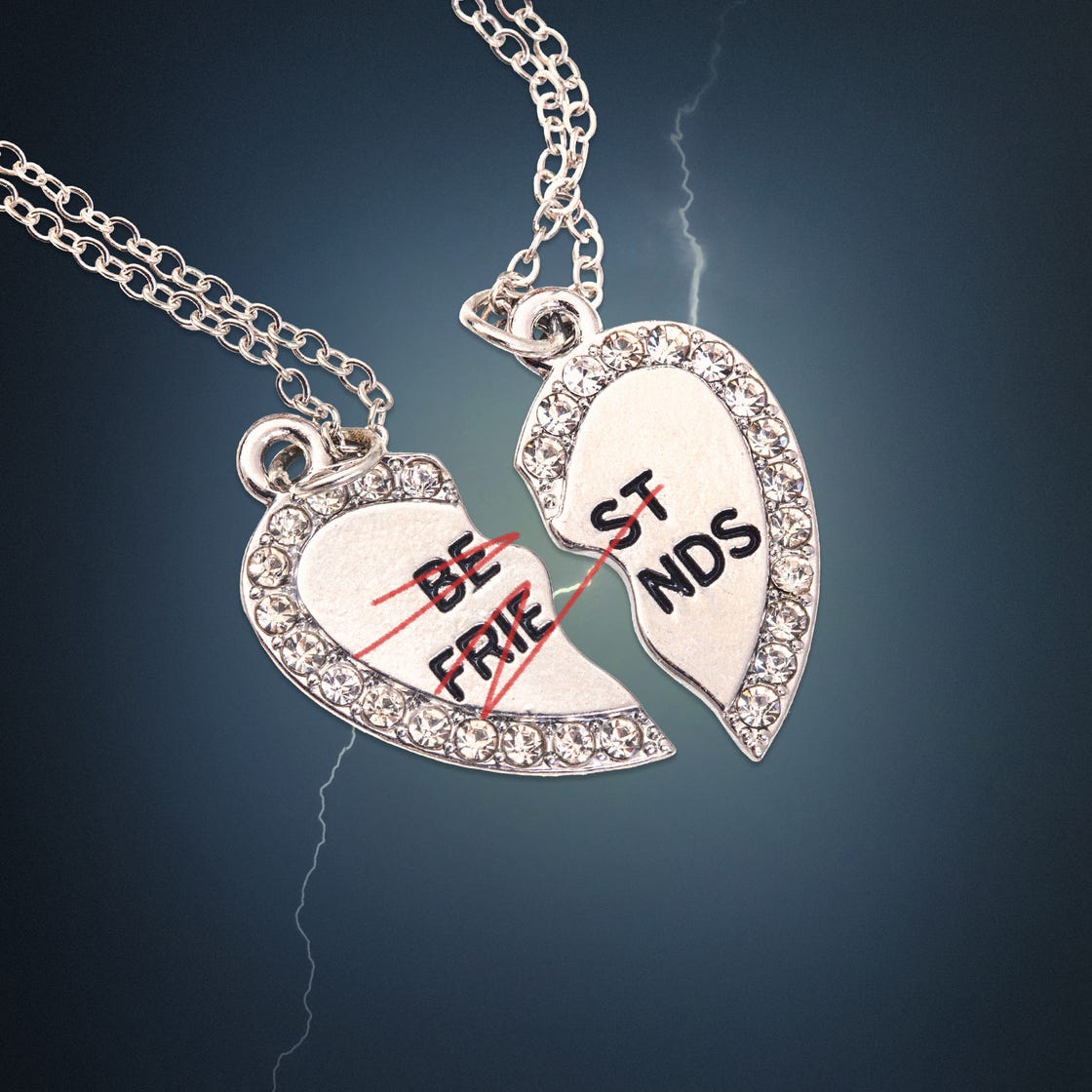
There is a grief that has no ceremony. No announcement marks its beginning. No condolence messages arrive. No one asks how you are doing in its aftermath, because no one outside the relationship necessarily knows it has ended, and even if they do, the cultural scripts available for processing loss do not extend cleanly to this particular kind. The person you called first when anything happened, who knew the full history of your family complications and your work frustrations and the specific texture of your inner life, is simply no longer there. Not dead. Not estranged in any dramatic, legible way. Just gone, gradually or suddenly, from the position they occupied in your life. And you are left holding a loss that the world around you has almost no framework for acknowledging.
Friendship breakups are among the most emotionally significant experiences a person can go through, and among the least socially recognised. The infrastructure of support that surrounds the end of romantic relationships, the sympathetic friends, the culturally sanctioned period of grieving, the social permission to be visibly not okay, is largely absent when the relationship that ends is a friendship. You are expected to process it quietly, to acknowledge that these things happen, to move on with a composure that the actual weight of the loss rarely warrants.
This piece is about why friendship loss hurts as much as it does, why it is so poorly supported, and what it might look like to grieve it honestly.
Why friendship loss hits harder than the culture suggests
The depth of pain produced by the end of a significant friendship is frequently surprising to the person experiencing it, partly because the cultural hierarchy of relationships has not prepared them to expect it. Romantic partnerships sit at the top of that hierarchy. Family relationships occupy the middle. Friendships, despite their central role in most people’s daily emotional lives, are implicitly positioned as supplementary, as the relationships you have in addition to the main ones rather than as primary sources of belonging and meaning in their own right.

This positioning is not accurate to the lived experience of most people, and the gap between the cultural valuation of friendship and its actual psychological significance is where much of the unacknowledged pain of friendship loss is generated.
Research in attachment theory and social psychology has consistently found that close friendships fulfil the same fundamental psychological needs as romantic partnerships: belonging, validation, the experience of being known and chosen, a secure base from which to navigate the world. The friend who has been present for a decade of your life, who has witnessed your growth, your failures, your private self, and remained, is attached to you in ways that are neurologically and psychologically real, regardless of whether the relationship fits a culturally designated category of primary importance.
Studies examining the psychological impact of friendship loss have found that the end of a close friendship produces grief responses, including sadness, anger, confusion, and a disrupted sense of identity, that are comparable in intensity to those produced by the end of romantic relationships. The difference is not in the depth of the pain but in the social support available for processing it, which is significantly lower for friendship loss than for romantic loss across virtually every cultural context studied.
The specifically Ghanaian texture of friendship loss
In Ghana’s communal cultural context, friendships carry weight and complexity that the Western individualist framework of friendship as voluntary and provisional does not adequately capture. Long-term friendships in Ghanaian contexts are frequently embedded in overlapping networks of family connection, neighbourhood history, school ties, and church or mosque community, which means that the end of a friendship rarely affects only two people. It sends reverberations through shared spaces, shared relationships, and shared histories in ways that make clean endings very difficult and ambiguous middles very common.
The friend who was also your mother’s friend’s daughter, who attended your family’s funerals and your siblings’ graduations, who is connected to you through six different relational threads simultaneously, cannot simply be unfriended. The friendship exists in a social web that continues to require navigation even after the relationship itself has deteriorated or ended. Shared church congregations, shared family events, shared professional networks: these are the spaces in which the former friend continues to appear, and the management of those appearances requires a composure that the grief beneath does not make easy.
There is also the cultural expectation of loyalty and longevity in Ghanaian friendship that makes the acknowledgment of a friendship’s failure particularly painful. The culturally valued friendship is the childhood friend who is still present in adulthood, the person who has known you across phases of your life and remained constant. The friendship that ends, particularly after significant duration, carries an implicit cultural charge of failure, of something having gone wrong that should have been maintainable. This charge often prevents honest acknowledgment of the ending, which in turn prevents honest grief.
How friendships end: the ways that hurt differently
Not all friendship endings are equal, and the form the ending takes shapes the grief it produces in specific ways.
The dramatic rupture, the argument that becomes irreparable, the betrayal that cannot be absorbed, the deliberate cut, is in some ways the easiest to process, not because it is less painful, but because it is legible. There is a clear event, a clear before and after, and while the pain is acute, its source is identifiable. The person grieving knows what they are grieving and approximately when it began. The social world around them can, if they choose to disclose it, understand that something definitive has happened.

The slow fade is considerably more difficult to process. The friend who becomes gradually less available, whose responses slow and then stop, whose presence thins over months until it is essentially absent, without any acknowledged ending, leaves behind a grief that is ambiguous in the most psychologically uncomfortable way. There was no moment of rupture to point to. There is no clear answer to whether the friendship is over or merely dormant. The person left behind is not sure whether to grieve or wait, whether to reach out or respect the distance, whether to be hurt or understanding. The ambiguity keeps the loss open and unresolved in ways that make processing it extremely difficult.
The one-sided realisation, the moment when you understand that the investment in the friendship has been substantially unequal, that you have been more present, more consistent, more invested, that the friendship has been more important to you than to the other person, is a different kind of loss again. It is not the loss of the friend so much as the loss of the friendship as you understood it to be, the revision of a history you thought you shared in a way that reveals it was always partially a story you were telling yourself.
And then there is the grief of the friend you keep but no longer know, the person who is still technically present but with whom something essential has been lost, through divergent life paths, incompatible growth, or the accumulated weight of things left unsaid. That relationship continues to exist in a diminished form that is sometimes more painful than a clean ending, because it combines the loss of what was with the continued proximity of what remains.
Why it is so hard to talk about
The reluctance to talk openly about friendship grief operates at several levels simultaneously.
There is the social minimisation, the sense that the loss of a friend, while sad, is not a legitimate claim on significant emotional space in the way that the loss of a romantic partner or a family member would be. The person who takes to their bed after a friendship ending risks being told, in various ways, that they are overreacting, that they will make new friends, that these things happen. The social permission to be devastated is not available, so the devastation is managed privately, in the gap between what is felt and what the surrounding culture deems proportionate.
There is also the ambiguity of cause. Romantic relationship endings are often characterised by a specific, nameable reason, even if the full truth is more complex. Friendship endings frequently resist that clarity. The friendship that faded did not necessarily fail because of any single thing. It may have failed because two people grew in directions that made them less compatible, because the context that sustained the friendship changed, because a pattern of need and availability that worked in one life stage stopped working in another. These are not satisfying explanations, because they do not assign clear cause or clear blame, and the human mind, in grief, tends to want both.
In Ghana’s cultural context, there is an additional layer of reluctance around discussing friendship difficulties that stems from the value placed on communal harmony and the avoidance of interpersonal conflict. The cultural preference for maintaining surface relationships and managing difficulty indirectly means that many friendship tensions are never addressed directly, which means that many friendship endings are never acknowledged clearly, which means that the grief they produce is never legitimised, which means that it is carried quietly for much longer than it needs to be.

What the grief is actually about
Underneath the immediate pain of a specific friendship ending is usually a set of deeper losses that are worth identifying, because naming them makes them more processable than leaving them as an undifferentiated ache.
The loss of the witness is one. A long-term friend is someone who has seen your life across time, who remembers who you were and can therefore understand who you are in the context of who you have been. When that person is gone, something of your own history becomes less accessible, less confirmed. The self that was known by that friend becomes, in some way, less real in the absence of the knowing.
The loss of the person who knew the context is another. Every person carries a set of private references, private history, private language, that exists only in specific relationships. The joke that only the two of you understood. The shorthand for shared experiences. The ease of not having to explain yourself because the explanation was already given years ago. These do not transfer to new relationships. They have to be built again from scratch, and the knowledge of that effort is part of what makes friendship loss exhausting rather than merely sad.
There is also the loss of the imagined future, the version of your life that included this person, the future holidays, the shared milestones, the witness to the next chapter that you expected them to be. Grieving a friendship is partly grieving a future that has been cancelled without notice.
What processing it might actually look like
Grieving a friendship honestly begins with giving yourself permission to find it significant, which sounds simple and is not. The internal minimisation that mirrors the external one, the voice that says you are being dramatic, that adults lose friends, that this is not a big deal, is the first thing to challenge. It is a big deal. The size of the grief is proportionate to the size of what was lost, and if the friendship was significant, the grief is entitled to be significant too.
Talking about it, to someone who will receive it with the seriousness it deserves rather than minimising it, is important for the same reasons that talking about any significant loss is important. Grief that is not expressed does not disappear. It settles into the body and the emotional register and continues to generate its effects without a name attached to them. Finding a person, or a professional, who will hold the loss seriously gives it the witness that the culture around it has not provided.

The question of whether to attempt direct conversation with the person who is gone is one that only the specific situation can answer. Sometimes a direct conversation is possible and produces the clarity or the reconciliation that the ambiguity is preventing. Sometimes it is not possible, or not productive, or would cause more harm than the ambiguity is causing. The question to ask is not whether it would feel good, but whether it would serve the actual goal, which is understanding and eventually acceptance rather than the re-establishment of what cannot be re-established.
Allowing the grieving to have a timeline is also part of honest processing. Friendship grief does not resolve in a week. For a long and significant friendship, it may take months or longer before the acute phase passes and the loss settles into something that can be carried without weight. That timeline is not pathological. It is proportionate.
And eventually, not as a bypass of the grief but as a consequence of having moved through it, is the opening to new connection. Not as a replacement for what was lost, because significant friendships are not interchangeable, but as the acknowledgment that the capacity for friendship, for being known and knowing, remains even when a specific expression of it is gone. The loss of a friend does not diminish the self that was built partly in the presence of that friendship. It changes the landscape. The landscape can, in time, become somewhere worth inhabiting again.