

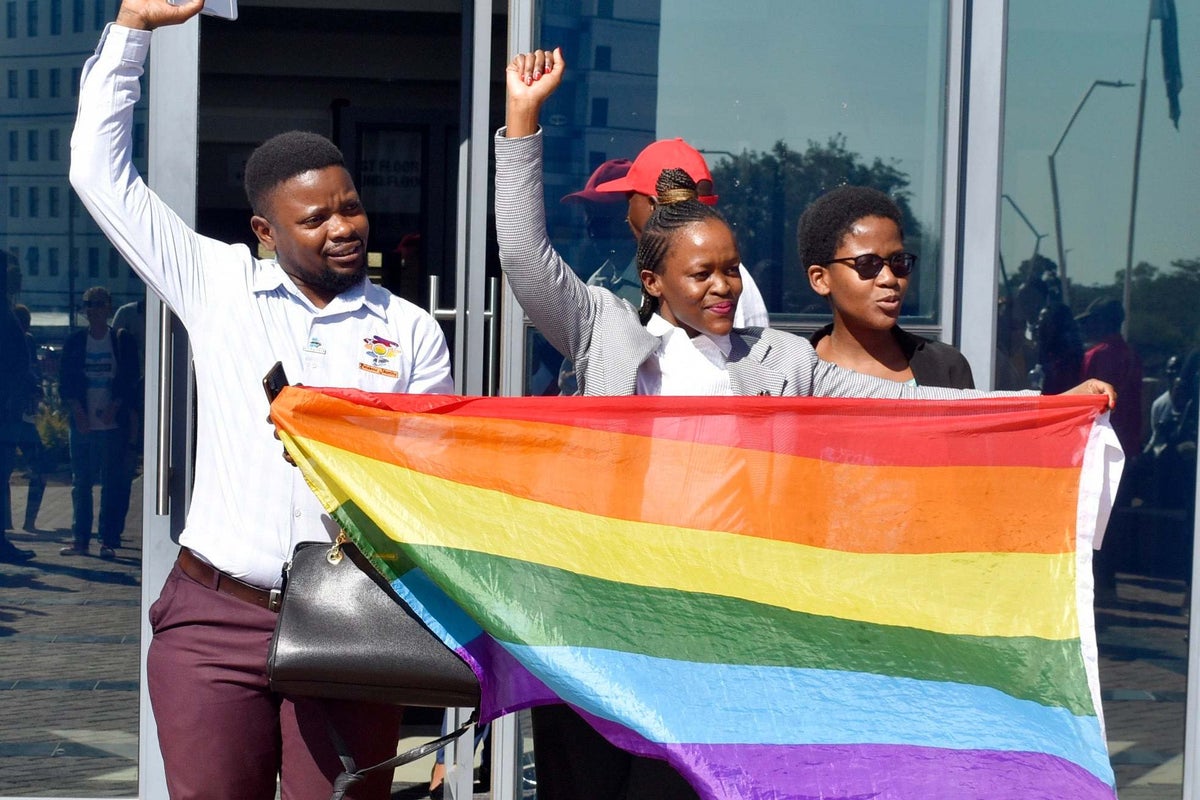
Botswana has formally deleted from its Penal Code the provisions that criminalised consensual same-sex relations between adults, completing a legal process that began with a landmark court ruling seven years ago. The move, announced on March 26, 2026, brings the country’s written law into full alignment with judicial decisions that had already rendered the provisions unenforceable, and marks a significant milestone in the slow but steady expansion of LGBTQ rights across southern Africa.
A statutory instrument titled “Rectification of the Laws (Penal Code) Order, 2026”, made by the Law Revision Commissioner, deleted paragraphs (a) and (b) of section 164 of the Penal Code. This was after years of legislative inaction following the courts having already declared the provisions unconstitutional, first by the High Court in 2019 and definitively by the Court of Appeal in 2021. Although the provisions had ceased to have legal effect upon being struck down, their deletion constituted a process of statute law revision, aligning the written law with the constitutional position established by the judiciary.
The provisions that have now been removed criminalised any person who “has carnal knowledge of any person against the order of nature” or “permits any other person to have carnal knowledge of him or her against the order of nature,” with penalties of up to seven years’ imprisonment. The Attorney General of Botswana, Dick Bayford, removed these paragraphs, leaving only the actions of anyone who “has carnal knowledge of an animal” as an unnatural offence under that section.

The legal journey that led to this outcome was long and at times contentious. The provisions dated back to when Botswana became a British protectorate in the 19th century. In 2019, the High Court of Botswana delivered a historic ruling deeming the law unconstitutional. At the time, Judge Michael Leburu wrote: “Human dignity is harmed when minority groups are marginalised. Sexual orientation is not a fashion statement. It is an important attribute of one’s personality.”
In July 2019, the government of Botswana appealed the High Court ruling to the Court of Appeal. The appeal was unanimously rejected on November 29, 2021, with retiring Court of Appeal president Ian Kirby writing for the court that laws criminalising same-sex relations “have outlived their usefulness, and serve only to incentivise law enforcement agents to become key-hole peepers and intruders into the private space of citizens.” .
The case was brought by Letsweletse Motshidiemang, a student at the University of Botswana, with the support of Lesbians, Gays and Bisexuals of Botswana, better known as LEGABIBO, and the Southern Africa Litigation Center. LEGABIBO welcomed the formal removal of the provisions, noting that the colonial-era clauses had long cast a shadow over the lives of LGBTIQ people in the country. “For many, these provisions were not just words on paper, they were lived realities. They affected access to healthcare, safety, employment, and the freedom to love and exist openly,” the group said.

LEGABIBO added that even after being declared unconstitutional, the continued presence of the provisions in the written law had sustained stigma, justified discrimination, and contributed to fear, silence, and exclusion within LGBTIQ communities. “While the amendment does not erase the harm of the past, it creates space for healing, inclusion, and continued progress toward full equality,” the group said. .
Botswana’s trajectory on LGBTQ rights stands out within the African context, where the majority of countries still criminalise same-sex relations. The country’s Employment Act has prohibited employment discrimination on the basis of sexual orientation since 2010, making it one of the few African nations to have such protections in place. The High Court also ruled in 2017 that transgender people have a constitutional right to change their legal gender marker on government documents.
However, formal equality under the law remains incomplete. A same-sex couple, Bonolo Selelo and Tsholofelo Kumile, are currently challenging the constitutionality of Botswana’s Marriage Act, arguing that it discriminates against them by failing to allow civil same-sex marriages. The couple, who have been in a relationship since 2023, tried to register their marriage with the Department of Civil and National Registration in Gaborone in April 2026, and were rejected. The Marriage Act does not expressly forbid same-sex marriages but refers to married couples as “husband” and “wife,” thereby inherently excluding same-sex relationships. .

The case has drawn opposition from several religious and traditional organisations, which have applied to join the High Court proceedings as respondents, arguing that same-sex marriage conflicts with Botswana’s religious and cultural values. Supporters outside the courtroom held placards reading “Say no to homosexuality,” “Save Botswana,” and “Botswana is a Christian nation.”
The High Court is expected to hear the marriage equality case in July 2026. The case asks whether Botswana’s constitution will continue to be interpreted as a living document that evolves with society, or remain constrained by what advocates describe as outdated moral assumptions.
The formal removal of the colonial-era sodomy provisions places Botswana among a small but growing number of African countries that have either decriminalised same-sex relations or removed such laws from their statute books. The continent still has a long way to go, with more than 30 African countries maintaining criminal prohibitions on same-sex intimacy, several of which carry severe penalties including life imprisonment. Botswana’s willingness to complete the process of aligning its written law with its constitutional jurisprudence offers a model that advocates across the continent hope other governments will eventually follow.