

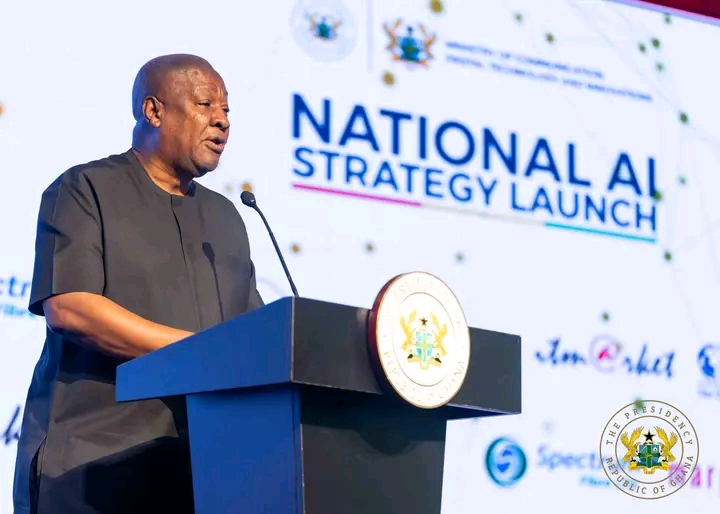
President John Dramani Mahama has officially launched Ghana’s National Artificial Intelligence Strategy, setting out an ambitious plan to position the country as a leading AI hub in West Africa and across the continent.
The strategy outlines a long term vision focused on harnessing artificial intelligence to drive economic transformation, improve public services, and prepare the workforce for a rapidly evolving digital future. Speaking at the launch, Mahama made it clear that the country’s priority is not whether AI will shape the future, but how Ghana will shape its use in line with national values and development goals.
He stressed that government is determined to ensure Ghanaians are equipped to lead in the era of technological transformation rather than being sidelined by it. “The defining question is not whether AI will shape our future, but how we will shape it to reflect our values and aspirations,” he said.

Central to the strategy is a strong focus on people. The government plans to invest significantly in upskilling and reskilling, particularly within the public sector, while also supporting workers across industries to adapt to new technological realities. The aim is to build a workforce that is not only digitally literate but capable of leveraging AI tools to enhance productivity and innovation.
Mahama emphasized that the strategy is not just a policy document but an actionable framework already being translated into concrete programmes. He noted that implementation will be guided by clear targets over a 10 year period, with a strong emphasis on discipline, accountability, and measurable outcomes.
A key institutional feature of the plan is the establishment of a Responsible Artificial Intelligence Office, which will oversee coordination, governance, and ethical deployment of AI technologies across sectors. This reflects growing global concern about the risks associated with AI, including issues around bias, privacy, and misuse.

The government’s approach signals an awareness that technological advancement must be matched with strong governance structures. By embedding responsibility into its AI framework, Ghana is positioning itself to balance innovation with public trust.
Supporting the strategy, Samuel Nartey George, Minister for Communications, Digital Technology and Innovations, reaffirmed the government’s commitment to strengthening the country’s digital backbone. He highlighted ongoing investments in 4G and 5G infrastructure as critical enablers of AI adoption, noting that without reliable connectivity, the benefits of AI cannot be fully realized.
The push for improved connectivity is expected to play a crucial role in expanding access to digital services, supporting startups, and enabling the development of local AI solutions tailored to Ghana’s unique challenges. From agriculture and healthcare to education and governance, AI is increasingly seen as a tool for addressing structural issues and unlocking new opportunities.
Ghana’s move aligns with a broader continental trend, where countries are beginning to formalize national AI strategies as part of their digital transformation agendas. The race to build AI capacity is no longer limited to global tech powers, as emerging economies recognize the strategic importance of artificial intelligence in shaping future competitiveness.

However, the success of the strategy will depend heavily on execution. Ambitious plans have historically faced challenges in implementation, particularly in areas such as funding, coordination, and institutional capacity. Ensuring that targets are met and that benefits reach ordinary citizens will be critical in determining the strategy’s real impact.
Mahama acknowledged this challenge, insisting that the transformation must go beyond rhetoric. He called for a results driven approach, where progress is measured and leaders are held accountable for delivering tangible outcomes.
The launch of the National AI Strategy marks a significant step in Ghana’s digital journey, positioning the country to play a more active role in the global technology landscape while addressing local development priorities through innovation.

OpenAI unveils new child safety blueprint as AI driven exploitation concerns rise