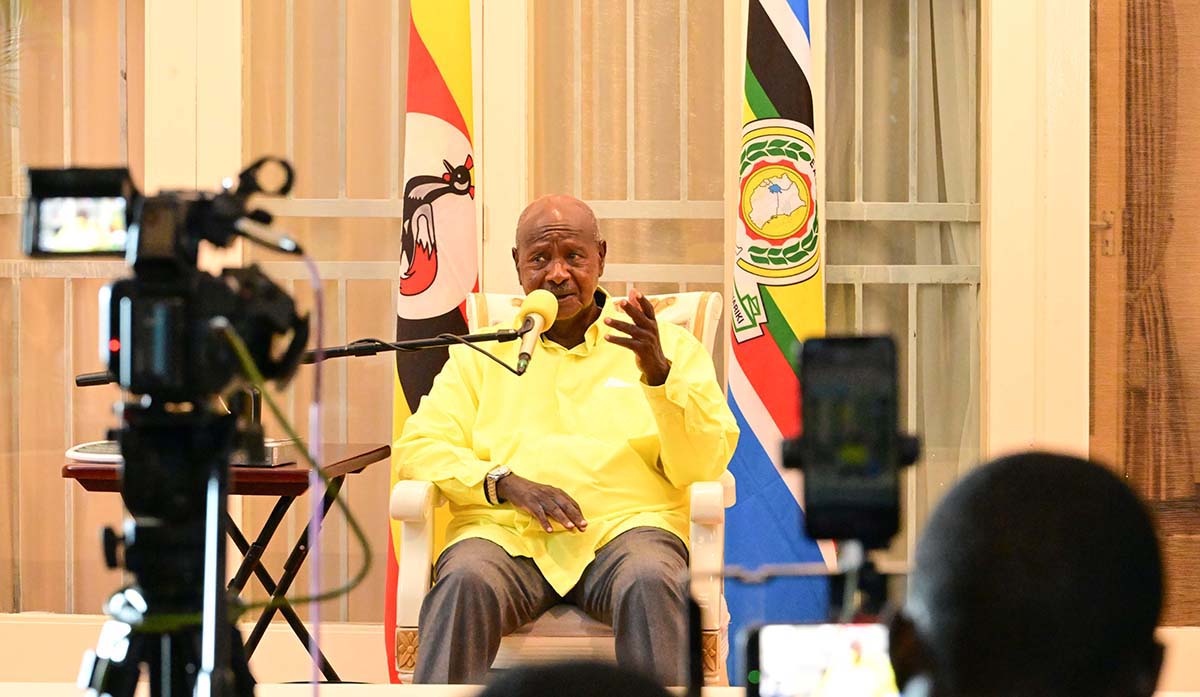
Museveni backs “Eye-for-an-Eye” proportional justice bill amid surge in violent crime

0
152

By James Mulwana 

President Yoweri Museveni has publicly endorsed the controversial Proportional Justice Bill, 2026, which seeks to embed the ancient “eye-for-an-eye” principle into Uganda’s legal system as a direct response to rising cases of violent crime.

The draft legislation, prepared by youth advocate Nyanzi Martin Luther, proposes that punishments should strictly correspond to the harm caused by offenders. This includes capital punishment for murder, maximum penalties for aggravated rape and defilement, and tougher sentences for repeat offenders.

In a recent address to legal professionals, Museveni reinforced his long-held position, stating: “People should know that if you take a life, your life will also be taken. You cannot kill people and you are left to move. That is not correct. A killer is a killer.” He however cautioned against mob justice, insisting that punishment must be administered only through formal state institutions.

The President’s remarks align with views he has consistently expressed over the years, as reported by Daily Monitor. In 2016 and again in 2021, Museveni told lawyers that the ruling National Resistance Movement (NRM) believes in the principle of “an eye for an eye.” 

“The NRM believes in an eye for an eye. If somebody kills your person, that one should also be killed,” he said, according to Daily Monitor reports.

Museveni has repeatedly drawn on Uganda’s liberation history to justify firm accountability. During the NRA bush war, he noted, killers were executed to maintain discipline. He has argued that this approach remains relevant today in dealing with serious crime.

The Proportional Justice Bill, 2026, has gained momentum amid widespread public frustration over what many view as a lenient justice system that fails to deter violent offenders. Supporters, including the bill’s drafter, say it will better protect victims and restore confidence in the law by ensuring penalties match the gravity of offenses.

Key elements of the proposed bill include:

– Mandatory death penalty for murder convictions

– Harsh maximum sentences for serious sexual and aggravated crimes

– Escalating penalties for repeat offenders

– Stronger focus on victim rights and deterrence

However, the bill has sparked sharp criticism from human rights advocates, legal experts, and civil society groups. Opponents argue that formalising an “eye-for-an-eye” approach risks undermining due process, constitutional safeguards, and Uganda’s international human rights commitments. They warn of the danger of irreversible errors in a justice system that still faces challenges with investigations, corruption risks, and judicial capacity.

As Uganda grapples with this debate, the country stands at a crossroads: whether to adopt a stricter retributive model rooted in traditional and historical principles of justice, or to pursue a more balanced system that incorporates rehabilitation alongside punishment.

Museveni backs “Eye-for-an-Eye” proportional justice bill amid surge in violent crime

With Museveni’s influential backing, the Proportional Justice Bill is expected to dominate parliamentary and public discussions in the coming months. How lawmakers navigate the tension between public demands for security and concerns over fairness and human rights will shape the future of Uganda’s justice system.

Author

  • Daniel Ablordey

    Daniel Ablordey is a Business Analytics student at the University of Ghana Business School and an emerging strategist at the intersection of data, markets, and narrative. With a keen analytical mind and a passion for African business and economic trends, he is building a career focused on translating complex data-driven insights into accessible, decision-relevant stories that matter.As a writer and editor with Insight Ghana, African Business Insight, and The African Journal, Daniel delivers sharp, high-impact analysis on current affairs, business developments, and emerging trends across the continent. His work is defined by precision, clarity, and a deep commitment to responsible journalism — ensuring that every story he tells is not only accurate but meaningful to the audiences it serves.Beyond his editorial work, Daniel serves as an Ecobank Youth Ambassador, where he actively promotes financial inclusion, digital banking, and financial literacy among young Ghanaians. His leadership experience spans academic, professional, and faith-based institutions, where he has consistently driven initiatives centered on growth, structure, and long-term impact.Grounded in the principles of Pan-Africanism and service, Daniel brings a rare combination of analytical rigour and storytelling depth to his work. Whether unpacking market behavior, profiling emerging business leaders, or covering cultural shifts shaping the continent, he approaches every assignment with strategic intent and editorial integrity.His broader ambition is to contribute to Africa's transformation by shaping how data, business, and storytelling intersect — not just locally, but on a global stage.

Previous articleFrom Legon to the Moon: Christina Koch proves global learning can shape space history
Next articleAfrica cannot afford another external shock as Afreximbank steps in with US$10bn shield
Daniel Amenyo Ablordey
Daniel Ablordey is a Business Analytics student at the University of Ghana Business School and an emerging strategist at the intersection of data, markets, and narrative. With a keen analytical mind and a passion for African business and economic trends, he is building a career focused on translating complex data-driven insights into accessible, decision-relevant stories that matter.As a writer and editor with Insight Ghana, African Business Insight, and The African Journal, Daniel delivers sharp, high-impact analysis on current affairs, business developments, and emerging trends across the continent. His work is defined by precision, clarity, and a deep commitment to responsible journalism — ensuring that every story he tells is not only accurate but meaningful to the audiences it serves.Beyond his editorial work, Daniel serves as an Ecobank Youth Ambassador, where he actively promotes financial inclusion, digital banking, and financial literacy among young Ghanaians. His leadership experience spans academic, professional, and faith-based institutions, where he has consistently driven initiatives centered on growth, structure, and long-term impact.Grounded in the principles of Pan-Africanism and service, Daniel brings a rare combination of analytical rigour and storytelling depth to his work. Whether unpacking market behavior, profiling emerging business leaders, or covering cultural shifts shaping the continent, he approaches every assignment with strategic intent and editorial integrity.His broader ambition is to contribute to Africa's transformation by shaping how data, business, and storytelling intersect — not just locally, but on a global stage.