

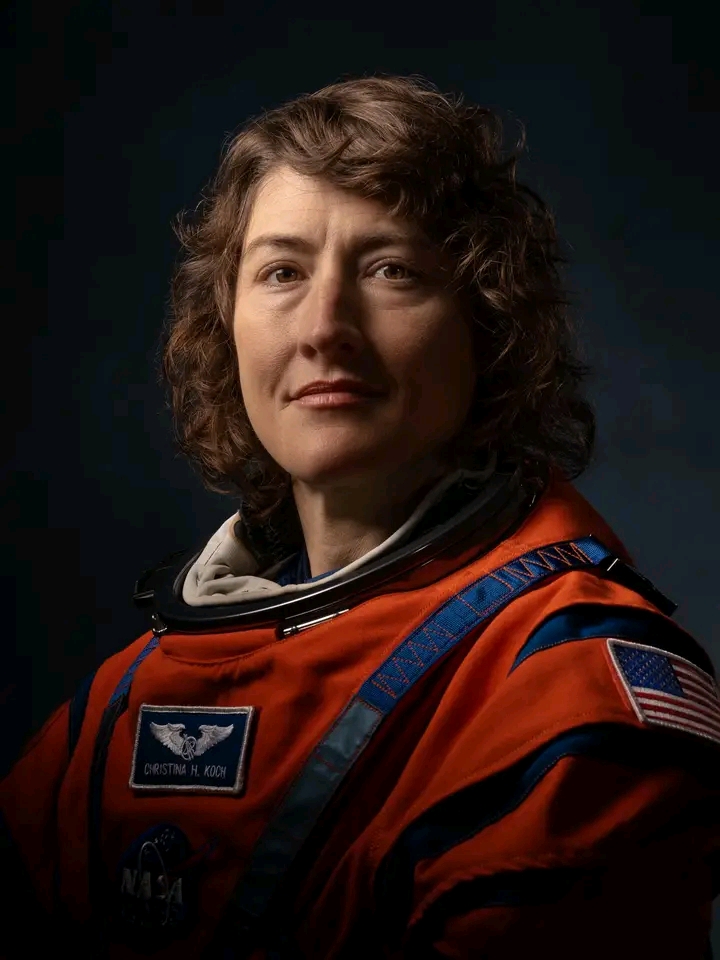
History rarely unfolds in ways that feel personal, but the journey of Christina Koch has created exactly that moment, linking a classroom in University of Ghana to one of humanity’s most ambitious space missions in decades. As part of Artemis II, she is now among the few humans to travel farther from Earth than anyone since the Apollo era, redefining what is possible in modern exploration.
The mission itself is historic on multiple levels. Launched in April 2026, Artemis II is the first crewed journey around the Moon in more than fifty years, designed to test systems that will eventually return humans to the lunar surface. The four-person crew, including Koch, travelled more than 200,000 miles from Earth and even passed thousands of miles beyond the far side of the Moon before beginning their return. What makes this milestone even more significant is that Koch has become the first woman to travel beyond low Earth orbit and around the Moon, placing her name firmly in the history of space exploration.
But beyond the scale of the mission lies a story that resonates closer to home. Long before she became a record-setting astronaut, Koch spent part of her academic journey in Ghana. In 1999, she participated in an exchange programme at the University of Ghana, Legon, where she studied astrophysics, adding an international dimension to her scientific training. That detail, often overlooked in global reporting, is what transforms this mission from a distant achievement into something relatable and inspiring for young Africans.

Koch’s career has been defined by pushing limits. Before Artemis II, she spent 328 consecutive days in space aboard the International Space Station, the longest single spaceflight ever recorded by a woman. She also participated in the first all-female spacewalks, helping to break long-standing barriers in a field historically dominated by men. These milestones are not isolated achievements but part of a consistent pattern of technical excellence, resilience, and global exposure.
Her path to space was not linear. She worked as an engineer and researcher in extreme environments, including Antarctica and remote scientific stations, before being selected as a NASA astronaut in 2013. That trajectory reflects a broader truth about modern science: breakthroughs are rarely the product of a single place or experience. They are built through a combination of global learning, interdisciplinary skills, and sustained effort over time.
For Ghana, the connection to Artemis II carries symbolic weight. It challenges a persistent narrative that world-changing achievements are geographically distant or inaccessible. The reality is more complex. Talent development today is global, and exposure to diverse academic environments plays a critical role in shaping future innovators. Koch’s time in Legon may have been one chapter in a much larger journey, but it represents the kind of international academic exchange that continues to shape scientific progress.
There is also a deeper implication for policy and education. While the story inspires, it also raises questions about how countries like Ghana can better position themselves within global scientific ecosystems. Exposure alone is not enough. Without sustained investment in research infrastructure, STEM education, and innovation systems, such connections risk remaining symbolic rather than transformative.
The Artemis II mission itself is not just about returning to the Moon. It is part of a long-term strategy to establish a sustained human presence beyond Earth, with future missions expected to build lunar bases and eventually support journeys to Mars. In that context, the individuals shaping these missions are not just astronauts; they are pioneers of a new phase in human history.

Koch’s story therefore operates on two levels. On one hand, it is a personal achievement, defined by discipline, expertise, and years of preparation. On the other, it is a reminder of how interconnected the modern world has become, where a student can move from a university in West Africa to the forefront of global scientific discovery.
The phrase “From Legon to the Moon” is more than a headline. It captures a reality that is becoming increasingly relevant in the 21st century: the boundaries of possibility are no longer defined by geography alone. What matters is access, opportunity, and the ability to connect local experiences to global platforms.
As Artemis II continues its journey, the image of Earth seen from deep space carries a powerful message. It reduces borders to lines and differences to perspective. For those watching from Ghana and beyond, the mission is not just about distance travelled. It is about what becomes possible when ambition meets opportunity, and when local stories find their place in global history.