

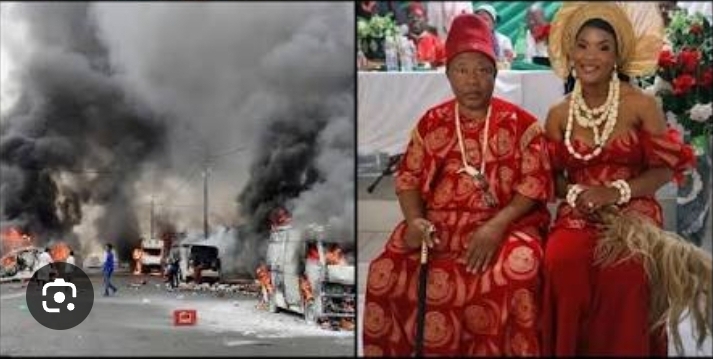
A controversial installation ceremony in East London, South Africa, has triggered widespread political and social backlash after Solomon Ogbonna Eziko was declared as “Igwe Ndigbo na East London,” a title associated with traditional leadership within Nigeria’s Igbo ethnic group. The event has been condemned by local authorities and traditional leaders, who argue that it undermines South African customary structures and raises sensitive questions about sovereignty and community leadership recognition.
The ceremony, described by critics as a “coronation,” has become a flashpoint in ongoing debates around migration, identity and cultural organisation within South Africa’s diverse society. According to local reports, the installation was not authorised by recognised South African traditional authorities, particularly those linked to the amaRharhabe Kingdom, under whose jurisdiction the area falls. Officials and traditional leaders have insisted that any attempt to establish parallel leadership structures without formal approval violates established legal and cultural frameworks.
Provincial authorities in the Eastern Cape have expressed concern over the development, warning that it risks inflaming already fragile social tensions. Zolile Williams, the provincial Member of the Executive Council responsible for Cooperative Governance and Traditional Affairs, reportedly described the event as unlawful and emphasised that South Africa’s legal system would respond firmly to any actions seen as undermining national sovereignty or traditional governance systems.

Traditional leadership structures in South Africa operate within a formalised constitutional framework that recognises kingships, chieftaincies and councils under specific legislation. These systems are deeply rooted in historical governance practices among indigenous communities and are protected by law. Authorities argue that the introduction of external or unrecognised leadership titles within these jurisdictions risks creating confusion, parallel authority structures and potential disputes over legitimacy.
The controversy has also spilled into the broader national conversation on immigration and social cohesion. South Africa hosts a significant number of foreign nationals from across the continent, including Nigeria, many of whom are engaged in business, trade and community activities. However, economic pressures, unemployment and inequality have periodically fuelled tensions between local populations and migrant communities.
In response to the East London ceremony, activist groups staged protests, with some calling for stricter immigration controls and, in more extreme cases, mass deportations of foreign nationals. Demonstrations reportedly drew participants from different parts of the country, including controversial public figures known for their outspoken positions on immigration and cultural identity. These protests have further intensified concerns about xenophobic sentiment and the risk of violence if tensions are not carefully managed.
Authorities have warned that linking individual community leadership structures to broader national or ethnic tensions can be dangerous, particularly in a country with a history of xenophobic outbreaks. South Africa has experienced several episodes of violence against foreign nationals in the past two decades, often triggered by economic frustration and political rhetoric around migration.

Traditional leaders within the affected region have also condemned the installation. Representatives of the amaRharhabe Kingdom have stated that the ceremony was conducted without consultation or approval from legitimate customary authorities. They argue that such actions undermine established systems of governance and risk destabilising community relations at a local level.
Legal experts familiar with South African customary law note that while cultural expression is protected, the recognition of traditional leadership titles is strictly regulated. Any installation claiming authority within South African territory typically requires validation through recognised traditional councils and, in many cases, provincial or national government acknowledgment. Without such recognition, the legitimacy of any leadership claim remains highly contested.
The individual at the centre of the controversy, Solomon Ogbonna Eziko, has been presented by supporters as a cultural figure representing the Nigerian Igbo diaspora in East London. However, critics argue that the use of traditional royal titles within a foreign jurisdiction complicates legal and cultural boundaries and may be misinterpreted as an attempt to establish parallel governance structures.
Community relations experts have urged restraint, warning that inflammatory language from both activists and officials could escalate tensions. They emphasise the importance of dialogue between migrant communities, traditional leadership structures and government institutions to avoid further polarisation.
The situation highlights a broader challenge faced by many multicultural societies, where diaspora communities seek to preserve cultural identity while operating within host country legal frameworks. Balancing cultural expression with respect for local governance systems remains a delicate issue, particularly in regions where historical land and authority structures are deeply embedded.
As investigations and public debate continue, South African authorities are expected to monitor developments closely to ensure that public order is maintained. The incident has already become a focal point in discussions about immigration policy, traditional authority and national identity, with calls for clearer guidelines on cultural installations involving foreign nationals.
For now, the controversy surrounding the East London installation remains unresolved, with tensions reflecting deeper social and political fault lines that extend far beyond a single ceremony.
Ningo Chiefs Deny Alleged Igbo Village Claims and Call for Investigation