

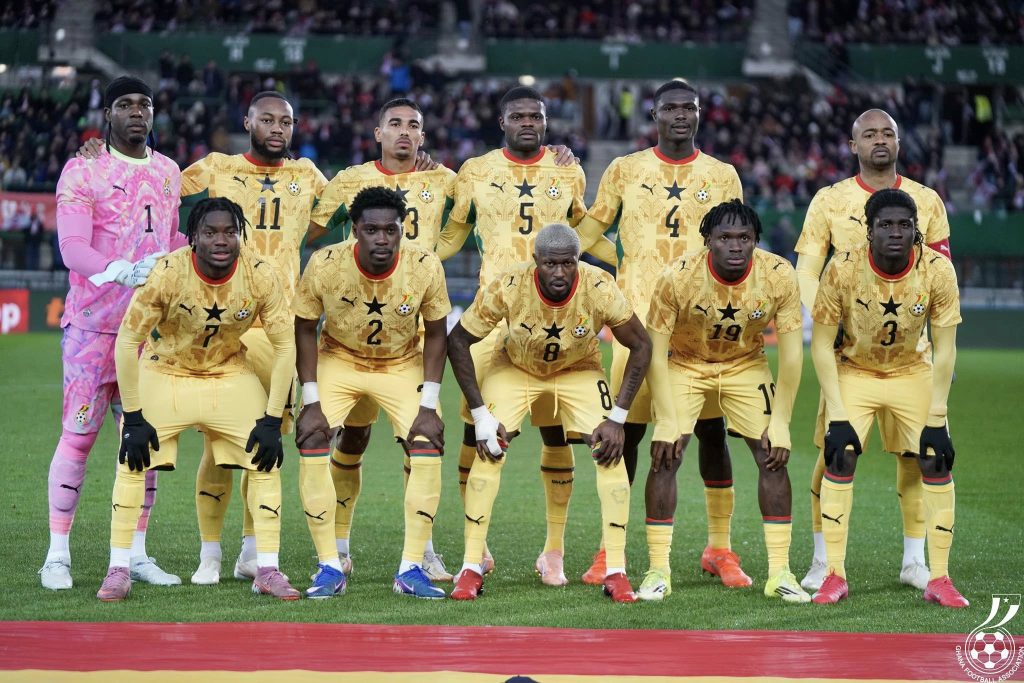
The Ghana national football team suffered a crushing 5–1 defeat to the Austria national football team in an international friendly in Vienna, raising serious concerns about the team’s readiness for the 2026 FIFA World Cup. The match, played at the Ernst Happel Stadium, was intended to serve as a key preparatory test, but instead exposed significant tactical and defensive weaknesses within Otto Addo’s side.
From the outset, Ghana showed some early composure, attempting to build play through midfield with experienced figures like Thomas Partey anchoring proceedings. However, that early promise quickly faded after a pivotal moment when Austria were awarded a penalty following a handball incident. Marcel Sabitzer converted from the spot to give the hosts the lead, setting the tone for what would become a one-sided encounter.
Despite falling behind, Ghana attempted to respond with attacking intent, with players like Antoine Semenyo and Abdul Fatawu Issahaku pushing forward. Yet, their efforts lacked precision in the final third, as clear chances failed to translate into meaningful attempts on goal. The inability to convert possession into scoring opportunities became a recurring issue throughout the game, highlighting a lack of clinical edge in attack.

Austria, on the other hand, displayed efficiency and composure. Their attacking structure proved too dynamic for Ghana’s defense, which struggled with positioning and coordination. Early in the second half, Michael Gregoritsch doubled the lead before defender Stefan Posch capitalised on poor marking to make it 3–0. At this stage, the Black Stars appeared overwhelmed, with their defensive line repeatedly exposed by Austria’s quick transitions and movement.
Ghana briefly found a moment of relief when captain Jordan Ayew scored a consolation goal in the 77th minute, offering a glimpse of individual quality. However, any hopes of a comeback were short-lived. Austria responded almost immediately, with Carney Chukwuemeka restoring their three-goal advantage, before Nicolas Seiwald added a fifth goal deep into stoppage time to seal a dominant performance.
Match statistics further underline Austria’s superiority. The European side controlled approximately 60 percent of possession and registered more shots on target, reflecting their overall dominance in both midfield control and attacking execution. Ghana, by contrast, struggled to maintain defensive discipline and failed to create sustained pressure in the final third.

The defeat is particularly concerning given the timing. As part of preparations for the 2026 FIFA World Cup, friendly matches are expected to help teams refine tactics, test squad depth and build confidence. Instead, this result has exposed structural issues within Ghana’s setup, including defensive fragility, limited cohesion and an apparent gap in quality when facing high-intensity European opposition.
Coach Otto Addo experimented with his lineup, introducing new players and adjusting formations, but the changes failed to deliver the desired impact. Debutants and fringe players were unable to shift the momentum, while the overall team structure appeared disjointed, particularly in transition phases. The midfield struggled to shield the defense effectively, leaving gaps that Austria exploited with precision.
This defeat also highlights a broader challenge facing the Black Stars. While Ghana remains one of Africa’s historically strong football nations, performances against top-tier European teams continue to reveal inconsistencies. The gap in tactical execution, game management and defensive organisation becomes more evident in high-pressure matches, raising questions about the team’s competitiveness on the global stage.

Looking ahead, Ghana is scheduled to face stronger opposition in subsequent friendlies, including a high-profile clash against Germany. These matches will be critical in determining whether the team can address its weaknesses and build the resilience required for the World Cup. Failure to respond effectively could see Ghana enter the tournament with diminished confidence and unresolved tactical issues.
Ultimately, while friendly matches do not carry competitive stakes, their significance in preparation cannot be underestimated. For Ghana, this heavy defeat serves as a wake-up call. It underscores the urgent need for tactical adjustments, improved defensive coordination and greater efficiency in attack. If these issues are not addressed promptly, the Black Stars risk facing similar struggles on the world stage, where the margin for error is far smaller and the level of competition significantly higher.