

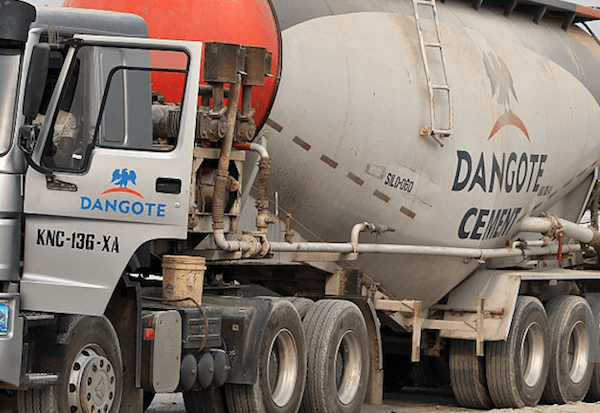
Dangote Cement is rapidly strengthening its position as a regional supplier of key construction materials, exporting close to one million tonnes of clinker to Ghana and Cameroon even as local demand pressures reshape its operations across parts of Africa.
The company’s latest audited financial results show that Nigeria exported about 970,100 tonnes of clinker to Ghana and Cameroon in 2025, shipped through 34 vessels. This marks a 6.9 percent increase compared to the previous year and reinforces Nigeria’s growing role as a supply hub for neighbouring markets. Overall clinker and cement exports from Nigeria rose by 18.6 percent to around 1.4 million tonnes, highlighting the company’s expanding export strategy.
This export surge is not accidental. It reflects a deliberate shift by Dangote Cement to maximise production capacity in Nigeria and supply countries that lack sufficient limestone resources to produce clinker domestically. Several West and Central African economies, including Ghana and Cameroon, rely heavily on imports to sustain their cement industries, creating a natural demand corridor for Nigerian exports.

Ghana and Cameroon alone accounted for more than two thirds of Nigeria’s clinker exports during the period, underscoring their strategic importance to Dangote’s regional operations. These shipments play a critical role in sustaining cement production in host countries, particularly where local grinding plants depend on imported clinker as a primary input.
In Cameroon, for example, Dangote Cement’s subsidiary relies heavily on clinker imports to keep its Douala plant operational. The facility, which has an installed capacity of 1.5 million tonnes per year, saw production decline to about 1.2 million tonnes in 2025, down from 1.4 million tonnes in the previous year. This drop was largely attributed to weaker domestic demand linked to political and economic uncertainty surrounding the country’s presidential election.
The slowdown in Cameroon reflects a broader reality across parts of Africa, where infrastructure spending, construction activity and political stability directly influence cement demand. In Dangote’s case, local sales in Cameroon fell by more than 14 percent, forcing the company to rely more heavily on exports and intra group trade flows to balance operations.
Rather than reducing output, Dangote has leaned into exports as a buffer strategy. By redirecting surplus clinker from Nigeria to regional markets, the company is maintaining utilisation rates at its plants while supporting downstream operations in other countries. This approach not only stabilises revenue but also strengthens its position as a pan African industrial leader.
The export driven model is also aligned with the broader vision of the African Continental Free Trade Area, which aims to boost intra African trade by reducing barriers and improving logistics. Dangote Cement has consistently positioned itself to benefit from this shift, leveraging its scale, logistics network and geographic spread to dominate regional supply chains.
Beyond immediate volumes, the company is thinking long term. It has set an ambitious target to increase clinker and cement exports to as much as 10 million tonnes annually by 2030, backed by ongoing investments in capacity expansion and infrastructure. This signals a clear intention to move beyond national markets and become a continental export powerhouse.
At the same time, the current dynamics reveal structural challenges within African economies. Cement demand remains highly sensitive to political cycles, currency pressures and public spending constraints. When local markets slow down, companies like Dangote must pivot quickly to external markets to sustain growth.
The situation also highlights the uneven distribution of industrial capacity across Africa. While Nigeria has developed a strong manufacturing base with abundant raw materials, many neighbouring countries still depend on imports for critical industrial inputs. This imbalance creates both opportunities and dependencies within regional trade.

Dangote’s export expansion is therefore both a business strategy and a reflection of Africa’s evolving economic integration. By supplying clinker across borders, the company is effectively linking construction value chains across multiple countries, enabling infrastructure development even in markets with limited production capacity.
However, this model is not without risks. Logistics costs, port efficiency, currency fluctuations and trade policies all influence the profitability of exports. Any disruption in these areas could quickly impact supply chains and margins.
Still, the numbers point to a clear trend. As domestic demand fluctuates, regional trade is becoming a key stabiliser for large industrial players. Dangote Cement’s growing clinker exports to Ghana and Cameroon illustrate how African companies are adapting to these realities, using scale and cross border integration to stay resilient.
In practical terms, this means Africa’s industrial future may depend less on isolated national markets and more on interconnected regional ecosystems. Companies that can move products efficiently across borders will likely define the next phase of growth.