

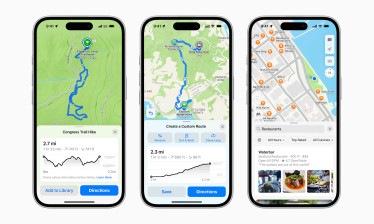
Apple is beginning to put advertising inside its navigation app for the first time, a major shift in strategy that will embed promoted content into Apple Maps listings this summer in the United States and Canada. The change comes as Apple broadens how it helps businesses reach customers and monetises services beyond device sales, signaling an evolving approach to Apple’s software ecosystem.
Until now, Apple Maps remained largely free of commercial messaging, prioritising user experience over advertising. That stance distinguished Apple’s mapping service from competitors, especially Google’s Google Maps, which shows sponsored pins and promoted search results. But as iPhone and Apple Watch users increasingly rely on Maps for navigation, discovery and local search, Apple sees an opportunity to create new revenue while helping local businesses stand out in an era where digital visibility is critical.
Starting this summer, users in the U.S. and Canada will begin seeing ads when they search for specific places inside Maps. For example, if someone searches for coffee shops, the app may show a promoted result from a nearby café at the top of the list with a small label indicating it is an ad. Apple says it will limit how many promotional results appear to avoid cluttering the map or undermining the core navigation experience. The company emphasises that the advertising will be opt‑in for businesses and will respect users’ privacy choices, aligning with Apple’s broader messaging that personalised advertising will not track individuals across apps or websites unless they explicitly allow it.
In addition to rolling out ads, Apple is launching a suite of new Apple Business offerings on April 14 that will give businesses more ways to manage their presence on Maps and connect with customers across the Apple ecosystem. These tools include enhanced business profiles, new analytics features, and integrated services for managing reviews and bookings. Apple sees this as a way to bridge the gap between local merchants and the millions of people who use Apple Maps to find directions, explore nearby places, and plan outings.

For small and medium sized businesses, the shift could be significant. Advertising on Apple Maps allows merchants to reach potential customers at the precise moment they are looking for a service or product. That immediacy of intent is valuable for advertisers because it can increase the chances that a search leads directly to a visit or purchase. For Apple, this represents a strategic expansion of its services revenue, which already includes income from the App Store, Apple Music, iCloud subscriptions, and other software based offerings.
Tech industry analysts see the move as part of Apple’s broader effort to deepen business to business relationships while diversifying its revenue streams. Advertising revenue has been dominated by companies like Google and Meta Platforms, and Apple’s entry into Maps ads puts it in direct competition with existing players. However, Apple’s emphasis on privacy and its enormous installed base of iPhone users give it a unique position in the market. The company’s privacy frameworks, such as app tracking transparency, could appeal to both users and advertisers who are wary of pervasive third party tracking.
Critics of the change worry that even subtle advertising could degrade the streamlined user experience that Apple Maps users have come to expect. Maps is often used in high focus situations such as driving, walking or biking, and too many promotional elements could become distracting. Apple appears to be aware of these concerns and has pledged to roll out ads in a thoughtful way, starting with limited categories and expanding only as it gauges user response and engagement.
Apple’s introduction of business tools also parallels broader shifts in the digital economy, where the lines between navigation, discovery and commerce are blurring. Consumers not only want directions but inside information on hours, inventory, pricing and reviews. By empowering businesses to better present themselves and pay to be more visible in search results, Apple is trying to create a more complete local ecosystem, where users find what they need and businesses benefit from being found.

The timing of these changes also reflects how central maps and location services have become to the way people interact with technology. Mobile navigation apps are routinely used not just for driving, but for planning travel, finding restaurants, checking public transit, and exploring new neighbourhoods. Monetising this context makes sense to companies that can balance revenue opportunities with user experience.
From Apple’s perspective, carefully curated advertising in Maps could be a major long term revenue source. It leverages the company’s existing strengths — massive user engagement, strong privacy controls and a powerful platform — while offering something advertisers value: placement at the moment of discovery. Whether users embrace ads in Maps will depend on how unobtrusive and helpful they prove in real world use.
As these tools roll out, observers will be watching both user feedback and how quickly businesses adopt Apple’s new advertising and profile management options. If adoption is strong, this could mark a notable evolution in Apple’s services strategy and how it connects the physical world of business with the digital world of its users.
Apple MacBook: 2 Incredibly Powerful Types and it’s Features. The Significance of Apple MacBook.