


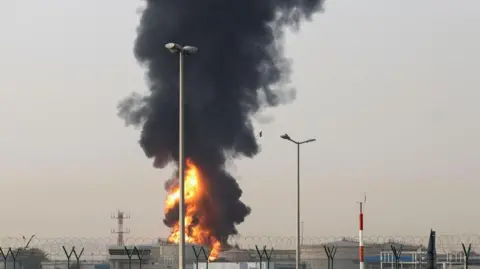
Iran has launched a series of coordinated strikes targeting critical infrastructure in the United Arab Emirates, including the strategically vital Fujairah oil port and Dubai International Airport, marking a significant escalation in the ongoing regional conflict.
The attacks, carried out using drones and missiles, are part of a broader wave of Iranian strikes across the Gulf as tensions intensify following the ongoing war involving Iran, the United States, and Israel.
Targets and immediate impact
Iranian strikes hit the Port of Fujairah, one of the UAE’s most important oil export hubs, and areas near Dubai International Airport, one of the world’s busiest aviation centers. The Fujairah facility plays a critical role in global energy markets, serving as the UAE’s primary oil export route that bypasses the Strait of Hormuz.

The attack on Fujairah forced a temporary suspension of oil loading operations, highlighting vulnerabilities in global energy supply chains and raising concerns about disruptions to international oil markets.
At the same time, a drone strike near Dubai International Airport caused a fire and led to the temporary suspension and diversion of flights, disrupting travel across the region.
Authorities reported that emergency services quickly contained the fire, and no major casualties were immediately confirmed in connection with the airport incident.
Wider regional context
The strikes form part of a broader Iranian campaign targeting infrastructure across the Gulf, including ports, oil facilities, airports, and shipping routes.

This escalation follows earlier U.S. and Israeli military actions against Iranian targets, including strikes on key infrastructure such as Kharg Island, a major Iranian oil export hub. In response, Iran has expanded its retaliation beyond Israel to include Gulf states perceived as strategically aligned with its adversaries.
Explosions were reported across parts of the UAE, and the country briefly closed its airspace as it intercepted incoming drones and missiles.
Strategic and economic significance
The targeting of Fujairah is particularly significant due to its role in global oil logistics. The port allows the UAE to export crude oil without passing through the Strait of Hormuz, a critical chokepoint for roughly one fifth of the world’s oil supply.
Disruptions at Fujairah, combined with heightened risks to shipping in the Strait of Hormuz, have already contributed to rising oil prices and increased volatility in global energy markets.
The aviation sector has also been affected, with multiple airlines suspending or diverting flights to and from Dubai amid ongoing security concerns.
Escalation of the Conflict
The attacks underscore a widening conflict that is increasingly affecting civilian and commercial infrastructure across the Middle East. Since late February 2026, Iran has launched repeated drone and missile strikes on targets across the Gulf, while U.S. and Israeli forces continue their military campaign against Iranian assets.
Casualties have been reported across multiple countries, and the conflict has displaced large populations, particularly in Lebanon.
Iran has signaled its willingness to continue targeting economic and logistical hubs in the region, raising fears of a prolonged conflict that could further destabilize global trade and energy supplies.
International response and outlook
Global reactions have been cautious, with several countries urging de-escalation while avoiding direct military involvement. Concerns are mounting over the potential closure of the Strait of Hormuz and the broader implications for global energy security.
The situation remains fluid, with the risk of further strikes and counterstrikes continuing to threaten stability in one of the world’s most strategically important regions.
Iran’s strikes on the UAE’s Fujairah oil port and Dubai International Airport represent a major escalation in the regional conflict, directly targeting critical infrastructure with global economic significance.
As tensions continue to rise, the attacks highlight the increasing vulnerability of energy and transport networks in the Gulf and the growing risk of wider international consequences.