

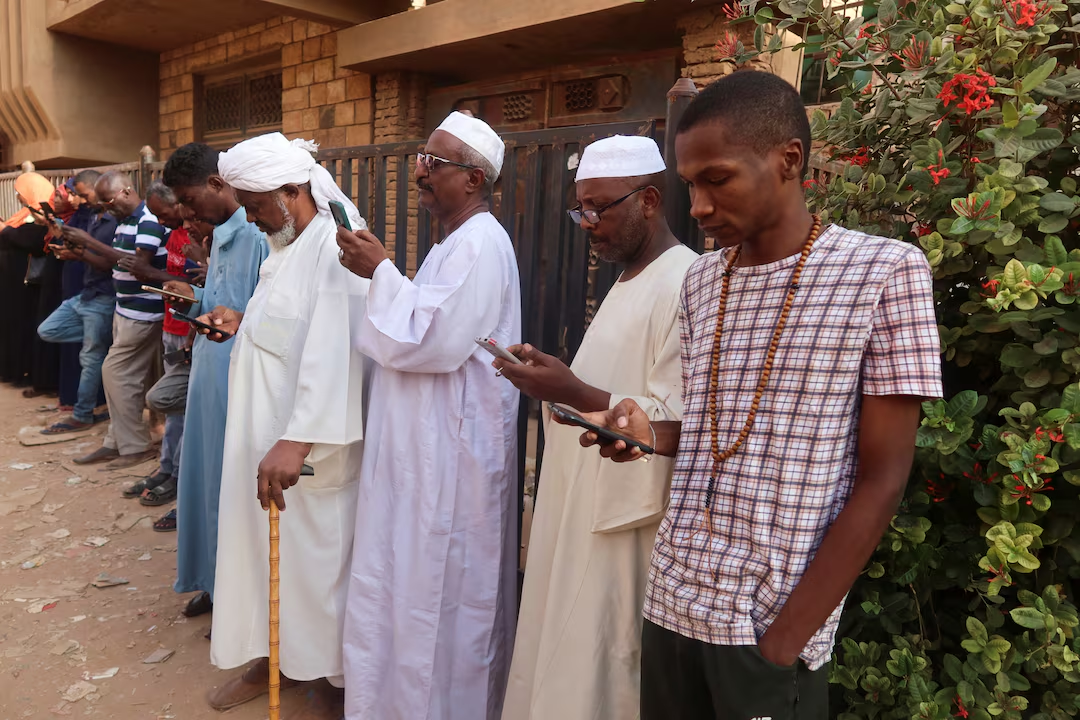
In the dusty displacement camps scattered around Tawila, North Darfur, a small cluster of people sits in silent anticipation, eyes fixed on their phones as they wait for the familiar green Wi Fi signal to flicker to life. In a region ravaged by conflict and nearly complete communication blackout, this moment, however fleeting, represents a vital link to the outside world and to the loved ones they have been forced to leave behind.
Since the outbreak of war between the Sudan Armed Forces SAF and the Rapid Support Forces RSF, all four of Sudan’s major telecommunications companies, Zain, MTN, Sudani and Canar, have ceased operations in much of Darfur. Towers lie destroyed, fuel supplies are depleted, and vast swathes of territory fall outside state control, leaving hundreds of thousands of people with no conventional means of communication. In this communication void, Starlink satellite internet, operated by SpaceX, has emerged as the only way for many displaced residents to connect with the world beyond their camps.

For many families, Starlink means more than access to news or social media, it is often the sole way to find out whether a loved one is still alive. Abubakr Adam, a displaced man from El Fasher now sheltering in Tawila, captures the emotional weight of the connection: “Without Starlink, they would be in the Stone Age,” he says, clutching his battered phone. He has not heard from his daughter, her husband, and their five children in more than three weeks. The last message was sent when they were surrounded by militias in a school in El Fasher, and he has no idea what has happened to them since.
Despite its lifesaving potential, Starlink’s presence in Darfur comes at a steep cost. At the entrance to a shelter where people gather for connectivity, a handwritten sign advertises Starlink access at 1,000 Sudanese pounds per hour, a staggering price in a region where the local currency has collapsed and most families have no regular income. Some places charge as much as 1,500 pounds per hour, though providers sometimes reduce the price to 500 pounds for those in dire straits. These services are made possible only because devices are smuggled into Sudan through neighbouring Libya and Chad, circumventing the lack of official telecommunications infrastructure.
For those who can afford it, the connection can be emotionally overwhelming as well as literally lifesaving. Khadija Mohammed, 55, waited for 45 minutes to make a voice call to her eldest son, who is still in El Fasher. During the call, he told her that hunger was ravaging their community, with no money for water or medicine, and that his young children were dying before his eyes. Khadija spent four decades weeping in silence before gradually returning to the shelter, hoping that she might hear her grandson’s voice once again.

Starlink’s use in this context also entails serious security concerns. Because the service relies on satellites and ground stations outside Sudan, communications can theoretically be monitored by parties with advanced surveillance capabilities. Osama Hassan, a displaced network engineer, explains that geolocation data can put users at risk: there have been instances where people reported receiving threats alleging they were communicating with opposing forces, although it is unclear how such targeting occurred. In a war zone, even the act of connecting to the internet can carry grave danger.
Yet for activists, journalists and humanitarian observers, Starlink has become indispensable for documenting violations and sending urgent reports from besieged areas. Intermittent access has allowed the transmission of distress messages from detainees suffering from cholera, footage of summary executions, and images of dozens of bodies, testimonies that would otherwise never reach global audiences. However, most displaced people lack modern smartphones or the funds to access Starlink regularly, meaning many stories of suffering remain unheard.
Since El Fasher fell under RSF control, thousands have fled to Tawila and nearby villages, with humanitarian estimates suggesting that tens of thousands now live in camps with minimal access to food, clean water, medicine or shelter. Even with Starlink, the plight of these displaced communities remains stark. Humanitarian aid is sparse, safe passage routes are closed, and communication outside of the satellite link is nearly non existent. For many, the tenuous connection provided by Starlink is not a solution, it is simply the last thread of hope in the face of overwhelming despair.

The fragile nature of this lifeline highlights the broader crisis in Darfur: a digital divide deepened by war, where the ability to communicate, seek help, and bear witness becomes a matter of survival and dignity. Those awaiting the glow of a Wi Fi icon in Tawila do not just seek connection, they seek reassurance that their families are alive, and that someone, somewhere, still hears their voices amidst the silence.