

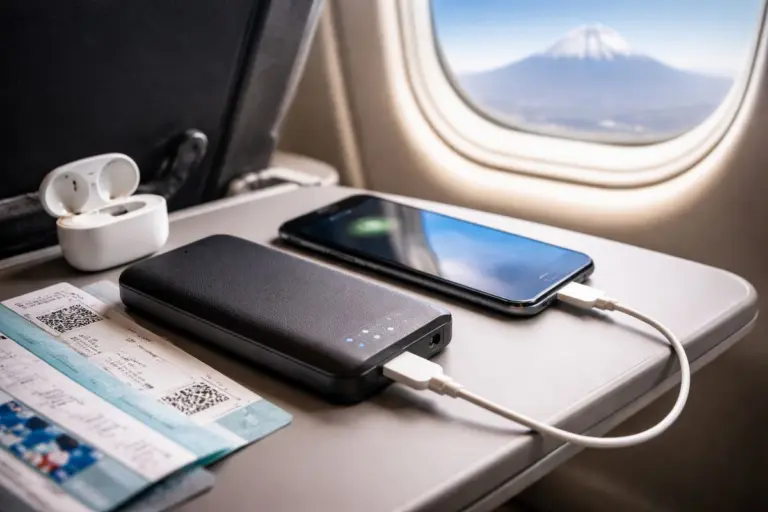
Japan Power Bank Ban will take effect from April 2026, marking a significant shift in aviation safety rules for passengers travelling to and from the country. The new regulation prohibits the use of portable power banks during flights, even though passengers may still carry limited units in their hand luggage.
The Japan Power Bank Ban reflects growing global concern about lithium-ion battery risks in aircraft cabins. While the rule may appear minor to casual travellers, it signals a broader tightening of safety standards within the aviation industry.
Why the Japan Power Bank Ban Matters
The Japan Power Bank Ban matters because lithium-ion batteries have increasingly been linked to overheating incidents and fire hazards. Aviation authorities are responding to rising cases of battery malfunctions, particularly during charging. In enclosed aircraft cabins, even a small battery fire can escalate quickly, posing serious safety threats.
By banning in-flight use rather than outright possession, regulators are targeting the highest-risk scenario: charging devices mid-air. The Japan Power Bank Ban therefore aims to reduce the likelihood of thermal runaway incidents without completely restricting passenger convenience.
For regulators, safety takes precedence over convenience. Air travel relies heavily on risk minimisation, and even rare incidents are treated with urgency. This demonstrates a preventative approach rather than a reaction to a single catastrophic event.
How the Japan Power Bank Ban Affects Passengers
Under the Japan Power Bank Ban, travellers can no longer charge phones, tablets or laptops using portable batteries during flights. Devices must be charged before boarding or powered through airline-approved systems if available.
Passengers are still permitted to carry limited batteries within specified watt-hour thresholds, but usage during the flight is prohibited. This means business travellers accustomed to working mid-air may need to rethink power management strategies.
The Japan Power Bank Ban could be particularly inconvenient on long-haul flights where access to seat power outlets is limited. For families travelling with children who rely on tablets for entertainment, planning becomes more essential. Fully charging devices before departure will become standard practice.
Business Implications of the Japan Power Bank Ban
For airlines, the power bank ban adds another layer of compliance and monitoring responsibility. Cabin crew must enforce the rule and ensure devices remain unplugged and visible throughout the journey. This increases operational oversight but reduces fire risk exposure.
Technology retailers and power bank manufacturers may also feel indirect effects. As awareness grows around lithium battery safety, demand could shift toward certified lower-capacity models or alternative charging technologies.
Travel accessory companies may benefit from increased sales of high-capacity yet regulation-compliant batteries. Meanwhile, airport lounges and terminals could see higher demand for charging stations as passengers seek to power devices before boarding under the Japan Power Bank Ban.
Airlines operating international routes must also harmonise policies with Japan’s standards. Carriers serving Japanese airports will align procedures to avoid regulatory penalties. This could gradually influence global aviation practices, especially if other countries adopt similar restrictions.
Household Impact of the Japan Power Bank Ban
For households, the Japan Power Bank Ban represents a small but noticeable shift in travel habits. Families will need to check battery watt-hour ratings, pack devices carefully and ensure compliance before departure.
Frequent flyers who rely on uninterrupted connectivity may face adjustments, particularly on flights without built-in charging ports. Digital nomads, remote workers and entrepreneurs may need to plan workflows around battery life constraints.
However, the broader benefit lies in enhanced safety. The Japan Power Bank Ban reduces the risk of in-flight battery fires, protecting passengers and crew. While inconvenience is immediate, safety reassurance carries long-term value.
Global Context of the Japan Power Bank Ban
The Japan Power Bank Ban aligns with a wider industry trend. Several international carriers have already restricted power bank usage during flights due to lithium battery concerns. Aviation authorities worldwide are reviewing battery policies as part of broader safety deliberations.
By acting decisively, Japan positions itself among countries prioritising precautionary regulation. The Japan Power Bank Ban may encourage further global coordination, especially if international aviation bodies issue stronger guidance in the coming years.
Balancing Safety and Convenience
Critics may argue that the Japan Power Bank Ban imposes inconvenience on modern travellers who depend on constant connectivity. Yet aviation regulators often adopt strict measures precisely because aircraft cabins allow little room for error.
Lithium-ion technology, while efficient, carries inherent risks under certain conditions. Charging devices in-flight increases stress on batteries, raising the probability of overheating. The Japan Power Bank Ban therefore targets the point of highest vulnerability rather than restricting ownership altogether.
The Japan Power Bank Ban underscores how aviation safety continues to evolve alongside technological dependence. For passengers, it means planning ahead and adapting travel routines. For airlines and regulators, it represents a proactive effort to reduce fire hazards linked to lithium batteries.
Businesses connected to travel and technology may experience operational adjustments, while households must adapt to new compliance rules. Ultimately, the Japan Power Bank Ban prioritises safety over convenience, reinforcing aviation’s long-standing commitment to risk prevention.