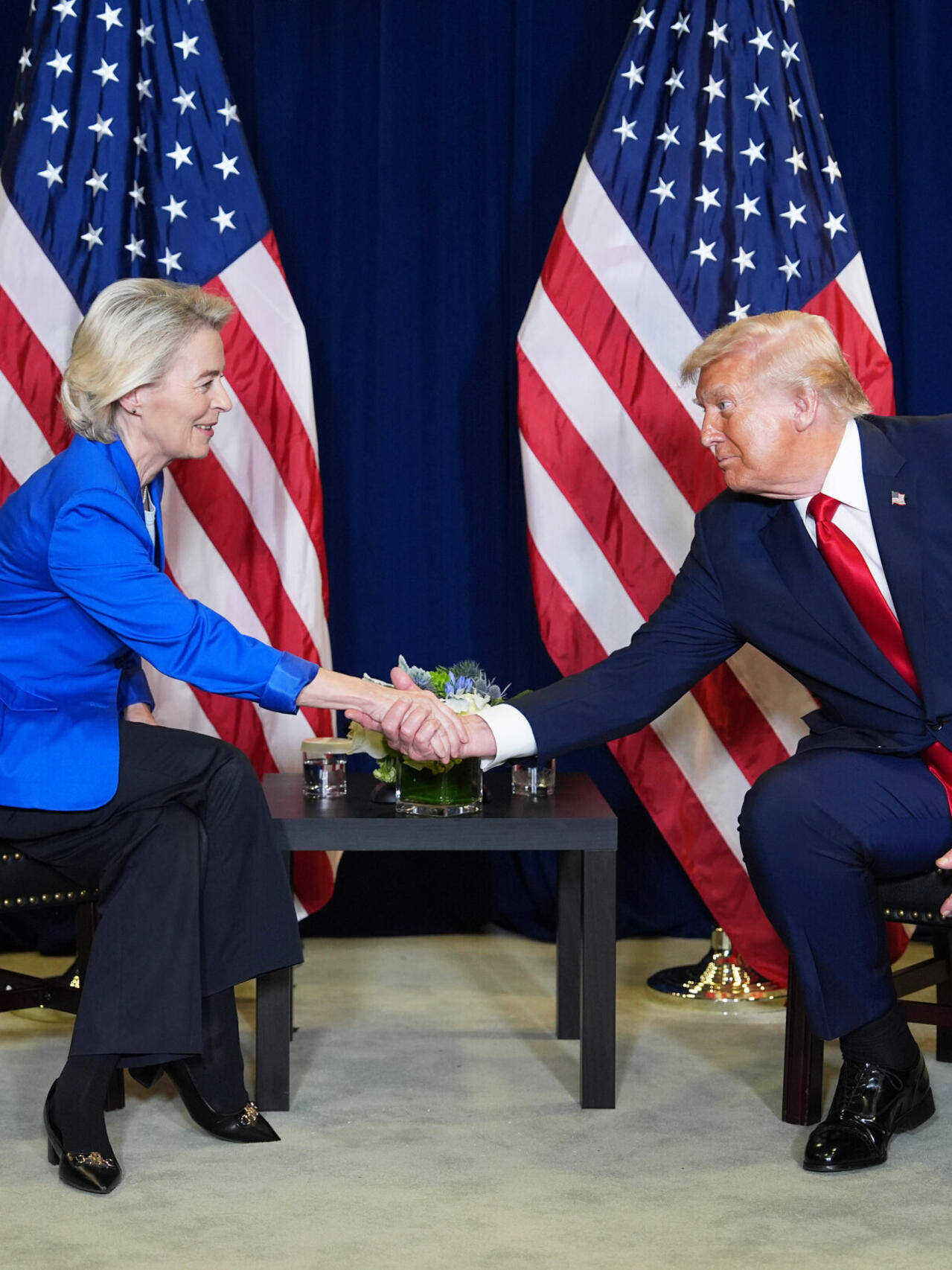
EU demands clarity after U.S. Supreme Court overturns Trump tariffs

0
123

The European Commission is seeking urgent clarification from the United States after the Supreme Court of the United States struck down several sweeping tariff measures introduced by President Donald Trump, a ruling that has injected fresh uncertainty into trans-Atlantic trade relations.

In a statement, the Commission, which manages trade policy for the EU’s 27 member states, called for “full clarity” from Washington and urged adherence to commitments outlined in the EU-U.S. Joint Statement agreed in August 2025. EU officials warned that the legal and policy turbulence risks undermining efforts to maintain what both sides had described as fair, balanced and mutually beneficial trade ties.

President Trump responded sharply to the court’s decision, signaling support for a 15 percent global tariff rate, an increase from the 10 percent rate he had announced just a day earlier. The abrupt shift has heightened volatility surrounding last year’s bilateral trade agreement, which set a 15 percent import tax on roughly 70 percent of European goods entering the U.S. market.

supreme court,tariff

Within the European Parliament, frustration is growing. Bernd Lange, who chairs the legislature’s international trade committee, indicated he would recommend suspending the ratification process tied to the agreement, describing the U.S. approach as chaotic and unpredictable.

Despite the political tension, the economic relationship remains immense. According to Eurostat, total trade in goods and services between the EU and the United States reached approximately €1.7 trillion in 2024, equivalent to about $2 trillion. That translates to roughly €4.6 billion in daily exchanges, underscoring the scale of interdependence.

The Commission emphasized that the 2025 agreement must remain intact. It reiterated that EU products should continue benefiting from the agreed tariff ceiling and competitive treatment without unilateral increases.

On the U.S. side, Jamieson Greer, President Trump’s chief trade negotiator, stated that Washington intends to respect its trade commitments and expects reciprocity from partners. He noted that discussions with European counterparts were ongoing and that no formal breakdown of the agreement had been signaled.

The stakes extend across multiple sectors. Europe’s top exports to the U.S. include pharmaceuticals, automobiles, aircraft, chemicals, medical devices, wine and spirits. Meanwhile, the EU imports substantial volumes of U.S. services, including payment systems and cloud infrastructure, alongside oil and gas, aerospace products and vehicles.

EU demands clarity after U.S. Supreme Court overturns Trump tariffs

The Commission cautioned that unpredictable tariff measures carry systemic risks for global markets. Sudden policy shifts can erode business confidence, disrupt supply chains and intensify volatility in financial markets already navigating geopolitical and economic uncertainty.

If tensions escalate further, the EU could invoke its Anti-Coercion Instrument, a mechanism designed to counter what it views as economic pressure from third countries. The tool allows the bloc to impose trade and investment restrictions, potentially limiting access to the EU’s 450 million consumers. Such measures could expose U.S. firms to significant financial losses and deepen strain in trans-Atlantic relations.

For now, both sides appear to be signaling a desire to preserve the broader trade framework. However, with legal rulings, political rhetoric and tariff adjustments unfolding rapidly, businesses on both sides of the Atlantic face a period of heightened uncertainty.

Shein EU investigation: EU launches formal probe amid digital services concerns

Author

  • Daniel Ablordey

    Daniel Ablordey is a Business Analytics student at the University of Ghana Business School and an emerging strategist at the intersection of data, markets, and narrative. With a keen analytical mind and a passion for African business and economic trends, he is building a career focused on translating complex data-driven insights into accessible, decision-relevant stories that matter.As a writer and editor with Insight Ghana, African Business Insight, and The African Journal, Daniel delivers sharp, high-impact analysis on current affairs, business developments, and emerging trends across the continent. His work is defined by precision, clarity, and a deep commitment to responsible journalism — ensuring that every story he tells is not only accurate but meaningful to the audiences it serves.Beyond his editorial work, Daniel serves as an Ecobank Youth Ambassador, where he actively promotes financial inclusion, digital banking, and financial literacy among young Ghanaians. His leadership experience spans academic, professional, and faith-based institutions, where he has consistently driven initiatives centered on growth, structure, and long-term impact.Grounded in the principles of Pan-Africanism and service, Daniel brings a rare combination of analytical rigour and storytelling depth to his work. Whether unpacking market behavior, profiling emerging business leaders, or covering cultural shifts shaping the continent, he approaches every assignment with strategic intent and editorial integrity.His broader ambition is to contribute to Africa's transformation by shaping how data, business, and storytelling intersect — not just locally, but on a global stage.

Previous articleUS Africa investment push targets energy and minerals
Next articleIvory Coast to announce mid-crop cocoa price early as global market slumps
Daniel Amenyo Ablordey
Daniel Ablordey is a Business Analytics student at the University of Ghana Business School and an emerging strategist at the intersection of data, markets, and narrative. With a keen analytical mind and a passion for African business and economic trends, he is building a career focused on translating complex data-driven insights into accessible, decision-relevant stories that matter.As a writer and editor with Insight Ghana, African Business Insight, and The African Journal, Daniel delivers sharp, high-impact analysis on current affairs, business developments, and emerging trends across the continent. His work is defined by precision, clarity, and a deep commitment to responsible journalism — ensuring that every story he tells is not only accurate but meaningful to the audiences it serves.Beyond his editorial work, Daniel serves as an Ecobank Youth Ambassador, where he actively promotes financial inclusion, digital banking, and financial literacy among young Ghanaians. His leadership experience spans academic, professional, and faith-based institutions, where he has consistently driven initiatives centered on growth, structure, and long-term impact.Grounded in the principles of Pan-Africanism and service, Daniel brings a rare combination of analytical rigour and storytelling depth to his work. Whether unpacking market behavior, profiling emerging business leaders, or covering cultural shifts shaping the continent, he approaches every assignment with strategic intent and editorial integrity.His broader ambition is to contribute to Africa's transformation by shaping how data, business, and storytelling intersect — not just locally, but on a global stage.