

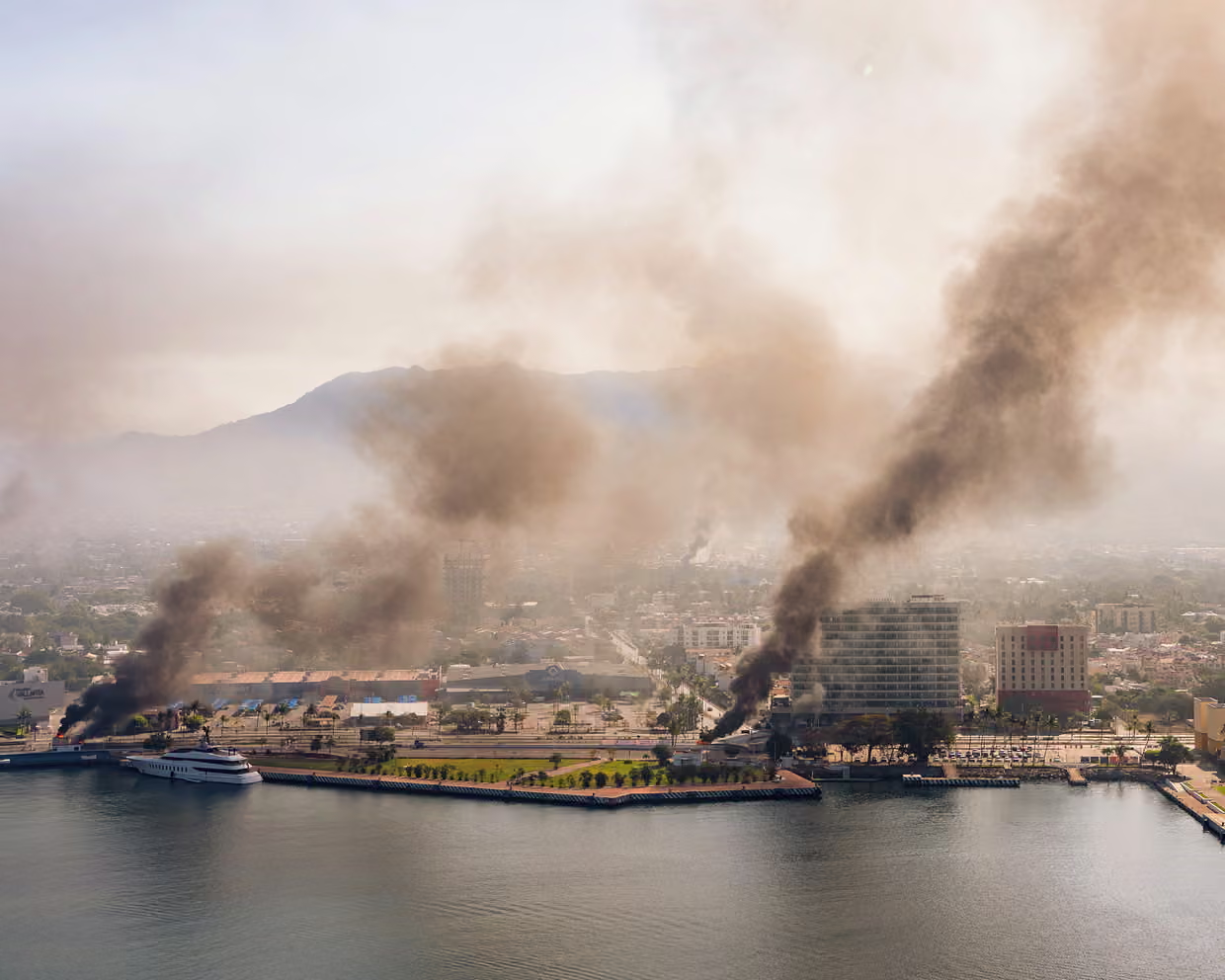
Mexican authorities have disclosed new details surrounding the killing of Nemesio Rubén Oseguera Cervantes, widely known as “El Mencho”, revealing that the notorious cartel leader was located by tracking a romantic partner to a secluded safe house near a scenic mountain town. His death has since unleashed one of the most intense episodes of cartel retaliation seen in recent years.
During a press conference, senior officials outlined how the operation unfolded, marking the first official account of the mission that eliminated the leader of the Jalisco New Generation Cartel, Mexico’s most powerful organised crime group. The military raid, carried out on Sunday, was followed almost immediately by widespread violence that effectively paralysed large parts of western Mexico.
El Mencho, 59, was fatally wounded as Mexican forces attempted to capture him during the operation, which received intelligence support from Washington. The United States has urged Mexico to intensify its efforts against criminal groups involved in trafficking fentanyl, methamphetamine, and cocaine across the border.

Mexico’s defence secretary, Ricardo Trevilla Trejo, said the military surrounded a cabin in a wooded area outside Tapalpa, approximately 80 miles south-west of Guadalajara. As troops closed in, El Mencho’s bodyguards opened fire, forcing a fierce exchange of gunfire.
During the confrontation, a military helicopter was forced into an emergency landing, recalling a failed 2015 operation in which cartel gunmen shot down a helicopter using a rocket-propelled grenade. The clash continued as El Mencho fled the cabin and ran into a nearby forest, where he was wounded, captured, and later died while being transferred to Mexico City for medical treatment.
Seven of El Mencho’s men were killed in the firefight, while two soldiers sustained injuries. Authorities also seized rifles and grenade launchers at the scene.
Almost immediately after news of his death spread, cartel gunmen launched a coordinated campaign of violence across the country. Nearly 100 major roads were blocked, vehicles were set ablaze, and security forces were attacked, particularly in the states of Jalisco and Michoacán.
Mexico’s security minister, Omar García Harfuch, reported that 25 members of the national guard were killed and 14 wounded during the clashes. In addition, 34 cartel gunmen and one civilian bystander lost their lives. Authorities also confirmed the arrest of 70 individuals nationwide.
Trevilla further confirmed that Hugo César Macías Ureña, known as “El Tuli”, a close ally of El Mencho who coordinated the violent reprisals and even placed a bounty on soldiers, was killed during a separate confrontation.
By Monday, officials stated that all road blockades across the country had been cleared. Addressing the nation, Mexican president Claudia Sheinbaum said the country was calm and reassured citizens that authorities were working across all states to restore normalcy.

Despite the official assurances, sporadic incidents of burning vehicles continued to be reported in Michoacán. Schools remained closed in several states as a precaution, and airline operations had yet to fully resume in Guadalajara and Puerto Vallarta, both of which bore the brunt of the cartel’s retaliation.
Security analyst Stephen Woodman, based in Guadalajara, said the violence erupted almost immediately after the operation became public. He explained that criminal groups have pre-arranged plans to respond rapidly to major arrests or killings, aiming to cause maximum disruption. He described the scale of the unrest as overwhelming, with reports emerging simultaneously from multiple locations.
The situation was further complicated by a flood of misinformation on social media, including AI-generated images and videos. According to Woodman, this made it difficult to distinguish fact from fabrication, intensifying public anxiety.
In response to the chaos, Jalisco governor Pablo Lemus Navarro urged the state’s eight million residents to remain indoors and suspended public transportation services.
On the outskirts of Guadalajara, trainee doctor Tanya Dittmar described hiding in a closet as a prolonged gun battle erupted near her home, where cartel gunmen attacked a national guard base. What initially sounded like construction noise quickly became recognisable as gunfire, causing panic as the sounds grew closer. Reinforcements eventually arrived, and the gunfire subsided, replaced by the sound of ambulance sirens.
The violence underscored the CJNG’s capacity to instil fear in Mexico’s second-largest city, which is scheduled to host matches during the 2026 World Cup. In Puerto Vallarta, tourists were seen on beaches as thick smoke rose over the city. More than 200 vehicles were torched, flights were suspended, and authorities urged residents to remain indoors.
International travel advisories followed, with warnings that routes to airports could be blocked and citizens advised to shelter in place. The US embassy echoed those warnings, while international airlines cancelled dozens of flights.

Although less globally known than the Sinaloa cartel once led by Joaquín “El Chapo” Guzmán, the Jalisco cartel is infamous in Mexico for its extreme violence and formidable arsenal. Founded about 16 years ago, the group has been accused of targeting senior government officials, including a 2020 assassination attempt on García Harfuch that left him wounded and killed two bodyguards and a bystander.
Washington had offered a $15 million reward for El Mencho’s capture and confirmed that US intelligence supported the operation. Senior US officials welcomed his killing following months of pressure from Donald Trump, whose administration designated the cartel a foreign terrorist organisation.
While El Mencho’s death may ease diplomatic pressure, analysts warn it could create a dangerous power vacuum. Organised crime experts caution that if the cartel splinters, rival lieutenants could unleash further violence. Some sources point to his stepson, Juan Carlos, as a potential successor, though whether he can maintain unity remains uncertain.