

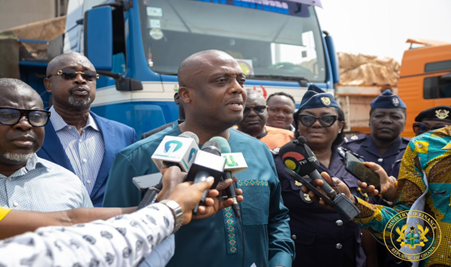
The GRA Customs Enforcement has intercepted 12 articulated trucks along the Dawhenya–Tema Road in a significant crackdown on transit violations, highlighting the critical role of strict customs supervision in safeguarding Ghana’s revenue. The operation, carried out between 10:00 p.m. and 5:00 a.m., involved collaboration between the Deputy Commissioner, Operations, the Chief Revenue Officer, Preventive (Tema Collection), the Revenue Mobilisation Taskforce of National Security, and enforcement officers from Customs Headquarters and Tema Collection.
Authorities revealed that the trucks were part of an 18-truck consignment declared as goods in transit from Akanu to Niger via Kulungugu. However, the vehicles were moving without the mandatory Customs human escort, a serious breach of transit procedures. The trucks were carrying 44,055 packages of edible cooking oil, tomato paste, and spaghetti, with an estimated tax value exceeding GH¢85 million.
The GRA Customs Enforcement emphasized that 11 of the trucks have been secured at the GPHA Transit Terminal under strict Customs supervision, while one truck experienced a mechanical fault, requiring its contents to be transferred to another vehicle to safeguard the goods. Preliminary checks confirmed that all 18 trucks had been electronically gated out of the system, yet only 12 were physically secured, leaving six trucks under active investigation.
Revenue Implications for Businesses and Households
The operation underscores how non-compliance with Customs regulations can threaten state revenue, which ultimately affects businesses and households across Ghana. The potential GH¢85 million loss represents funds that could support public services such as health, education, and infrastructure. Non-compliant traders also risk heavy financial penalties, confiscation of goods, and reputational damage, highlighting the tangible costs of bypassing legal frameworks.
For households, effective GRA Customs Enforcement indirectly ensures stable government revenue streams, which support public projects and service delivery. Any significant revenue leakages could lead to higher taxes or reduced public spending, affecting household budgets and economic stability. For businesses, adherence to Customs procedures reduces operational risk, ensures timely delivery of goods, and fosters fair competition in the market.
Investigations Underway and Accountability
Deputy Minister for Finance, Thomas Nyarko Ampem, lauded the team for the successful operation and confirmed ongoing investigations to locate the six outstanding trucks. He directed the Commissioner-General to conclude investigations within one week, with particular scrutiny on the two Customs officers implicated in the breach.
Mr. Ampem stressed the seriousness of the matter, noting the significant potential revenue loss: “We take these things seriously because the impact on our revenue is serious.”
Commissioner-General of the Ghana Revenue Authority, Anthony Kwasi Sarpong, reinforced the warning to businesses and traders, emphasizing strict compliance: “We will apply the law of confiscation. The full arms of the law will be applied. Any business or individual found culpable of actions that deny the state much-needed revenue will face consequences.”
The swift response demonstrates the GRA’s commitment to protecting Ghana’s fiscal interests, deterring illicit trade practices, and reinforcing trust in the formal trade system.
Broader Trade and Market Implications
The bust also highlights the risks associated with transit operations and the importance of monitoring supply chains. Businesses relying on import-export activities must ensure full compliance with Customs protocols to avoid disruptions, financial losses, and legal consequences.
The GRA Customs Enforcement measures serve as a warning to traders about the necessity of proper documentation, escort requirements, and adherence to transit procedures. Beyond individual companies, the crackdown signals the government’s resolve to maintain regulatory standards, contributing to a stable trade environment and reducing unfair competitive advantages from illicit practices.
Moreover, maintaining compliance ensures that taxes collected on goods are reinvested into national development, creating a ripple effect that benefits households through improved infrastructure, social services, and economic stability. Conversely, persistent breaches could destabilize local markets, inflate import costs, and compromise government revenue planning.
GRA Customs Enforcement as a Revenue Safeguard
The seizure of 12 trucks by the GRA Customs Enforcement illustrates the importance of vigilance, compliance, and effective monitoring in protecting Ghana’s revenue base. By preventing potential losses exceeding GH¢85 million, the operation protects both state interests and the broader economic environment. Businesses are reminded to follow all transit and Customs regulations, while households benefit indirectly from a stronger, more stable fiscal ecosystem.
In an era of increasing trade complexity, the UAE’s example of structured, sovereign-backed enforcement demonstrates that consistent monitoring and accountability are crucial in ensuring sustainable revenue streams and economic growth.
President Mahama signs 24-Hour Economy Authority Bill into law