

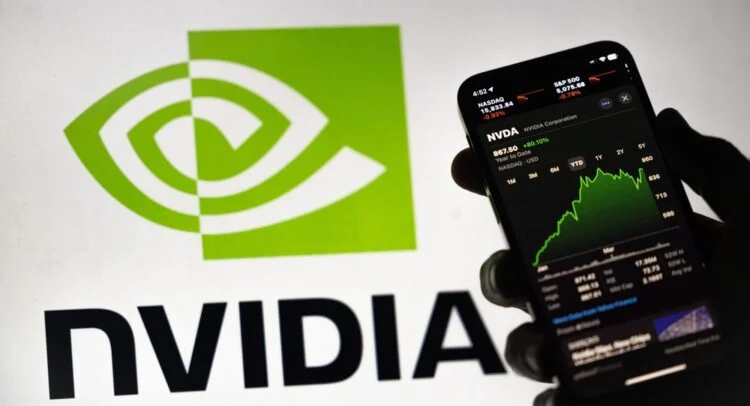
A bold Nvidia stock forecast is reigniting debate on Wall Street after one prominent analyst projected that Nvidia could reach a $20 trillion market capitalization by 2030, implying a 332% surge from current levels. The call comes at a time when the AI chipmaker’s share price has stalled in 2026, following a meteoric rise of roughly 1,200% since early 2023.
The Nvidia stock forecast matters not just because of its eye-popping upside, but because it reflects broader expectations about artificial intelligence spending, data center expansion, and the sustainability of corporate tech investment. For households and businesses alike, the implications stretch far beyond a single ticker symbol.
Nvidia Stock Forecast Hinges on AI Momentum
The bullish Nvidia stock forecast rests on extraordinary recent performance. In its fiscal third quarter of 2026, the company posted revenue of $57 billion, up 62% year over year, while earnings per share climbed 67%. Its data center segment, the engine behind AI-related sales, surged 66% to more than $51 billion.
Guidance for the following quarter pointed to revenue of around $65 billion, suggesting continued rapid growth. Chief executive Jensen Huang has also highlighted a massive order backlog stretching into 2027, signaling that demand from hyperscalers and enterprise customers remains strong.
For the Nvidia stock forecast to materialize, revenue would need to approach roughly $900 billion annually by 2030, assuming valuation multiples remain steady. That implies sustained annual growth north of 30% for several years, a pace rarely maintained at such scale.
Why the Nvidia Stock Forecast Matters for Businesses
The Nvidia stock forecast is essentially a bet on AI infrastructure. If accurate, it would confirm that global corporations are still in the early innings of AI adoption. Businesses across finance, healthcare, manufacturing, and retail are pouring billions into AI-driven automation and analytics, much of which runs on Nvidia’s graphics processing units.
For corporate leaders, this forecast signals continued capital expenditure pressure. Companies that delay AI investment risk falling behind more technologically advanced competitors. On the other hand, heavy spending on AI hardware could strain balance sheets if economic growth slows or if AI productivity gains take longer than expected to materialize.
Suppliers and partners in the semiconductor ecosystem would also feel the ripple effects. A sustained surge aligned with the Nvidia stock forecast could benefit chip designers, cloud service providers, and advanced manufacturing firms. Conversely, if AI demand cools, these same players could face overcapacity and pricing pressure.
Nvidia Stock Forecast and Household Investors
For households, the Nvidia stock forecast underscores both opportunity and risk. Many retail investors have significant exposure to Nvidia through individual holdings or index funds. A 332% climb would meaningfully boost retirement portfolios and brokerage accounts.
Yet forecasts of this magnitude can also fuel speculative behavior. After years of rapid appreciation, some investors worry about an AI bubble. If expectations embedded in the Nvidia stock forecast prove overly optimistic, a sharp correction could erode household wealth, particularly for those heavily concentrated in technology stocks.
Valuation is central to this debate. Nvidia currently trades at a forward price-to-sales ratio above 20, a premium that assumes robust and sustained expansion. While revenue growth of more than 60% year over year supports the narrative today, maintaining that pace becomes more difficult as revenue scales into the hundreds of billions.
The Path to a $20 Trillion Valuation
The analyst behind the Nvidia stock forecast argues that Nvidia’s competitive moat strengthens the case. The company’s CUDA software ecosystem creates high switching costs for developers, while its rapid product cycles reinforce technological leadership. These factors, combined with accelerating global AI infrastructure spending, form the backbone of the projection.
Still, execution risks remain. Competitors are investing heavily in custom AI chips, and major cloud providers are developing in-house alternatives. Regulatory scrutiny and geopolitical tensions could also disrupt semiconductor supply chains. Any slowdown in enterprise AI budgets would challenge the assumptions underlying the Nvidia stock forecast.
Insight Explains: A Bellwether for the AI Economy
Ultimately, the Nvidia stock forecast serves as a proxy for the future of AI-driven growth. If Nvidia achieves anything close to the projected $20 trillion valuation, it would signal a structural transformation in global productivity powered by AI. That outcome could boost corporate earnings broadly, support job creation in tech-driven sectors, and lift household investment portfolios.
However, if AI adoption moderates or economic headwinds intensify, the lofty Nvidia stock forecast may prove too aggressive. For investors and business leaders, the key takeaway is not whether Nvidia precisely hits $20 trillion, but whether AI spending continues compounding at today’s extraordinary rates.
In that sense, the Nvidia stock forecast is less about one company and more about the durability of the AI revolution itself. Whether it becomes reality will shape corporate strategy, market valuations, and household wealth for years to come.