

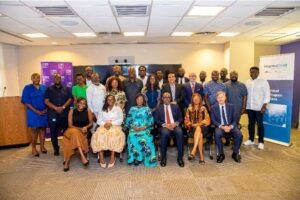
The International Finance Corporation (IFC), a member of the , has convened its third Family Governance Workshop in Ghana, reinforcing its strategic push to strengthen indigenous enterprises through structured generational transitions and long-term governance planning.
Held under IFC’s Integrated Environmental, Social, and Governance (IESG) Advisory program, with support from the (SECO), the session brought together founders, second-generation successors, and third-generation leaders from Ghanaian family-owned businesses to confront one of the most defining determinants of enterprise sustainability, succession.
Family-owned enterprises remain central to Ghana’s private sector architecture. They drive job creation, stimulate innovation, preserve local capital, and anchor community development. Yet globally, research indicates that approximately 95 percent of family businesses do not survive beyond the third generation, often due to weak succession planning, inadequate governance systems, unmanaged expansion, and unresolved internal conflicts.

The workshop addressed these structural vulnerabilities head-on.
Governance as Strategy, Not Formality
Participants engaged in intensive discussions around four foundational pillars of multigenerational resilience:
- Aligning family values with professionalized business systems
- Preparing next-generation leaders early and deliberately
- Establishing structured conflict-resolution mechanisms
- Building governance frameworks that protect both family cohesion and enterprise performance
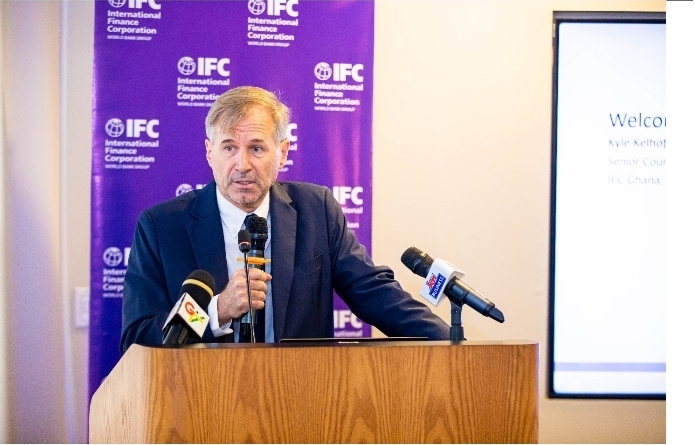
“Family-owned businesses are not just important to Ghana’s economy. They are critical to shaping legacies that endure across generations,” said Kyle Kelhofer, IFC Senior Country Manager for Ghana and Liberia.
He emphasized that succession is not merely an operational shift but a strategic transformation. “Navigating generational transitions requires preparing next generations to lead, supporting incumbents to let go, and ensuring succession happens smoothly and intentionally. This improves operations, preserves wealth, and even enhances access to finance,” he noted.
The message was clear: governance is not bureaucracy, it is infrastructure for continuity.
Succession Is a Two-Way Commitment
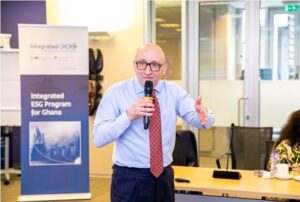
The session was facilitated by governance specialist Moez Miaoui, who drew on international experience across Europe, Africa, South Asia, and East Asia. He underscored that while contexts differ, succession challenges follow similar patterns worldwide.
“Whether you are working with a first- or fifth-generation business, the patterns are remarkably similar. Family governance is fundamental to sustaining enterprises that drive job creation across regions,” he explained.
Miaoui framed succession as a reciprocal process rather than a forced inheritance. “Successors need to convince you they are ready, and you need to convince them they want to take over. It is a two-way street. Passion cannot be imposed; it must be cultivated and transferred authentically,” he said.
The discussion resonated strongly with participants who shared candid reflections on succession anxieties, maintaining entrepreneurial energy across generations, managing growth pressures, and balancing family expectations with commercial realities.
Scaling Beyond Survival
Kelhofer expressed confidence in the long-term potential of Ghanaian family enterprises to evolve into regional and cross-sector leaders.
“Ghana has outstanding family enterprises that could become major regional players and cross-sector champions. They reach a point where they can either remain small or scale, creating opportunities for growth, investment, and legacy,” he stated.
The workshop, the third in an ongoing series, reflects increasing demand for structured governance advisory among Ghana’s business community. According to Kelhofer, repeat participation signals that companies are recognizing governance as an ongoing discipline rather than a one-time intervention.
“Like going to the gym, governance improvement is something we work on regularly. Feedback shows participants keep returning, demonstrating the value of these sessions,” he added.
Beyond Dialogue: Practical Implementation
The format combined expert facilitation with peer-to-peer engagement, allowing business leaders to exchange lived experiences and practical tools for:
- Succession road-mapping
- Conflict mediation frameworks
- Wealth preservation strategies
- Institutionalizing family councils and boards
- Professionalizing management structures
By balancing structured systems with deeply held family values, participants explored how to transition from founder-led models to institutionalized enterprises capable of enduring across decades.
Reaffirming IFC’s long-term commitment to Ghana’s private sector, Kelhofer stated: “We stand ready to provide tailored advisory solutions and investment tools to help family businesses build stronger, more resilient enterprises for generations to come. Our mission is to help these businesses achieve beyond what they currently imagine, potentially becoming leading local corporates and even global players.”
As Ghana continues to position itself as a regional business hub, the sustainability of family-owned enterprises will play a decisive role. Governance, once seen as optional, is now emerging as a competitive advantage, and for many businesses, the difference between survival and legacy.
IFC Hosts Second Family Business Governance Workshop in Accra