

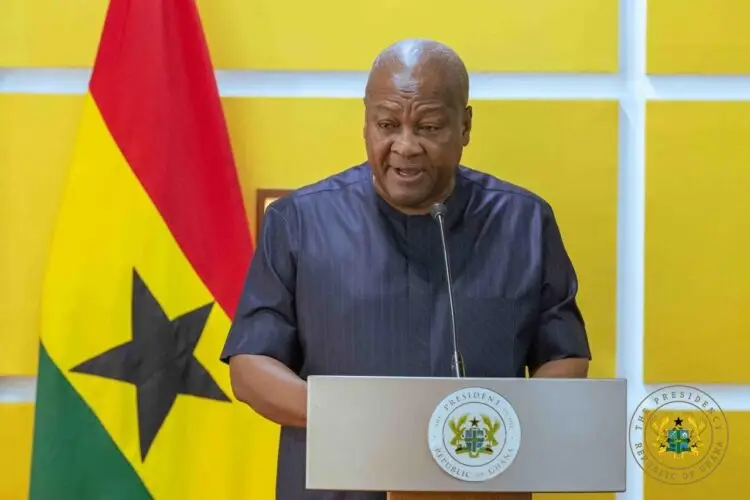
State-owned enterprise reform is once again at the centre of Ghana’s economic debate after President John Dramani Mahama openly acknowledged deep structural weaknesses in the management of state-run institutions. Speaking at the swearing-in of the Presidential Group on the Economy, the President described the oversight of state-owned enterprises (SOEs) as inconsistent and, at times, disorderly — a candid admission that signals renewed urgency around economic restructuring.
His remarks were not framed as political criticism but as a sober assessment of institutional performance. However, the implications of state-owned enterprise reform extend far beyond government offices. They directly affect businesses, households, and investor confidence in Ghana’s economic future.
Why State-Owned Enterprise Reform Matters Now
Ghana’s state-owned enterprises operate in strategic sectors such as energy, transport, agriculture, and finance. These entities were historically designed to stabilise markets, create employment, and support national development. When properly managed, they act as anchors of economic stability. When mismanaged, however, they become fiscal burdens.
President Mahama pointed to weak governance frameworks, political interference, and inadequate financial discipline as recurring challenges. Without effective state-owned enterprise reform, these weaknesses risk draining public resources, increasing national debt, and undermining service delivery.
For households, this can translate into higher utility costs, unstable power supply, reduced employment opportunities, and slower economic growth. For businesses, especially small and medium-sized enterprises (SMEs), inefficiencies within SOEs can increase operating costs and limit access to essential services.
One of the most striking examples cited was the cocoa sector. The President noted that Cocobod’s once-strong ability to raise sustainable funding and syndicate loans, a function it had performed successfully since the early 1990s, has been significantly weakened.
The cocoa industry is not just another sector; it is a pillar of Ghana’s export economy and a primary income source for hundreds of thousands of farming households. Weak performance in this area underscores why state-owned enterprise reform cannot be postponed.
When Cocobod struggles to secure funding efficiently, cocoa farmers may face delayed payments, reduced access to inputs, or unstable pricing structures. This affects rural incomes, consumption patterns, and overall economic activity. The ripple effect spreads from farming communities to urban markets and financial institutions.
Investor Confidence and Economic Stability
Beyond domestic impact, state-owned enterprise reform plays a critical role in shaping international investor perception. Investors closely monitor governance standards, financial discipline, and institutional independence when evaluating emerging markets.
Persistent governance lapses in SOEs raise red flags for lenders and rating agencies. This can increase borrowing costs for the government and limit access to international capital markets. In contrast, credible reform signals transparency, accountability, and long-term policy consistency.
President Mahama’s acknowledgment of past shortcomings may be interpreted as an effort to reset expectations and demonstrate political will. Markets often respond positively to transparency, particularly when paired with structured reform plans.
Political Interference and Governance Risks
A recurring theme in the President’s remarks was political interference. This remains one of the most significant barriers to sustainable state-owned enterprise reform. When appointments and operational decisions are influenced by short-term political considerations rather than professional criteria, institutional efficiency suffers.
Strong governance frameworks, independent boards, and transparent reporting mechanisms are central to any meaningful reform agenda. Without these safeguards, financial leakages and operational inefficiencies persist.
For households, weak governance often manifests indirectly, through inflationary pressures, currency instability, or increased taxes used to cover SOE losses. For businesses, it creates uncertainty that discourages long-term investment planning.
Economic Recovery Hinges on Reform Execution
The swearing-in of the Presidential Group on the Economy suggests that state-owned enterprise reform may become a central pillar of Ghana’s broader economic recovery strategy. However, acknowledgment alone does not guarantee transformation.
Successful reform will likely require:
- Strengthening corporate governance standards
- Reducing political interference
- Enhancing financial transparency
- Enforcing performance accountability
- Encouraging strategic partnerships or partial privatisation where necessary
If implemented effectively, these measures could restore SOEs to their intended role as engines of credibility and stability.
Importantly, President Mahama framed the discussion as “lessons in responsibility,” rather than accusations. This framing matters. Reform efforts that are overly politicised risk stalling. Sustainable state-owned enterprise reform requires cross-party cooperation and institutional continuity beyond electoral cycles.
For Ghanaian households and businesses, what ultimately matters is not rhetoric but results: stable prices, reliable public services, job creation, and improved economic predictability.
The coming months will determine whether this renewed focus translates into structural change. If it does, state-owned enterprise reform could become a turning point in Ghana’s economic trajectory. If it falters, the fiscal and social costs may deepen.
In today’s fragile economic climate, the stakes are simply too high for reform to remain an aspiration rather than a reality.