

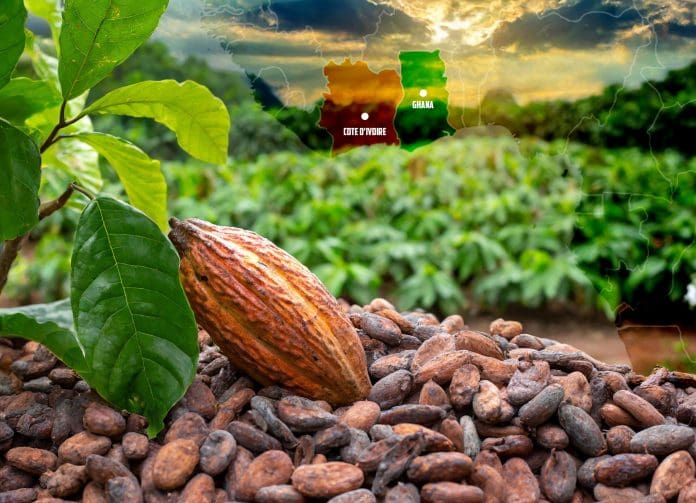
Ghana cocoa value chain is facing a profound structural challenge, long affecting national revenue, rural livelihoods, and international trade credibility. After a record harvest of 1.04 million tonnes in 2020/21, production dropped for three consecutive seasons, falling to just over 530,000 tonnes in 2023/24, with a modest recovery projected at 700,000–750,000 tonnes for 2024/25 and 2025/26. The sector is under pressure not only from declining yields but also from delayed payments to farmers. Broken financing mechanisms have left warehouses full of unsold beans and eroded confidence among producers, highlighting how Ghana’s current export-oriented model leaves little room for liquidity shocks or policy missteps.
Financing Shortfalls and Confidence Crisis
For decades, the Ghana Cocoa Board (COCOBOD) relied on syndicated loans to pay farmers at the start of each season. These loans, while costly, ensured predictability and allowed Licensed Buying Companies (LBCs) to operate efficiently. From 2023 onward, COCOBOD shifted toward a “self-financing” model, relying heavily on pre-financing from international buyers.
When global prices spiked, buyers became hesitant to provide upfront credit, creating a liquidity trap. The result: COCOBOD could not pay LBCs, LBCs could not pay farmers, and beans stagnated in warehouses. The Ghana cocoa value chain is thus experiencing a confidence crisis, with farmers unsure if their hard-earned harvests will ever convert into income.
Côte d’Ivoire Comparison: Lessons in Processing
The contrast with Côte d’Ivoire underscores Ghana’s vulnerability. While both nations supply over 60% of the world’s cocoa, Côte d’Ivoire has invested heavily in domestic processing, handling 44% of its cocoa harvest locally in 2024. This strategy doubles the value per tonne of cocoa products exported compared to raw beans.
Ghana, by contrast, still exports the vast majority of raw cocoa, limiting its ability to capture value. Analysts suggest that Ghana cocoa value chain reform toward domestic processing is essential to shift the country from a low-margin, export-dependent model to one that generates higher income, strengthens industrial capacity, and buffers against global price volatility.
Industrialization and Value Addition: The Path Forward
Recent initiatives demonstrate the potential for cocoa-led industrialization. Ventures such as Fairafric in Suhum and Niche Cocoa have shown that “bean-to-bar” production and branded chocolate exports retain significantly more value locally. Fairafric, for instance, keeps roughly four times more value per bar in Ghana than conventional export models.
Expanding these successes across the Ghana cocoa value chain requires coordinated policy, investment, and infrastructure support. Targeted tax incentives, concessional financing for SMEs, skills upgrading, and investment in processing clusters could transform cocoa from a commodity into a high-value industrial input.
NCVCIC 2026: Policy and Governance Imperatives
The National Cocoa Value Chain Integration & Competitiveness Conference (NCVCIC 2026) offers a roadmap for transformation. Its agenda focuses on integrating all nodes of the value chain, from farm inputs to processing, branding, and exports, while stabilizing farmer incomes.
Key proposals include:
- Restoring liquidity and farmer confidence: Transparent escrow mechanisms for farm-gate payments.
- Domestic processing growth: Incentives for SME and large-scale processing to absorb cocoa during low-price years.
- Market expansion: National campaigns and school feeding programmes to increase local consumption, while regional ECOWAS markets are targeted for exports.
A presidential-led council could oversee implementation, ensuring cross-ministerial coordination, data-driven monitoring, and alignment with Côte d’Ivoire on initiatives like the Living Income Differential (LID). Such oversight positions the Ghana cocoa value chain as a strategic national asset rather than a vulnerable export commodity.
Implications of the Ghana cocoa value chain for Businesses and Households
Reforming the Ghana cocoa value chain has immediate implications for both enterprises and households:
- For businesses: Investment in processing, branding, and export-oriented cocoa products can increase revenue, diversify operations, and improve resilience against raw cocoa price shocks. SMEs gain access to concessional financing, technical training, and market linkages.
- For households: Farmers benefit from timely payments, skill development, and greater participation in high-value production. Consumers enjoy higher-quality, locally made cocoa products, while rural economies see job creation through expanded processing and SME activity.
Failure to reform risks continued raw-bean dependency, reduced competitiveness, and lost international influence in cocoa pricing and sustainability initiatives.
Ghana now stands at a decisive crossroads. Without immediate interventions, spanning liquidity stabilization, value chain integration, industrial policy, and governance, the country risks ceding global market share, economic leverage, and moral authority in the cocoa sector. Conversely, bold reforms under NCVCIC 2026 could reposition Ghana as a price-maker, industrial hub, and center for high-quality cocoa products.
Ghana cocoa value chain reform is not just an economic imperative; it is a matter of national competitiveness, rural livelihoods, and long-term sustainability. The choices made in the next 12–24 months will determine whether Ghana’s cocoa sector remains a pillar of resilience or becomes a cautionary tale of missed opportunity.
Cocoa sector in crisis: COCOBOD blames legacy contracts and buyer retreat as farmer arrears rise