

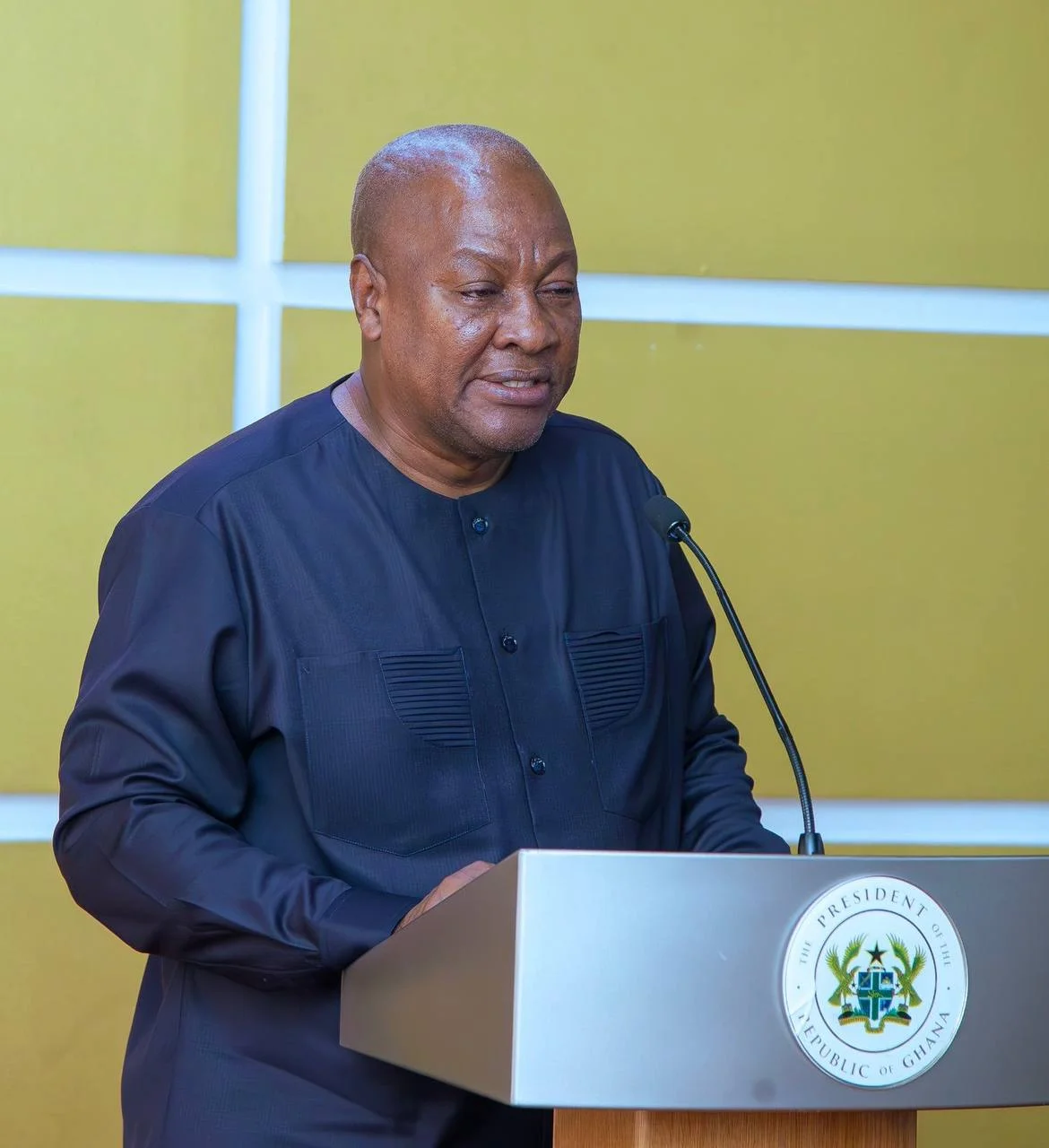
President John Dramani Mahama has intervened in a heated parliamentary debate by urging the leadership of the majority caucus to suspend efforts to introduce legislation seeking to dismantle the Office of the Special Prosecutor (OSP). His appeal reflects a firm stance that the institution remains vital to Ghana’s anti-corruption framework and should be preserved and strengthened rather than repealed.
The President’s intervention comes in response to a Private Members’ Bill drafted by the Majority Leader and the Majority Chief Whip, which proposes to repeal the legal act establishing the OSP. These legislators argue that the anti-corruption agency has struggled with structural and operational challenges since its inception, including overlapping mandates with the Attorney-General’s Office, constitutional ambiguities, and limited impact relative to its cost.
In a statement issued by his spokesperson and Minister of Government Communications, the President formally requested that the Majority Leader and Chief Whip withdraw the draft bill. The statement emphasised that abolishing the OSP would be inconsistent with broader goals to strengthen institutional integrity and combat corruption at all levels of society. The President reiterated his public support for the OSP, describing it as a crucial institution that must be allowed to mature and deliver on its mandate effectively.
President Mahama’s appeal follows a public reiteration of his support for the OSP during an engagement with the Peace Council. During that meeting, he underscored the importance of the office in the national governance landscape and called on its leadership to do more to boost public confidence by pursuing corruption cases more assertively and transparently.
While the proposed repeal bill has sparked significant debate, the President emphasised that now is not the time to dismantle anti-graft structures. Instead, he said, Ghana should focus on improving and resourcing its existing mechanisms to achieve more tangible results. In his view, the OSP’s presence provides an additional layer of oversight and prosecutorial independence that complements, rather than conflicts with, the work of other prosecutorial bodies.
The Proposed Bill and Rationale
The draft legislation, formally titled the Office of the Special Prosecutor (Repeal) Bill, 2025, seeks to return full authority for prosecuting corruption and corruption-related offences solely to the Attorney-General’s office as provided under Article 88 of the Constitution. Sponsors of the bill argue that after eight years of operation, the OSP has not sufficiently demonstrated that it can meet expectations as an independent and effective anti-corruption body.
In support of their position, the bill’s memorandum highlights what the authors describe as duplication of prosecutorial functions and jurisdictional overlap between the OSP and the Attorney-General’s Department. They contend that consolidating these functions under a single office could reduce administrative costs, simplify legal processes, and eliminate institutional friction that has slowed down the resolution of corruption cases.
The proposed repeal also includes transitional arrangements designed to integrate the OSP’s operations, assets, staff, and ongoing cases into the Office of the Attorney-General. Government officials have acknowledged that these proposals are rooted in a desire to streamline the national prosecutorial architecture, though critics argue that such integration could undermine prosecutorial independence.
Diverse Views and Public Debate
The draft bill has generated both support and opposition across political and civil society spaces. Advocates for abolition claim that the dual-prosecutor model has not yielded the desired results and that Ghana could benefit from a more unified legal approach. These voices have called for reforms that prioritise efficiency and accountability while aligning all prosecutorial functions under one constitutional authority.
However, opponents of the proposal including President Mahama caution that abolishing the OSP could weaken the fight against corruption, particularly given longstanding concerns about the independence of the Attorney-General’s office. They argue that the OSP was created to address gaps in the anti-corruption architecture and to ensure that politically sensitive cases could be handled without undue influence.
Some legal experts and governance advocates have also expressed concern about the timing and implications of the repeal effort. They suggest that rather than abolishing the OSP, Parliament should consider reforms that address specific operational challenges, strengthen institutional capacity, and improve collaboration between anti-corruption agencies.
Government Position and Next Steps
In his appeal, President Mahama asked the Majority leadership to reconsider the bill and refrain from advancing it at this time. He stressed that the government remains committed to the continuous improvement of anti-corruption institutions and that the abolition of the OSP should not be entertained while concerted efforts are underway to fortify its capabilities.
The President also reiterated that while government institutions must be held accountable, abandoning them outright could have adverse consequences for governance and public trust. His call reflects a broader strategy to ensure that Ghana’s anti-corruption architecture remains robust, credible, and capable of addressing both high-profile and everyday cases of wrongdoing.
As the debate unfolds, stakeholders will be watching closely to see whether the Majority leadership accedes to the President’s request or proceeds with formal consideration of the repeal bill in Parliament. The outcome could have far-reaching implications for Ghana’s legal and governance landscape, particularly in terms of how the nation prosecutes corruption and upholds the rule of law.