

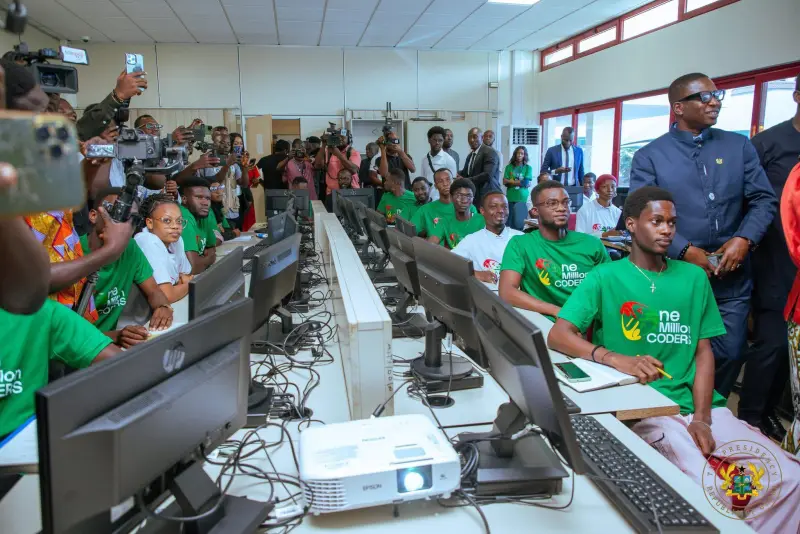
Ghana’s 2025 commemoration of the International Day of Persons with Disabilities saw a major announcement from the Ministry of Communication, Digital Technology and Innovations (MoC), as the government pledged deepening commitment to digital inclusion. The Minister, Samuel Nartey George (Sam George), revealed that 50,000 fully funded training slots will be reserved exclusively for persons with disabilities (PWDs) under the national One Million Coders Programme.
The announcement came during the IDPD celebration on 4 December 2025, held at the NCA Tower in Accra under the theme “Assistive Technology: Empowering Lives, Advancing Inclusion.” Sam George framed the decision as a moral and legal obligation, referencing Ghana’s Persons with Disability Act and global human-rights commitments.
Launched earlier in 2025, the One Million Coders Programme is designed to equip a million Ghanaians with in-demand digital skills — including coding, data science, software development, cybersecurity, and cloud computing — in order to position Ghana as a competitive technology hub. The inclusion of 50,000 slots for PWDs signals a strong push towards inclusive growth and equal opportunity.
In his speech, the Minister underscored that accessible technology and inclusive digital education are “not privileges, but a human-rights obligation.” He further explained that the move aims to open doors for persons with disabilities, offering them the chance to engage in the growing digital economy on an equal footing.
To ensure meaningful inclusion, the Ministry will collaborate with the Ghana Federation of Disability Organisations (GFD), regulatory bodies like the National Communications Authority (NCA), and social-protection agencies to guarantee accessibility across all programme dimensions — from registration and learning platforms to assistive-technology support.
Advocacy groups welcomed the announcement, describing it as historic. Many had long called for intentional inclusion of PWDs in national digital-skills initiatives. They believe that equipping PWDs with marketable ICT skills can significantly improve their employability, independence, and participation in Ghana’s knowledge economy.
However, success will depend on more than slot allocation. Disability-rights activists have emphasised that the programme must ensure accessible infrastructure — including adaptive software, accessible training centres, assistive devices, and reasonable accommodations — to truly be inclusive in practice. Some also called for transparent monitoring and feedback mechanisms to safeguard against tokenism.
With this commitment, Ghana has taken a meaningful step toward bridging the digital divide and democratizing access to future-oriented skills. For persons with disabilities who have often been marginalised in education and employment, the 50,000-slot pledge under One Million Coders offers new hope. The next test will be implementation — and delivering on the promise such that PWDs can fully benefit from Ghana’s digital transformation.