

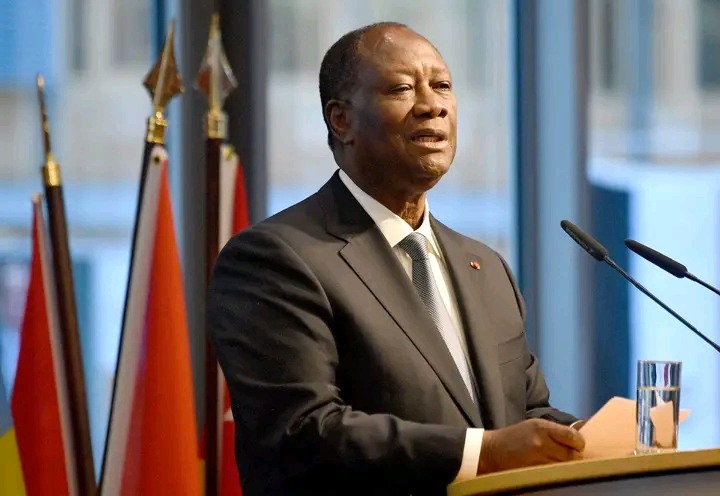
Ivory Coast’s 83-year-old leader, Alassane Ouattara, has been declared the winner of the 2025 presidential election, securing a controversial fourth term in office. Provisional results released by the Independent Electoral Commission late Sunday night confirmed Ouattara’s commanding lead, extending his 15-year rule over one of West Africa’s largest economies.
According to the results, Ouattara’s ruling Rally of Houphouëtists for Democracy and Peace (RHDP) secured over 80% of the vote. However, turnout was reported to be below 40%, with most major opposition candidates either disqualified or boycotting the election, citing what they described as an uneven playing field and institutional bias. Several observers from civil society and regional organisations have noted irregularities in parts of the country, though no large-scale violence was reported.
Ouattara’s victory speech, delivered from the presidential palace in Abidjan, was framed around themes of stability, growth, and continuity. “The Ivorian people have once again chosen peace and progress,” he said, thanking supporters for what he called their “unwavering confidence in our collective vision for a prosperous Côte d’Ivoire.” He promised that his final term would focus on consolidating economic gains, modernising infrastructure, and fostering national reconciliation after years of political division.

The announcement, however, has deepened domestic and international debate about the state of democracy in Côte d’Ivoire. Many observers argue that Ouattara’s continued hold on power reflects the erosion of democratic norms in West Africa, where constitutional term limits have been amended or disregarded in several countries. Opposition figures denounced the results as a “constitutional coup,” accusing the government of using the judiciary and electoral commission to silence dissent and exclude rivals from contesting.
Former president Laurent Gbagbo and former speaker Guillaume Soro, both long-time political adversaries of Ouattara, were among those barred from running due to legal and procedural restrictions. Their exclusion effectively cleared the path for Ouattara’s re-election, a move analysts say undermined voter confidence and reduced competition. “When the opposition is dismantled before an election begins, the legitimacy of any victory is inevitably questioned,” said Dr. Yao N’Guessan, a political science lecturer at the University of Cocody.
Despite these criticisms, supporters of Ouattara argue that his leadership has transformed the country’s economy and restored stability after the deadly civil conflict that followed the disputed 2010 election. Under his tenure, Ivory Coast has become one of Africa’s fastest-growing economies, driven by investments in cocoa, infrastructure, and energy. “We must not forget where we were before 2011,” said Kader Coulibaly, a youth leader in Abidjan. “President Ouattara brought back peace and opportunity. He deserves to finish his work.”
The African Union and ECOWAS have congratulated the Ivorian people for conducting a largely peaceful vote but urged dialogue between political actors to preserve national unity. Western governments, while cautious in tone, have reiterated calls for respect for human rights and inclusive governance. The U.S. State Department issued a statement acknowledging the results but encouraged the Ouattara administration to “build trust through transparent governance and political reforms that ensure equal participation.”

For many Ivorians, the election outcome is both familiar and unsettling. “We have peace, but we don’t have a real choice,” said Aminata Koné, a shopkeeper in Yamoussoukro. “People are tired of politics that never changes.” Some civil society groups are now calling for constitutional reforms to prevent future presidents from extending their rule indefinitely. Others fear that the opposition’s fragmentation and the government’s control over key institutions will make such reforms unlikely in the near future.
As celebrations continued late into the night in Ouattara strongholds, a sense of unease lingered in parts of Abidjan and Bouaké, where opposition supporters gathered quietly, expressing frustration but avoiding confrontation. Analysts warn that unless the government reaches out to disillusioned citizens and opposition leaders, the next few years could test the country’s fragile political stability.

Ouattara, who first took office in 2011 after a disputed election that triggered months of violence and claimed over 3,000 lives, now faces the challenge of governing a divided nation. His age and the question of succession are expected to dominate political discourse going forward. “Ivory Coast has chosen continuity,” said journalist Rodrigue Kouadio. “The real question is: what happens after Ouattara?”
Djibouti Parliament Votes to Lift Presidential Age Limit, Paving Way for Guelleh’s 6th Term