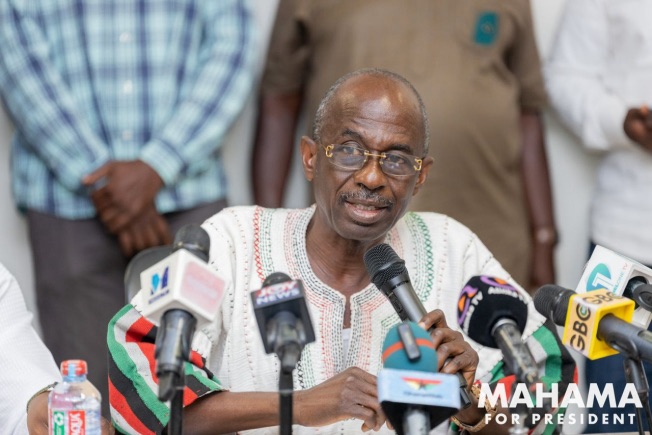
Entire EC leadership should be removed, says Asiedu Nketia

0
177

Chairman of the National Democratic Congress (NDC)Johnson Asiedu Nketia, has boldly called for the removal of the entire leadership of Ghana’s Electoral Commission (EC). In an interview with Radio Gold, Mr. Nketia emphasized that under the NDC’s Reset Agenda, a fresh start must include replacing the current top-ranking officials of the EC.

“Jean Mensa Is No Angel” – Asiedu Nketia

Speaking in Twi, Mr. Asiedu Nketia stated:

“I am the one who started the whole conversation about the removal of high-ranking officers at various state institutions, including the Auditor General and the Electoral Commission.”

Asie

Asiedu Nketia continued:

“The fact that the NDC won the 2024 election does not turn the EC Chair, Mrs. Jean Mensa, into an angel. Left with me alone, she should be removed together with the entire leadership of the Electoral Commission.”

This declaration follows ongoing concerns from the NDC over the credibility, neutrality, and performance of the EC in recent electoral processes.

Current EC Leadership Profile

Chairperson – Mrs. Jean Mensa
A seasoned barrister and policy expert, Jean Mensa is known for her work in governance and democratic reform. Appointed in 2018, she has served as the face of the Electoral Commission during two general elections. Critics, however, continue to question her impartiality.

Asie

Deputy Chairperson (Corporate Services) – Dr. Bossman Eric Asare
A former head of the Political Science Department at the University of Ghana, Dr. Asare holds a Ph.D. in Political Science from West Virginia University.

Deputy Chairperson (Operations) – Mr. Samuel Tettey
With over two decades at the EC, Mr. Tettey has served in various roles, including Director of Electoral Services and Regional Director.

Commissioners Include:

  • Rev. Akua Ofori-Boateng – Anglican priest, engineer, and governance scholar.
  • Hajia Salima Ahmed Tijani – Banking professional and governance expert with degrees in finance, accounting, and project management.
Asie

EC’s Constitutional Independence

The Electoral Commission was established under the Electoral Commission Act (Act 451) and operates as a constitutionally independent body under Article 46 of the 1992 Constitution. It is not subject to control by any authority in the execution of its duties—except where provided by law.

The Chairperson and deputies enjoy permanent tenure of office and conditions of service equal to Justices of the Superior Courts, further shielding them from undue political influence.

What’s Next?

Mr. Asiedu Nketia’s remarks signal a potential confrontation between the ruling party and a constitutionally autonomous body. While the call for leadership changes aligns with the NDC’s push for systemic reform, it also raises questions about how such a process would legally unfold.

With Prof. Mike Oquaye’s committee expected to release reports on electoral performance and institutional recommendations, the debate around the EC’s future is far from over.

Author

  • Asie

    Abraham Kofi Amudzegbe is a Level 300 Nursing student at the University
    of Ghana, Legon, an author, student leader, and youth advocate with a
    strong passion for public service, leadership, and student empowerment.
    Through his writing, he explores topics related to education, youth
    development, leadership, health, and social impact, contributing
    meaningful perspectives on issues that affect students and young people.

    As an author at Insight Ghana, Abraham leverages his strong communication
    and research skills to produce informative and thought-provoking content.
    His work reflects a commitment to advocacy, public engagement, and
    fostering conversations that inspire positive change within society.

    Abraham currently serves in several leadership capacities, including
    Vice President of the Volta Region Students Association (VORSA Legon),
    Public Relations Officer (PRO) of the University of Ghana Nursing and
    Midwifery Students Association (UGHANMSA), Deputy Head of the Business
    and Political Chamber of PENSA Legon, Public Relations Officer (PRO) of
    the Oti Region Students Association (ORSA), and a Member of the
    University of Ghana Parliament House.

    Over the years, he has led and supported numerous student-centered
    initiatives, including academic tutorials, mentorship programmes,
    welfare interventions, and advocacy campaigns aimed at improving the
    student experience and promoting collective growth.

    As an aspiring President of the University of Ghana Students'
    Representative Council (UGSRC) for the 2026/2027 academic year,
    Abraham seeks to champion a vision centered on student welfare,
    accountability, inclusiveness, innovation, and effective representation.

Previous articleOld Mutual Ghana Celebrates Excellence at 2024 Annual Sales Gala
Next articleAfrica Needs More Confident Voices: Why Communication Coaching Is Key to Our Next Generation of Leaders
Abraham kofi Amudzegbe

Abraham Kofi Amudzegbe is a Level 300 Nursing student at the University of Ghana, Legon, an author, student leader, and youth advocate with a strong passion for public service, leadership, and student empowerment. Through his writing, he explores topics related to education, youth development, leadership, health, and social impact, contributing meaningful perspectives on issues that affect students and young people.

As an author at Insight Ghana, Abraham leverages his strong communication and research skills to produce informative and thought-provoking content. His work reflects a commitment to advocacy, public engagement, and fostering conversations that inspire positive change within society.

Abraham currently serves in several leadership capacities, including Vice President of the Volta Region Students Association (VORSA Legon), Public Relations Officer (PRO) of the University of Ghana Nursing and Midwifery Students Association (UGHANMSA), Deputy Head of the Business and Political Chamber of PENSA Legon, Public Relations Officer (PRO) of the Oti Region Students Association (ORSA), and a Member of the University of Ghana Parliament House.

Over the years, he has led and supported numerous student-centered initiatives, including academic tutorials, mentorship programmes, welfare interventions, and advocacy campaigns aimed at improving the student experience and promoting collective growth.

As an aspiring President of the University of Ghana Students' Representative Council (UGSRC) for the 2026/2027 academic year, Abraham seeks to champion a vision centered on student welfare, accountability, inclusiveness, innovation, and effective representation.