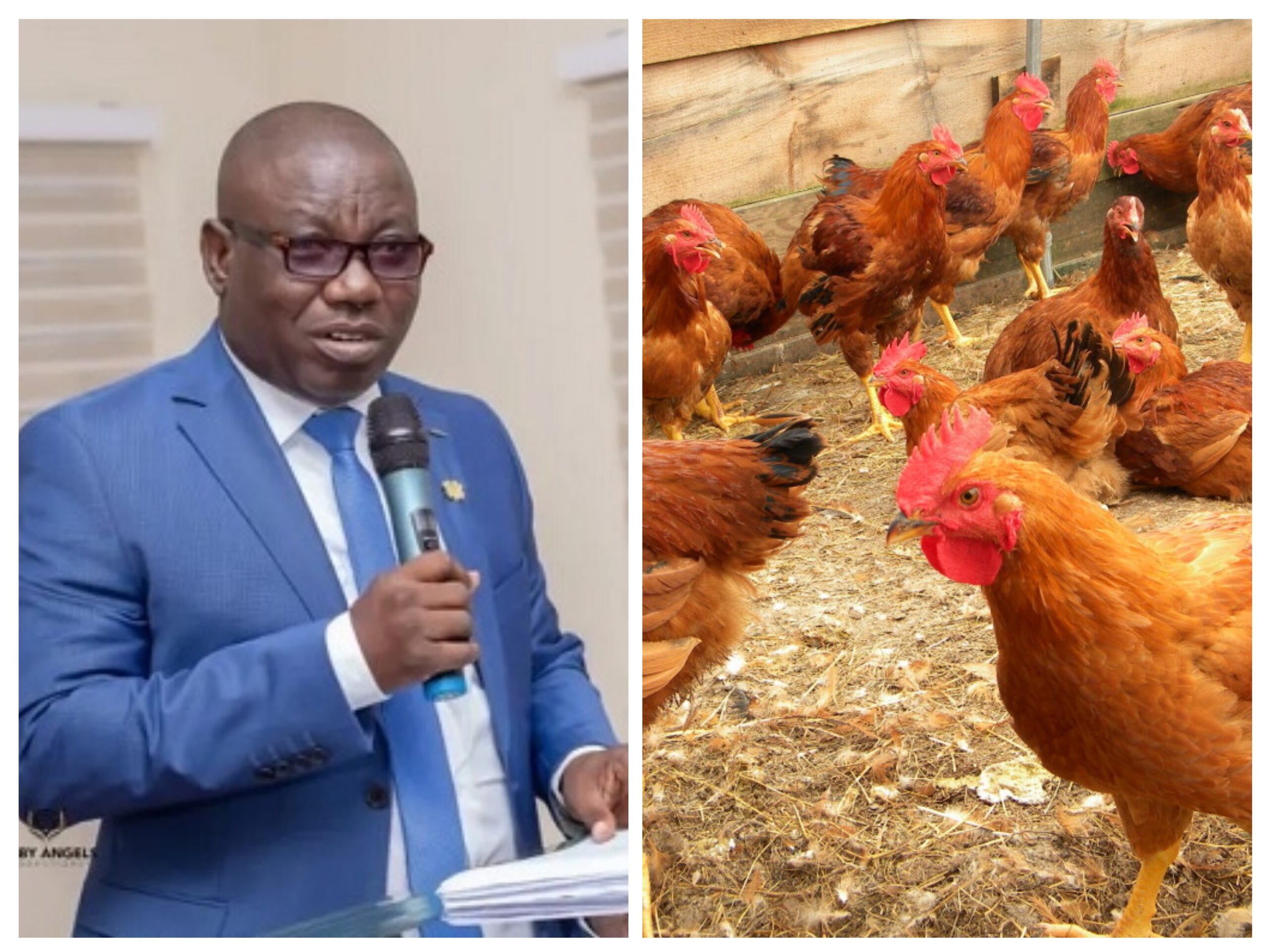
Government Strengthens Support for Local Poultry Industry to Cut $300Million Chicken Imports Annually– Adongo

0
166

The Government of Ghana has renewed its commitment to strengthening the local poultry industry as part of a strategic plan to reduce the country’s heavy reliance on imported chicken, according to Hon.Isaac Adongo, Member of Parliament for Bolgatanga Central and a board member of the Bank of Ghana.

$300 Million Spent on Imported Chicken Annually

Speaking on GHOne TV on Monday, March 3, 2025, Hon. Adongo revealed that Ghana spends over $300 million every year importing chicken from abroad. This massive expenditure, he said, is draining the economy and creating unnecessary pressure on the country’s foreign exchange reserves.

To tackle this, the government is implementing policies to boost local poultry production, aiming to make the sector competitive and ultimately reduce imports.

Supporting Farmers and Strengthening Supply Chains

Hon. Isaac Adongo

Hon. Isaac Adongo

Gov.

As part of the renewed strategy, government will support poultry farmers with better access to affordable credit, improved feed production, veterinary services, and modern poultry farming technologies. These interventions are designed to enhance productivity, reduce costs, and ensure the local industry can meet domestic demand.

According to Hon. Adongo, the goal is to create a self-sufficient poultry sector that can supply high-quality chicken products at competitive prices, reducing the need for imported frozen chicken from Brazil, the United States, and Europe.

Poultry Industry as a Key Economic Driver

The local poultry sector has the potential to create thousands of jobs, especially for youth and women in both urban and rural communities. By investing in the poultry value chain — including hatcheries, feed mills, and processing plants — the government hopes to boost employment and promote food security.

Calls for Public Support

Hon. Adongo further called on Ghanaians to actively support local poultry producers by prioritizing the purchase of locally produced chicken. He stressed that consumer confidence in Ghanaian poultry will be critical to sustaining the industry’s growth and reducing the country’s reliance on imports.

Reflections

With Ghana’s poultry sector historically plagued by challenges such as high production costs, competition from cheaper imports, and weak market linkages, the government’s latest intervention seeks to build a sustainable, resilient, and competitive poultry industry capable of feeding the nation and supporting the economy.

Also Read: ‘Daughter of a Murderer ‘: Speaker Bagbin Issues Ultimatum Over Insult Targeted at Zanetor Rawlings

Author

  • Daniel Ablordey

    Daniel Ablordey is a Business Analytics student at the University of Ghana Business School and an emerging strategist at the intersection of data, markets, and narrative. With a keen analytical mind and a passion for African business and economic trends, he is building a career focused on translating complex data-driven insights into accessible, decision-relevant stories that matter.

    As a writer and editor with Insight Ghana, African Business Insight, and The African Journal, Daniel delivers sharp, high-impact analysis on current affairs, business developments, and emerging trends across the continent. His work is defined by precision, clarity, and a deep commitment to responsible journalism — ensuring that every story he tells is not only accurate but meaningful to the audiences it serves.

    Beyond his editorial work, Daniel serves as an Ecobank Youth Ambassador, where he actively promotes financial inclusion, digital banking, and financial literacy among young Ghanaians. His leadership experience spans academic, professional, and faith-based institutions, where he has consistently driven initiatives centered on growth, structure, and long-term impact.

    Grounded in the principles of Pan-Africanism and service, Daniel brings a rare combination of analytical rigour and storytelling depth to his work. Whether unpacking market behavior, profiling emerging business leaders, or covering cultural shifts shaping the continent, he approaches every assignment with strategic intent and editorial integrity.

    His broader ambition is to contribute to Africa's transformation by shaping how data, business, and storytelling intersect — not just locally, but on a global stage.

Previous article‘Daughter of a Murderer ‘: Speaker Bagbin Issues Ultimatum Over Insult Targeted at Zanetor Rawlings
Next articleBreaking: MTN Stock Price Hits Record High on Strong Revenue Growth, Boosting Investor Confidence
Daniel Amenyo Ablordey
Daniel Ablordey is a Business Analytics student at the University of Ghana Business School and an emerging strategist at the intersection of data, markets, and narrative. With a keen analytical mind and a passion for African business and economic trends, he is building a career focused on translating complex data-driven insights into accessible, decision-relevant stories that matter.

As a writer and editor with Insight Ghana, African Business Insight, and The African Journal, Daniel delivers sharp, high-impact analysis on current affairs, business developments, and emerging trends across the continent. His work is defined by precision, clarity, and a deep commitment to responsible journalism — ensuring that every story he tells is not only accurate but meaningful to the audiences it serves.

Beyond his editorial work, Daniel serves as an Ecobank Youth Ambassador, where he actively promotes financial inclusion, digital banking, and financial literacy among young Ghanaians. His leadership experience spans academic, professional, and faith-based institutions, where he has consistently driven initiatives centered on growth, structure, and long-term impact.

Grounded in the principles of Pan-Africanism and service, Daniel brings a rare combination of analytical rigour and storytelling depth to his work. Whether unpacking market behavior, profiling emerging business leaders, or covering cultural shifts shaping the continent, he approaches every assignment with strategic intent and editorial integrity.

His broader ambition is to contribute to Africa's transformation by shaping how data, business, and storytelling intersect — not just locally, but on a global stage.