

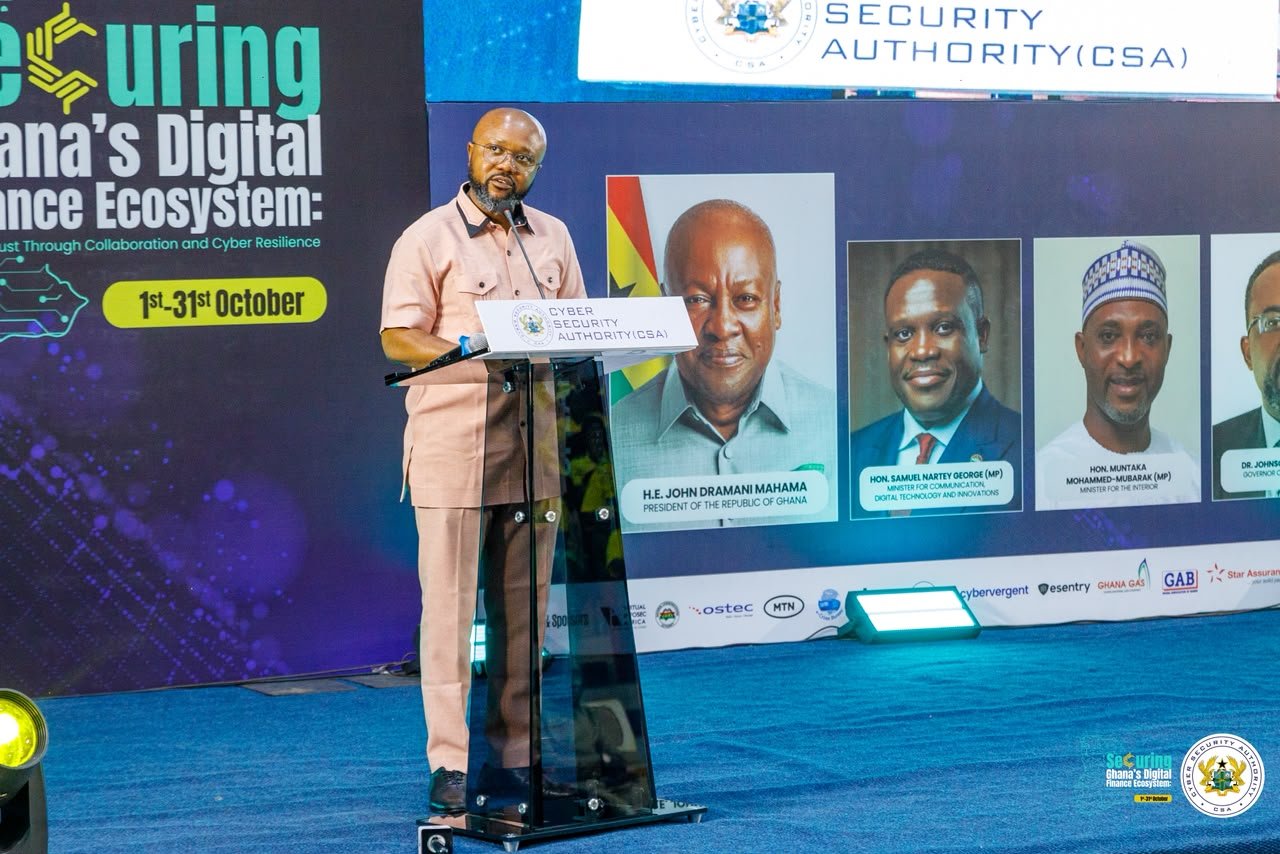
The Bank of Ghana is strengthening cybersecurity measures across the financial sector as the rapid growth of mobile money and digital payments creates new opportunities for fraud and other cyber threats.
Speaking on behalf of Governor Dr Johnson Pandit Asiama during the 2026 National Cyber Security Awareness Month, Daniel Sowah Klu, Acting Head of Cyber and Information Security at the Bank of Ghana, said the growth of digital finance must be matched by stronger systems for protecting customers, financial institutions and the wider economy.
Mobile money has become a major part of Ghana’s financial system. Bank of Ghana data show that the balance on mobile money float reached GH¢39.6 billion in 2025, up 45.6% from GH¢27.2 billion in 2024. Registered mobile money customer accounts also increased to 80.5 million, while transaction value rose by 50.8% to GH¢4.54 trillion.

The latest figures cited during the National Cyber Security Awareness Month point to continued growth in 2026, with mobile money float reaching about GH¢40 billion in June across more than 85 million registered accounts.
The scale of the digital financial system means that cybersecurity is increasingly tied to everyday economic activity. Mobile money accounts are used for payments, transfers, savings, business transactions and other financial services, putting large amounts of customer funds and personal information into digital systems.
But the expansion has also been accompanied by a rise in fraud.
The Cyber Security Authority said fraud cases reported across banks, specialised deposit taking institutions and payment service providers increased by 48% in 2025, rising from 16,733 cases in 2024 to 24,778 cases. The total value at risk exceeded GH¢101 million.
Fraud involving payment service providers was particularly significant. The CSA reported that electronic fraud incidents in that segment increased by 54%, while the value at risk rose by 95%, from GH¢19 million to GH¢37 million.
The broader cyber threat is also growing. Between January and July 2026, Ghana’s Computer Emergency Response Team recorded 3,876 cybersecurity incidents, with 1,818, or about 47%, linked to online fraud.
Klu said the response requires more than simply warning customers about scams. Financial institutions, regulators, technology companies and law enforcement agencies need systems that can detect threats, share information and respond quickly when attacks occur.
The Bank of Ghana has therefore revised its Cyber and Information Security Directive, replacing the framework introduced in 2018. The new CISD 2026 was designed to reflect changes in the financial sector, including the growing use of artificial intelligence, cloud computing, fintech platforms and digital data systems.

One of the major changes is the introduction of governance requirements for artificial intelligence and machine learning. Financial institutions using AI for areas such as fraud detection, credit scoring, customer interaction and other core processes are required to establish controls covering security, transparency, fairness, monitoring and accountability.
The directive also addresses cloud computing and data protection. The Bank of Ghana has said it does not support the wholesale movement of core systems or sensitive financial data to cloud platforms. Under the framework, sensitive customer and financial information must remain subject to Ghana’s data sovereignty requirements, while cloud use for non-sensitive services must follow a risk-based and approved approach.
The revised framework expands cybersecurity oversight beyond traditional universal banks. It brings savings and loans companies, microfinance institutions, fintechs and other relevant financial sector participants into a broader coordinated security structure.
The Bank of Ghana is also strengthening the Financial Industry Command Security Operations Centre, or FICSOC. Under the Cybersecurity Act, 2020, FICSOC serves as the sectoral Computer Emergency Response Team for Ghana’s financial industry, giving the central bank a formal role in coordinating responses to cyber threats.
The central bank has further indicated that it is investing in investigative and intelligence capabilities to support the fight against financial fraud. A digital forensic laboratory is being used to support investigations and evidence gathering, while work is also underway on an industry-wide fraud intelligence system to improve information sharing among financial institutions and relevant authorities.
The need for stronger intelligence sharing has become more urgent as fraudsters adopt increasingly sophisticated techniques. The Cyber Security Authority has warned that artificial intelligence is making scams more convincing through tools such as voice cloning, impersonation and social engineering.

The government and financial regulators have consequently placed greater emphasis on collaboration. The 2026 National Cyber Security Awareness Month, running throughout October under the theme “Securing Ghana’s Digital Finance Ecosystem: Building Trust Through Collaboration and Cyber Resilience”, brings together the Cyber Security Authority, Bank of Ghana, financial institutions, law enforcement agencies, technology companies and other stakeholders.
The initiative also reflects a shift in how cybersecurity is viewed within Ghana’s financial sector. Bank of Ghana officials have argued that cyber protection can no longer be treated solely as an information technology responsibility. The revised directive places greater emphasis on board-level accountability and requires financial institutions to build cybersecurity into governance and risk management.
For consumers and businesses, the challenge is becoming more immediate as digital payments become a larger part of everyday transactions. The value moving through mobile money and other electronic channels means that a successful cyberattack can affect not only individual customers but also merchants, financial institutions and confidence in the wider digital economy.
Ghana’s financial sector is therefore facing a race between digital expansion and security. The country is adding millions of digital accounts and moving trillions of cedis through electronic payment systems, while regulators and financial institutions work to ensure that the infrastructure supporting that growth can withstand increasingly sophisticated attacks.
The Bank of Ghana’s revised directive, stronger industry monitoring and new forensic and intelligence capabilities are intended to close that gap. The effectiveness of those measures will ultimately depend on how consistently financial institutions implement them and how quickly the sector can share information when new threats emerge.