


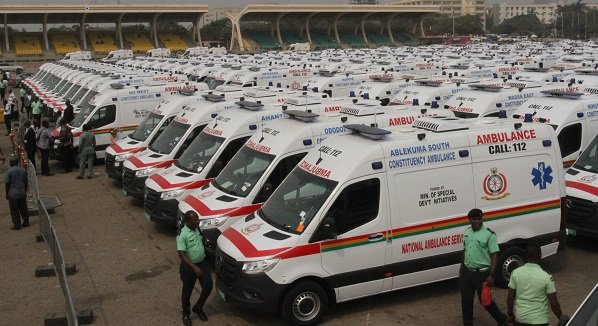
The National Ambulance Service (NAS) says it continues to respond to more than 300 emergency cases daily across Ghana despite challenges affecting the availability of some ambulances.
The Service said it remains operational in all 16 regions, with the national emergency number, 112, available around the clock to provide access to emergency medical response services.
NAS made the disclosure in a statement issued on Monday, September 21, 2026, following an investigative report by GHOne TV on the state of emergency medical response in the country.
The report raised concerns about the condition and availability of some ambulances, including vehicles that were reportedly grounded and unavailable for emergency operations. Editorial Standards
In its response, the National Ambulance Service acknowledged footage showing a number of ambulances that were not operational. However, management explained that most of the vehicles captured in the report had either been involved in road traffic accidents or were awaiting major repairs at the Service’s central workshop.
The Service said the current fleet challenges should be considered within the context of the operational demands placed on its ambulances over several years.
According to NAS, 307 Mercedes-Benz ambulances procured in January 2020 have been operating continuously across the country.
The vehicles have subsequently been exposed to heavy use, mechanical faults, normal wear and tear, as well as road traffic accidents.
The Service said these factors have contributed to some ambulances being temporarily removed from active duty while repairs are carried out.
“Despite these challenges, NAS remains operational in all 16 regions and continues to respond to an average of over 300 emergency cases daily nationwide,” the statement said.
The figure highlights the scale of demand placed on Ghana’s pre-hospital emergency care system, where ambulances are expected to provide rapid transportation and medical assistance to patients in critical situations.
The availability of functional emergency vehicles is particularly important because delays in pre-hospital care can affect patients requiring urgent treatment for road crashes, medical emergencies and other life-threatening conditions.
Efforts to address ambulance availability
NAS said it is working with the Ministry of Health to expedite the procurement of spare parts required to return grounded ambulances to service.
The Service is also seeking to operationalise regional maintenance centres as part of efforts to reduce the amount of time vehicles spend out of service.
Currently, the central workshop plays an important role in handling major repairs, but the planned regional maintenance arrangements are expected to bring some maintenance capacity closer to operational stations.
According to NAS, improving maintenance systems is necessary to ensure that ambulances can be repaired more quickly and returned to frontline operations. Editorial Standards
The Service’s response comes amid broader concerns about the sustainability of emergency medical services and the need to ensure that Ghana’s ambulance fleet remains capable of meeting growing demand.
Beyond vehicles and equipment, NAS also disclosed measures aimed at strengthening the clinical capabilities of its emergency medical personnel.
The Service said it is implementing a clinical competency enhancement programme for Emergency Medical Technicians (EMTs), including training in intravenous therapy.
The programme follows gaps identified through recent inquiries and is intended to strengthen the ability of emergency personnel to provide appropriate care to patients before they reach health facilities.
Such training forms part of the broader pre-hospital emergency care system, where EMTs can play an important role in stabilising patients during transportation.
NAS welcomes investigative report
Despite the concerns highlighted by the GHOne TV report, NAS management said it welcomed the investigation and viewed scrutiny of the emergency response system as important.

The Service said it remains committed to transparency and accountability while working to improve the quality of pre-hospital emergency care available to the public.
Management also reiterated its commitment to providing timely, safe and efficient emergency medical services to people across the country.
The statement provides a response to concerns surrounding grounded ambulances while acknowledging that fleet availability remains an operational challenge.
For members of the public, the Service’s continued operation across all 16 regions means the 112 emergency number remains available 24 hours a day, seven days a week. Newscard
NAS’s response also suggests that addressing the fleet challenge will require both the restoration of existing ambulances and longer-term investment in maintenance systems, spare parts and emergency medical personnel.
As the Service works with the Ministry of Health to improve maintenance capacity, the effectiveness of those measures will be important in determining how quickly grounded vehicles can return to the roads.
The National Ambulance Service has therefore sought to reassure the public that, despite challenges affecting parts of its fleet, emergency response operations remain active nationwide.
With more than 300 emergency cases reportedly handled on an average day, maintaining sufficient numbers of functional ambulances and adequately trained personnel remains central to the country’s emergency medical response system.