


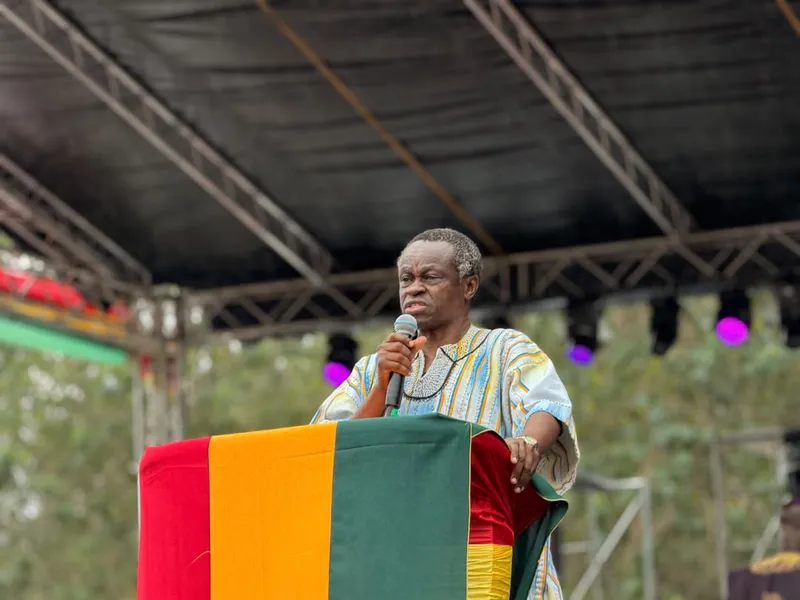
Kenyan lawyer, academic and Pan-Africanist Professor Patrick Loch Otieno Lumumba has called for renewed efforts to advance Osagyefo Dr Kwame Nkrumah’s vision of a united, self-reliant and prosperous Africa.
Prof Lumumba made the call while delivering the keynote address at the 2026 NkrumahFest at Nkroful in the Ellembelle District of the Western Region.

The festival, held under the theme “Nkrumah @ 117: Celebrating His Enduring Legacy — Africa Must Unite or Perish,” brought together political leaders, academics, traditional authorities, young people and Pan-Africanists to reflect on Nkrumah’s contribution to Ghana and the wider African continent.
Ghana’s independence was only the beginning
Prof Lumumba said Nkrumah’s approach to Ghana’s independence was different from that of many of his contemporaries because he viewed national freedom as part of a much broader struggle for African liberation.
He noted that although countries such as Liberia, Egypt, Morocco, Sudan and Ethiopia had attained varying degrees of independence or resisted colonial rule, Nkrumah explicitly linked Ghana’s independence to the freedom of the entire continent.
“On the 6th day of March 1957, the Osagyefo Kwame Nkrumah said that Ghana was free, but the independence of Ghana meant nothing if the rest of Africa was not free.”
According to Prof Lumumba, Nkrumah subsequently turned Ghana into a hub for liberation movements, providing a platform for political leaders and activists from across Africa and the diaspora.

He mentioned African leaders including Julius Nyerere of Tanzania, Milton Obote of Uganda, Kenneth Kaunda of Zambia, Hastings Banda of Malawi, Dawda Jawara of The Gambia and Jomo Kenyatta of Kenya.
He also cited anti-colonial figures such as Nelson Mandela, Robert Sobukwe, Sam Nujoma, Agostinho Neto, Eduardo Mondlane and Amílcar Cabral.
Beyond the continent, Prof Lumumba said personalities from the African diaspora, including W.E.B. Du Bois, George Padmore and Martin Luther King Jr., also visited Ghana and associated with the ideals promoted under Nkrumah.
“Ghana became a place of pilgrimage for all who were fighting for independence and the dignity of the people of Africa,” he said.
Africa still divided despite decades of independence
Prof Lumumba argued that one of the major aspects of Nkrumah’s vision that remains unfinished is the political and economic integration of Africa.
He recalled Nkrumah’s participation in the 1963 Addis Ababa conference, which led to the establishment of the Organisation of African Unity (OAU).
According to him, Nkrumah warned that Africa’s political independence would remain vulnerable without greater continental unity.
He said the continent’s continued division into separate countries, passports, visa regimes and communication systems demonstrated the challenges that remain.
“Today, we are still 54 countries with 54 passports. We still need visas to travel to countries within the continent of Africa,” he observed.
He also pointed to the cost and fragmentation of intra-African communication, arguing that technological advancement had not fully eliminated barriers between African countries.
Nkrumah’s ideas survived his overthrow
Prof Lumumba said Nkrumah’s influence had endured despite the 1966 military coup that removed him from office.
He argued that attempts to suppress Nkrumah’s ideas and writings following his overthrow could not eliminate his influence on debates about African unity and development.
“They thought that they had eliminated him, but like the phoenix before him, he is alive and well,” he said.
“That is why we say so very confidently, ‘Osagyefo never dies.’”
He said Nkrumah’s legacy should therefore go beyond annual commemorations and instead challenge present and future generations to act on the principles he championed.
Africa must prepare for new technologies
Turning to contemporary challenges, Prof Lumumba urged African countries to position themselves to benefit from emerging technologies, particularly artificial intelligence and the Fourth and Fifth Industrial Revolutions.
He expressed the hope that young Africans would develop technologies suited to the continent’s needs instead of remaining primarily consumers of innovations developed elsewhere.
He also identified the African Union’s Agenda 2063 and the African Continental Free Trade Area (AfCFTA) as existing frameworks through which aspects of Nkrumah’s vision for greater African integration could be pursued.
Prof Lumumba called for stronger economic integration and increased African production, saying the continent should be capable of meeting more of its own needs, from food and agricultural products to manufactured goods.
He also urged African countries to review their governance and economic systems to ensure that local resources and production contribute more directly to development.
“We are here to remind ourselves that work isn’t complete. We are here to remind ourselves that our governance systems must be reformed. We are here to remind ourselves that the continent of Africa will only be respected if we are united,” he said.
Young generation urged to carry the vision forward
Prof Lumumba also praised the intergenerational nature of the NkrumahFest, saying the participation of young people showed that Nkrumah’s ideas continue to attract interest beyond the generation that experienced his political career.
He singled out nine-year-old poet Ruqayyah, whose presentation at the event, he said, demonstrated how younger Africans could connect with Nkrumah’s legacy.
He urged the younger generation to take up the responsibility of advancing the principles of African dignity, self-belief, unity and collective development.
Prof Lumumba’s address ultimately framed NkrumahFest as both a commemoration of Ghana’s first President and an opportunity to examine the unfinished aspects of his Pan-African vision as Africa confronts contemporary political, economic and technological challenges.
By:Rachael Djabakie