

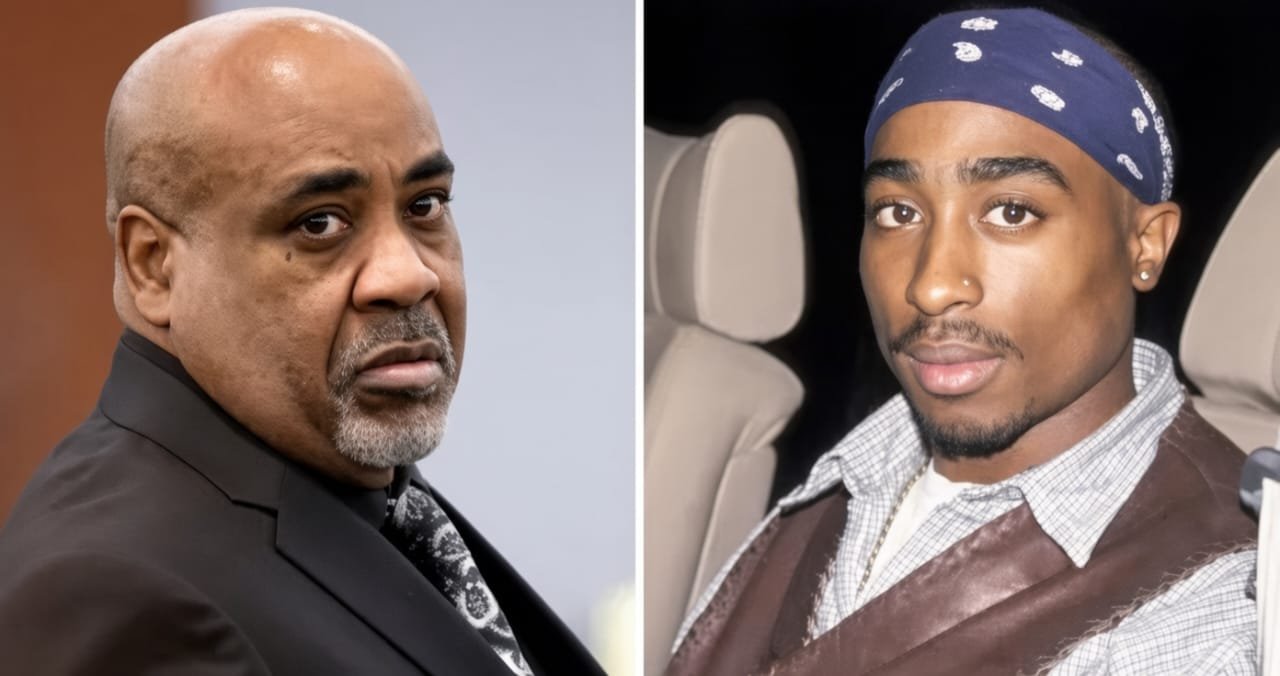
Former gang leader Duane “Keffe D” Davis has been found guilty of orchestrating the 1996 murder of legendary rapper Tupac Shakur, bringing a conviction to one of the most closely watched unsolved cases in hip-hop history.
A Las Vegas jury convicted the 63-year-old on one count of murder with a deadly weapon in connection with the drive-by shooting that claimed Shakur’s life on September 7, 1996.
Davis, dressed in a black suit, remained largely expressionless as the verdict was delivered in court. He later told the judge that he intended to appeal the conviction.
Prosecutors maintained that although Davis was not the person who pulled the trigger, he played a central role in planning the attack. They alleged that he ordered the shooting and provided the firearm used by his nephew, Orlando Anderson, to shoot Shakur.

Anderson, who had denied involvement in the killing, died in an unrelated shooting in 2008.
During the trial, jurors heard a recording of a 2008 police interview in which Davis acknowledged that he was inside the vehicle from which the shots were fired. However, he maintained that he did not fire the weapon himself.
Prosecutors argued that Davis organised the attack as retaliation after Anderson became involved in a physical confrontation with Shakur and members of his entourage in Las Vegas earlier that night.
Shakur was just 25 when he was fatally shot at the peak of his career. The rapper went on to become one of the most influential figures in hip-hop and has sold more than 75 million records worldwide.
His killing occurred during a period of heightened tension between East Coast and West Coast hip-hop artists, alongside longstanding conflicts involving the Bloods and Crips gangs.

The verdict brought an emotional reaction from Shakur’s family members, who held hands, embraced and cried inside the courtroom. His sister was seen hugging one of the prosecutors following the decision.
Outside the courthouse, Shakur’s supporters also reacted emotionally, with some cheering while others shed tears.
A major part of the prosecution’s case centred on Davis’ own statements about his involvement. He had repeatedly acknowledged that he was in the white Cadillac from which the fatal shots were fired.
Davis first disclosed details of his alleged involvement during a confidential 2008 police interview connected to the investigation into the death of fellow rapper The Notorious B.I.G., whose real name was Christopher Wallace.
He later provided further accounts of the incident in his 2019 memoir, Compton Street Legend, as well as in documentaries, podcasts and media interviews.

Prosecutors argued that Davis’ repeated public statements demonstrated his responsibility for the killing. Prosecutor Binu Palal urged jurors to believe Davis’ own accounts and convict him.
“For years,” Palal argued, Davis had been telling people “that he is responsible for Tupac Shakur’s murder” through documentaries, his memoir, podcasts and a police interview.
“He’s the shot caller – in every instance in every iteration he’s the leader of the South Side Crips,” Palal told the jury.
“When you have the shot caller sitting shotgun when shots are fired, there’s no doubt he’s responsible.”
Davis’ defence team, however, argued that his statements were exaggerated stories designed to build his reputation and generate income from his memoir and media appearances.

Defence lawyer Michael Sanft urged jurors to view Davis as an unreliable narrator who had fabricated stories for financial gain.
“There’s no proof,” Sanft told the jury.
The jury began deliberating on Monday and reached a guilty verdict within hours.
Following the verdict, Clark County District Court Judge Carli Kierny scheduled Davis’ sentencing for October 13.
As the court proceedings were coming to an end, Davis raised his hand and asked the judge for the return of some of his personal belongings, including his phone.
“I would like to appeal this matter,” Davis told the judge.
The judge explained that Davis could formally pursue an appeal after sentencing.
The conviction marks a major development in a case that remained unresolved for nearly three decades and generated numerous theories and conspiracy claims surrounding the death of one of rap’s most influential artists.
By: Prince Martey-Sogar