

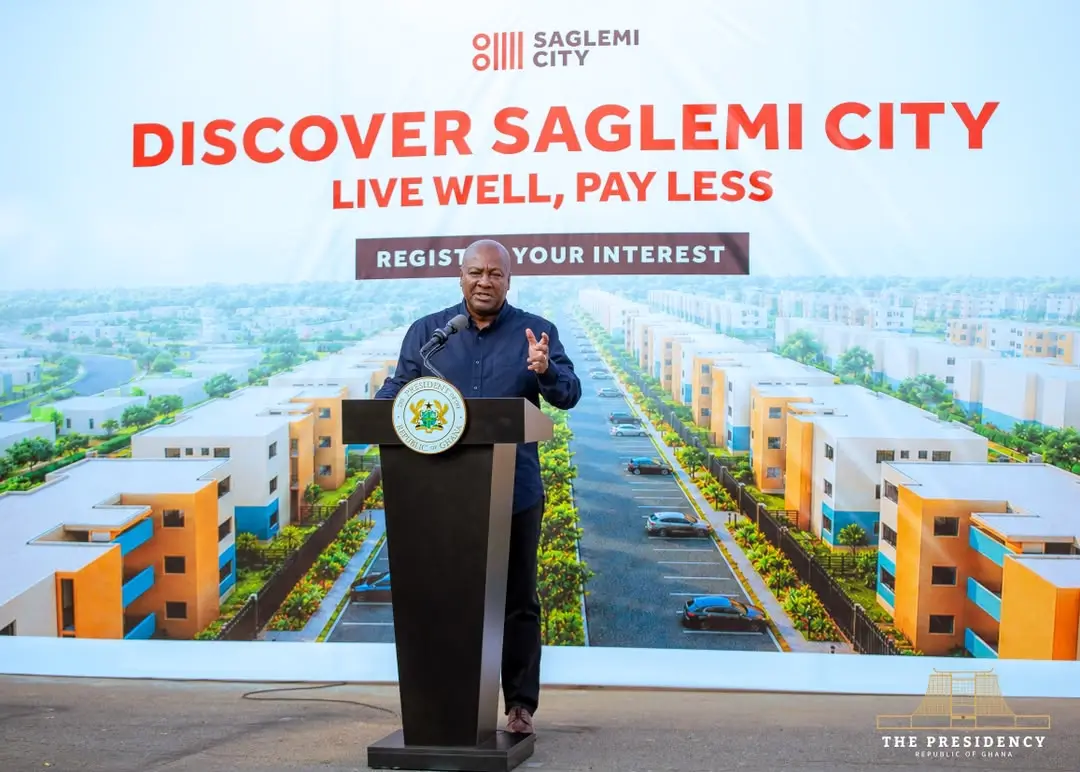
President John Dramani Mahama has announced that the first 700 housing units at the Saglemi Affordable Housing Project are expected to be completed and commissioned by March 2027, as government intensifies efforts to revive the long-delayed residential development.
The President further disclosed that the target is to complete a total of 1,500 housing units at the project by the end of December 2027, describing the development as an important component of government’s broader plans to create new residential and industrial communities along the Accra-Tema corridor.
President Mahama made the announcement during a tour of the Saglemi Housing Project in August 2026, where he inspected ongoing works and assessed progress being made by the private developer responsible for completing the project. The Saglemi Affordable Housing Project was initiated during President Mahama’s first administration as part of efforts to address Ghana’s housing deficit and provide affordable accommodation for workers and families.
However, the project became embroiled in controversy after a change of government, with questions raised about the execution and financing of the development. The project subsequently became the subject of investigations and a criminal justice process during the administration of the New Patriotic Party (NPP). The controversy and prolonged legal and administrative processes contributed to the project remaining incomplete for several years.

Speaking during the inspection, President Mahama said the prolonged inactivity had also exposed the development to significant deterioration and theft, leaving several of the completed structures without essential fittings and infrastructure. He said electrical cables, bathroom fittings, wash basins, baths, light bulbs and telecommunications cables were among items stolen from the project site during the period when the development was left unattended.
According to him, the scale of the theft meant that substantial work had to be undertaken to restore the housing units and prepare them for occupation. He said the government had subsequently agreed to work with the private sector to complete the development and bring the long-delayed project into productive use. “As the developer said, 700 units by March next year we will be able to commission. And another 1,000, actually a total of 1,500 by end of next year, by December next year,” President Mahama said.
He explained that the revival of Saglemi represented the continuation of a vision that began under the late President John Evans Fiifi Atta Mills and was later continued by his administration. “This was a vision that was started by Professor Atta Mills. And I came and continued it. Unfortunately, when government changed hands, there were some issues, legal issues. And the new government said they wanted to investigate,” he said.

President Mahama said the completion of the project would provide prospective homeowners with access to a modern residential community while also supporting the housing needs of workers in nearby industrial areas. He urged interested Ghanaians to be prepared to register when the official registration portal for the housing units is opened. The President said demand for the houses could be significant, particularly because of the proximity of Saglemi to several industrial developments around Tema and the Dawa Industrial Area.
He warned that if individual buyers did not register quickly enough, companies operating in the industrial corridor could acquire the available units for their employees. “It’s going to be a very conducive housing estate for occupation,” he said, adding that workers and families interested in living in the community would have an opportunity to acquire the houses once the registration process begins. President Mahama also highlighted plans to provide essential amenities and services to make the Saglemi community suitable for long-term occupation.
He said water supply would not be a major challenge because a water treatment plant located within the nearby Dawa Industrial Area has the capacity to produce more water than is currently required by the industrial park. According to him, part of the excess water would be supplied to the Saglemi estate, while additional water would be conveyed towards the Tema industrial area through collaboration with the Ghana Water Company Limited.

“All the things that were said are going to happen because I visited the water treatment plants when I came to catch sod for the solar plants. The industrial park is just next door. And it has a whole water treatment plant, which produces more water than the industrial park needs,” he said. The President also pointed to major road and railway infrastructure planned for the area, saying these projects would improve connectivity between the residential community, industrial centres and the Tema Port.
He noted that government was working on the dualisation of the road from the Saglemi area towards Aflao, with the first phase already under construction and the second phase from Central University having been awarded. He said the planned railway connection would serve both passengers and businesses by transporting people as well as containers and other goods from the Tema Port to industrial areas. “This is going to be a very major industrial and residential corridor,” President Mahama said.
President Mahama further explained that the Saglemi development forms part of government’s broader vision for the creation of a new city stretching from the area through Bundase and towards the Volta Lake. He said the Saglemi housing project and Dawa Industrial Park fit into the planned development because they combine residential accommodation with industrial and commercial activities.

“Because the new city is just stretching up from here through Bundase, where the military firing range used to be, all the way to the Volta Lake. And so that is the concept of the new city. So Saglemi fits into it very nicely. The Dawa Industrial Park fits into it very nicely,” he said.
The President expressed satisfaction with the partnership between the Ministry of Water Resources, Works and Housing and the private developer working to restore the project. He said he hoped the first batch of completed housing units would be commissioned around the Easter period following the Christmas completion target. Meanwhile, Chief Executive Officer and Chairman of LMI Holdings, Kojo Aduhene, said significant infrastructure works were currently underway across the Saglemi estate.
He said the developer was undertaking underground cabling, clearing overgrown vegetation and working to restore the infrastructure needed to make the community fully functional. “We’re doing all the underground cabling, clearing the weeds, and water will not be a problem because we’ve got a water plant ready in the Dawa Industrial Area and it’s enough to supply water for all the units,” Mr Aduhene said.

He also disclosed that internet connectivity would be made available across the estate, adding another layer of modern infrastructure to the residential development. The renewed construction at Saglemi marks a significant attempt to bring back into use a housing project that has remained largely incomplete for years.
If the current timeline is achieved, the completion and commissioning of the first 700 units by March 2027 would represent a major milestone in government’s efforts to revive the development, while the targeted 1,500 units by December 2027 could provide hundreds of families and workers with new housing opportunities. Beyond housing, the government is positioning the Saglemi project as part of a wider industrial, transport and urban development corridor linking communities and economic centres along the eastern part of Greater Accra.
The success of the project, however, will depend on the timely completion of the remaining infrastructure, effective management of the estate and the ability of the public-private partnership to maintain the development after the houses are occupied.
By: Philbert Amiba Ayuusah