

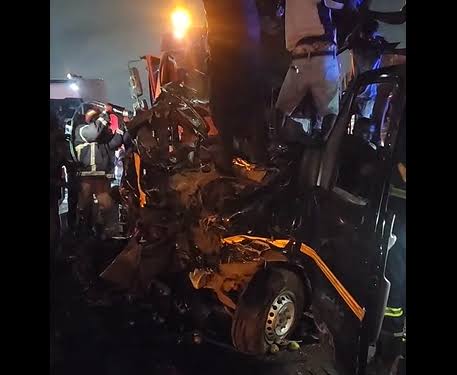
A devastating multi-vehicle collision at the Ofankor barrier area in Accra has claimed the lives of 11 people and left 13 others injured, according to the Ghana National Fire Service (GNFS).
The fatal accident occurred in the early hours of Thursday on the express lane of the N6 Highway, one of the busiest road corridors linking the Pokuase area to Achimota and central Accra. Emergency responders, including personnel from the Fire Service and the Ghana Police Service, were deployed to the scene to rescue victims, manage traffic and maintain order as motorists and residents gathered around the accident site.
According to preliminary information released by the GNFS, the crash involved four vehicles including two tipper trucks, a commercial minibus and a tricycle, popularly known as an “aboboyaa.” The collision occurred at approximately 4:00am on the stretch of road leading from Pokuase towards Achimota. The impact of the crash was severe, leaving several victims trapped inside the wreckage of the minibus, which suffered extensive damage. Rescue personnel described the vehicle as badly mangled, highlighting the force with which the vehicles collided.

Emergency teams worked for several hours to extricate trapped passengers and provide immediate medical assistance to survivors. The injured were subsequently transported to nearby health facilities for treatment, while the bodies of those who lost their lives were removed from the scene for preservation and identification.
The Ghana National Fire Service confirmed that 11 people died as a result of the crash, making it one of the deadliest road accidents recorded in the Greater Accra Region in recent months. Thirteen other persons sustained varying degrees of injuries.
Rescue operations continued well into the morning as firefighters used specialized equipment to cut through twisted metals to gain access to victims trapped inside the minibus. By approximately 8:45am, the GNFS announced that all trapped victims had been successfully extricated from the wreckage. The accident caused significant traffic disruption along the highway during the morning rush hour. With the express lane partially blocked by damaged vehicles and ongoing rescue efforts, motorists experienced long delays as traffic built up in both directions.

To ease the congestion and ensure the safety of road users, police officers redirected vehicles from the affected express lane onto the outer service lane. Traffic management teams remained at the scene throughout the morning, guiding motorists and preventing further incidents.
Eyewitnesses described scenes of chaos and distress immediately after the collision. Some residents and early-morning commuters reportedly rushed to assist victims before emergency responders arrived. The sound of sirens and the sight of heavily damaged vehicles attracted large crowds, prompting security personnel to establish a safety perimeter around the crash site.
Authorities have yet to determine the exact cause of the accident. However, investigators are expected to examine several possible factors, including speeding, driver fatigue, mechanical failure and visibility conditions at the time of the crash.
Road safety advocates have repeatedly raised concerns about the increasing number of fatal accidents on major highways across the country, particularly during the early morning hours when visibility is often reduced and traffic enforcement is limited. The Ofankor stretch of the N6 Highway is a critical transport route used daily by thousands of commuters and commercial vehicles traveling between Accra and surrounding communities.

The latest tragedy is expected to renew calls for stricter enforcement of road traffic regulations, enhanced driver education and improved monitoring of heavy-duty vehicles operating on Ghana’s highways.
Officials from the Ghana Police Service and the Motor Traffic and Transport Department (MTTD) are expected to conduct a detailed investigation into the circumstances surrounding the collision. Findings from the investigation will help determine responsibility and identify measures that can be implemented to prevent similar incidents in the future. Meanwhile, families of the victims have begun arriving at hospitals and morgues in search of information about their relatives. Authorities are working to identify all those affected and provide the necessary support to grieving families.
As investigations continue, the Ghana National Fire Service has urged motorists to exercise caution on the roads, adhere to speed limits and ensure that vehicles are roadworthy before embarking on journeys, particularly during the night and early morning hours.

The tragic accident has once again highlighted the human cost of road crashes in Ghana and underscored the urgent need for sustained efforts to improve road safety nationwide.
Philbert Amiba Ayuusah