

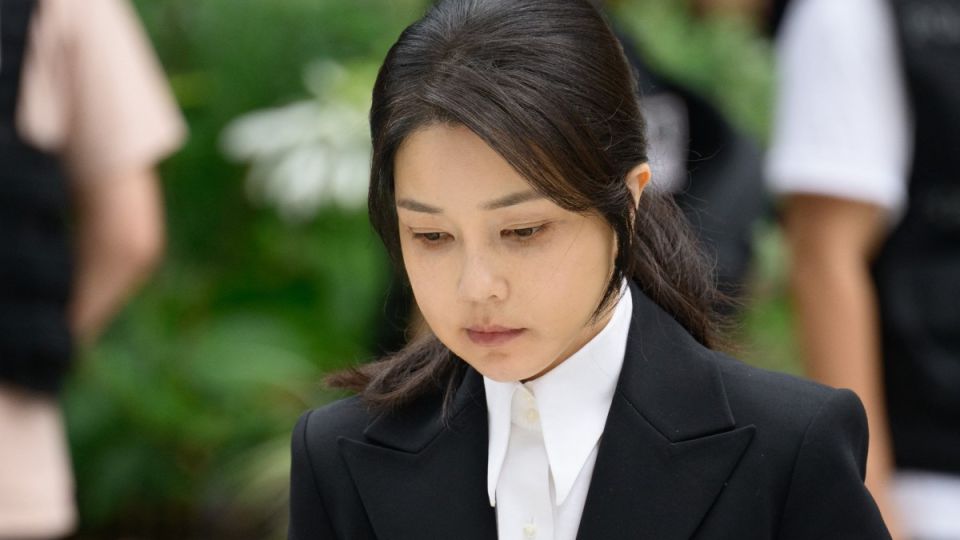
A Seoul court has sentenced former South Korean First Lady Kim Keon Hee to seven years in prison after finding her guilty of accepting luxury gifts, including a Dior handbag, expensive jewellery and other valuables, in exchange for political appointments and business favours while serving as the wife of former President Yoon Suk Yeol.
The Seoul Central District Court delivered the verdict on June 26, 2026, ruling that Kim abused her position as First Lady to broker appointments and influence government decisions for personal gain. In addition to the prison sentence, the court imposed a fine of 64.8 million won, approximately $47,000, and ordered the confiscation of luxury items linked to the bribery scheme where possible.
The court found that Kim accepted gifts worth nearly 300 million won, or about $217,000, from business executives and influential individuals seeking assistance with government appointments, parliamentary nominations and commercial interests. Among the items presented as evidence were a Dior handbag, a Van Cleef & Arpels diamond necklace, a Tiffany brooch, a Vacheron Constantin watch, artwork by renowned Korean artist Lee Ufan, and other luxury valuables.

Presiding Judge Cho Soon-pyo said Kim repeatedly accepted gifts that “ordinary citizens would hardly encounter during their lives” and exploited her privileged position as First Lady to exchange influence for personal benefit. The court described the case as one in which public office had effectively become a tool for private gain, undermining fairness in government appointments and damaging public confidence in state institutions.
Prosecutors argued that the gifts were not simple tokens of appreciation but were directly connected to requests for employment opportunities, parliamentary nominations and business advantages. Evidence presented during the trial showed that several businessmen and influential figures allegedly sought Kim’s assistance in securing appointments for relatives or advancing commercial interests through her proximity to the presidency.
Kim’s defence rejected the allegations throughout the proceedings, insisting that some of the gifts were exchanged through personal relationships while others had no connection to official duties or government decisions. Her legal team argued that prosecutors failed to prove a direct link between the luxury items and any specific political favour. Following the verdict, her lawyers announced plans to appeal, describing the ruling as based on an overly broad interpretation of influence peddling laws.

This latest conviction adds to Kim’s growing legal troubles. Earlier this year, she received a separate four-year prison sentence over stock manipulation and bribery linked to the Unification Church. The seven-year sentence announced this week relates to a different influence peddling case involving luxury gifts and official appointments, meaning she now faces multiple convictions arising from separate corruption investigations.
The ruling comes amid one of the most dramatic political crises in modern South Korean history. Kim’s husband, former President Yoon Suk Yeol, was removed from office following his controversial declaration of martial law in late 2024. He was subsequently convicted and sentenced to life imprisonment after courts found him guilty of rebellion and related offences connected to the failed attempt to impose military rule.
South Korea has earned a reputation for aggressively prosecuting senior political figures regardless of their previous status. Several former presidents, ministers and high-ranking officials have faced criminal investigations, convictions and prison sentences over corruption and abuse of office, reflecting the country’s strong judicial approach to public accountability. Analysts say the conviction of Kim Keon Hee further reinforces that tradition, demonstrating that even those closest to the country’s highest office remain subject to criminal prosecution.

The conviction is also expected to influence ongoing debates in South Korea about political ethics, transparency and the role of presidential spouses. Critics have long argued that informal influence exercised by family members of political leaders should be subject to greater oversight, while supporters of the prosecution believe the judgment sends a strong message that personal relationships cannot be used to secure public appointments or business advantages.
Kim remains in custody as the appeal process moves forward. Unless a higher court overturns or reduces the sentence, she will continue serving prison time while the confiscation of the luxury gifts and payment of the financial penalty are enforced under the court’s order.
Woman arrested over alleged TikTok threats against President Mahama