

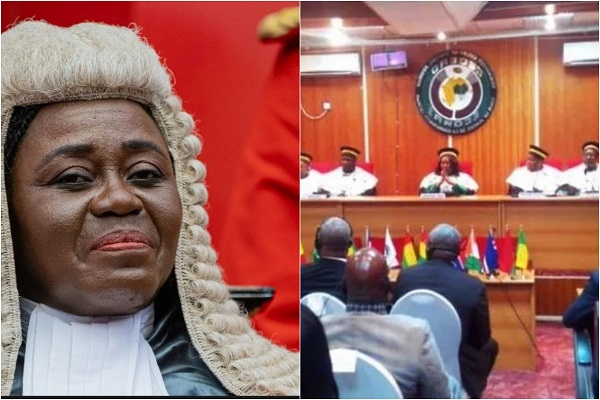
The ECOWAS Court of Justice has ruled in favour of Ghana, dismissing all claims brought by former Chief Justice Gertrude Araba Esaaba Sackey Torkornoo over her suspension and removal from office, in a judgment that firmly upholds the country’s constitutional process and rejects allegations of human rights violations.
In a decisive ruling delivered today, the regional court found that Ghana did not violate any of Torkornoo’s rights throughout the process that led to her suspension and eventual removal as Chief Justice. The court consequently rejected her demand for 10 million dollars in damages, ruling that she was not entitled to any compensation.
The case, which had drawn significant attention across Ghana and the West African sub region, was argued on behalf of the Republic of Ghana by Deputy Attorney General Dr Justice Srem Sai, while the former Chief Justice was represented by prominent Nigerian lawyer and Senior Advocate of Nigeria, Femi Falana.

Delivering its judgment, the ECOWAS Court addressed each of the major claims raised by Torkornoo and dismissed them comprehensively, concluding that the procedures followed by the Ghanaian authorities were lawful, proportionate and consistent with both domestic and regional legal standards.
On the issue of her suspension, the court held that it did not violate her right to work, rejecting her argument that the decision was arbitrary or motivated by ill will. The judges ruled that the suspension was carried out within the framework of Ghana’s constitutional provisions governing the removal of superior court judges.
The court further determined that Torkornoo was not arbitrarily dismissed from office. It found that due process had been observed throughout the proceedings, including the establishment of a committee to investigate petitions against her under Article 146 of the 1992 Constitution.
One of the more contentious arguments raised by Torkornoo was that her membership in the Supreme Court, Court of Appeal and High Court required separate removal processes. The ECOWAS Court dismissed this position, describing it as “absurd.” The court clarified that her membership of these courts flowed directly from her position as Chief Justice, and therefore ceased once she was no longer in that role.

The court also rejected her claim that the investigative committee acted unlawfully by focusing on only one of the petitions against her instead of addressing all three. In its reasoning, the court stated that the committee acted prudently and within the bounds of judicial economy, indicating that it was not necessary to examine every petition where sufficient grounds already existed.
On allegations of undignified treatment during the proceedings, including claims that she was subjected to a search and that her family members were excluded from hearings, the court ruled that the measures taken were lawful and proportionate. It emphasised that such actions were part of legitimate efforts to secure the proceedings and did not amount to rights violations.
The ECOWAS Court further dismissed her claim that her rights were violated when the removal proceedings continued despite her application for provisional measures to halt the process. The judges held that Ghana was within its rights to proceed with the constitutional process.
On the issue of access to information, the court ruled that Ghana did not violate Torkornoo’s right to receive details of the proceedings. It noted that although she was entitled to request the full report, she failed to demonstrate that she had formally requested it before taking the matter to the ECOWAS Court.

In a moment that drew attention in the courtroom, Femi Falana reportedly reacted strongly after the judgment, making remarks suggesting that the ruling would discourage judges in the sub region from ruling against their governments. The ECOWAS Court described his comments as “unacceptable” and stated that it did not expect such conduct from a lawyer of his standing.
The court, on the other hand, commended the submissions made by Ghana’s legal team, indicating that it found the arguments presented by Deputy Attorney General Justice Sai persuasive and consistent with the law.
The ruling marks a significant legal and political milestone, effectively closing a major chapter in the controversy surrounding Torkornoo’s removal and reinforcing Ghana’s position that its constitutional procedures were properly followed.
Legal analysts say the judgment will likely strengthen the authority of domestic constitutional processes within ECOWAS member states, while also clarifying the limits of regional court intervention in matters involving internal judicial discipline.
For Ghana, the outcome represents a strong validation of its legal framework and institutional processes. For the wider region, the decision is expected to serve as a reference point in future cases involving judicial removals and human rights claims at the regional level.
Suspended Chief Justice Torkornoo Drags Ghana to ECOWAS Court, Demands $10 Million Compensation