

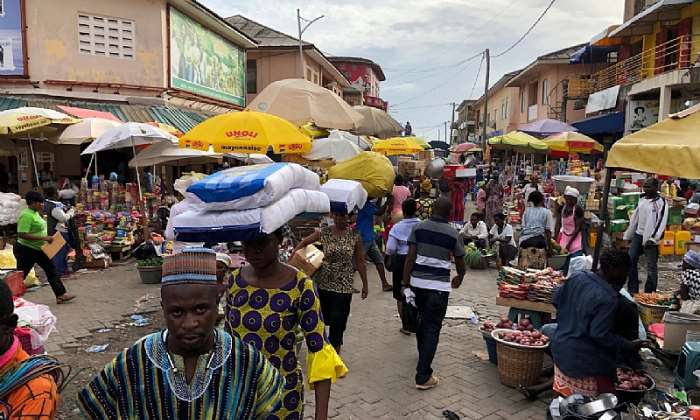
Ghana’s economy maintained its growth momentum in the first quarter of 2026, expanding by 6.4 percent compared to 6.2 percent during the same period in 2025, with the services sector emerging as the biggest contributor to economic activity and overall national output. The latest figures released by the Ghana Statistical Service indicate that the country’s recovery path remains on track, supported by strong performances in information technology, trade, transport, and mining.
According to the Ghana Statistical Service, the services sector accounted for nearly half of total economic growth during the quarter, cementing its position as the backbone of Ghana’s economy. The sector grew by 7.1 percent and contributed approximately 48.3 percent of overall Gross Domestic Product growth, outperforming its long term average and highlighting the increasing importance of service-based industries to the country’s economic transformation.
One of the standout performers was the Information and Communication Technology sector, which expanded by an impressive 25.2 percent year on year. The rapid growth reflects increasing digitalisation across businesses, financial services, telecommunications, and public institutions. Analysts say the expansion demonstrates how technology is becoming a major pillar of Ghana’s modern economy and a key source of employment and investment opportunities.

Transport and Storage also recorded strong growth of 13 percent during the period, benefiting from increased trade activity and improvements in logistics services. Meanwhile, Trade and Repair of Vehicles grew by 9 percent, reflecting steady consumer demand and business activity despite global economic uncertainties. Together, these sectors reinforced the broad-based nature of growth within the services industry.
The industrial sector also contributed significantly to the positive performance of the economy. Industry expanded by 6.9 percent, up from 4.1 percent recorded during the first quarter of 2025. The improvement was largely driven by a rebound in mining and quarrying activities, which recorded growth of 10.7 percent after several quarters of weaker performance. Ghana’s gold industry remained particularly strong, with gold production growing by 15.7 percent and continuing to play a crucial role in export earnings and foreign exchange generation.
The oil and gas sector also returned to positive territory, recording growth of 7 percent after previous contractions. Manufacturing maintained steady progress with a growth rate of 6.2 percent, while electricity production increased by a similar margin, providing further support to industrial output.

Agriculture continued to play an important role in the economy, although growth in the sector remained more moderate compared to services and industry. The sector contributed to overall economic stability through food production, employment generation, and rural livelihoods. Government statisticians noted that the balanced contributions from agriculture, industry, and services helped create a more resilient growth structure.
Another significant development was the continued expansion of the non-oil economy, which grew by 6.3 percent during the quarter. This suggests that Ghana’s economic growth is becoming less dependent on petroleum production and increasingly supported by diversified sectors such as technology, trade, mining, and services. Economists view this trend as a positive sign for long term economic sustainability.
The Ghana Statistical Service also highlighted improving price stability as a key factor supporting growth. The GDP deflator, a broad measure of inflation across the economy, declined significantly from 23.9 percent in the first quarter of 2025 to 4.1 percent in the first quarter of 2026. This suggests that economic expansion is increasingly being driven by real productivity gains rather than inflationary effects.

Nominal GDP reached approximately $30.5 billion during the quarter, while real GDP stood at approximately $4.2 billion. The figures underscore the continued resilience of Ghana’s economy despite global challenges, including geopolitical tensions, commodity market volatility, and uncertainty in international trade.
The latest data is likely to strengthen confidence among investors and development partners who have closely monitored Ghana’s economic recovery efforts. Analysts believe sustained growth in services, technology, and mining could further support job creation, private sector expansion, and government revenue mobilisation in the months ahead.
Ghana targets manufacturing boom as Mahama sets 15% GDP goal by 2030