


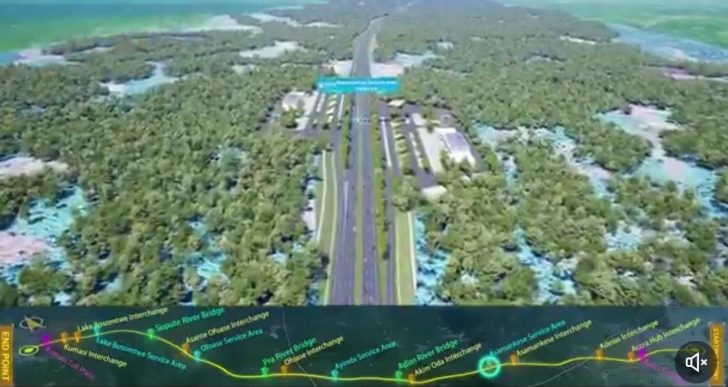
Ghana’s ambitious Accra-Kumasi Expressway project has recorded a significant early milestone, with about 51 kilometres of the designated corridor already cleared to make way for construction, according to the Finance Minister Dr Cassiel Ato Forson. The update signals steady physical progress on one of the country’s most high-profile infrastructure developments, even as compensation arrangements for affected landowners are being finalised.
The Finance Minister disclosed that the clearance work has been carried out largely by the Ghana Armed Forces, who were deployed to support the initial phase of the project. The exercise forms part of preparatory works ahead of full-scale construction of the expressway, which is expected to transform road transport between Ghana’s two largest cities, Accra and Kumasi.
According to official reports, compensation processes for individuals and communities affected by the project’s route are currently underway. The Minister indicated that payments are expected to begin in June once valuation and assessment exercises are completed by relevant state agencies. This means that while land clearance is progressing on the ground, government is simultaneously addressing one of the most sensitive aspects of large infrastructure projects: resettlement and compensation.

The Accra-Kumasi Expressway is designed as a modern, high-speed road corridor linking the capital city with Kumasi, the commercial hub of the Ashanti Region. Once completed, it is expected to significantly reduce travel time, ease congestion on the existing highway, and improve the efficiency of freight movement across the country’s economic heartland. Current estimates suggest the journey could be reduced to around two and a half hours, compared to the much longer travel times experienced on the existing route.
Preliminary project documents and feasibility assessments indicate that the expressway is expected to span close to 200 kilometres, incorporating multiple lanes, interchanges, and supporting infrastructure such as bridges and service lanes. The project is also being positioned as a major public-private partnership initiative, with government and investors expected to collaborate on financing, construction, and long-term maintenance.
The latest clearance milestone adds tangible momentum to a project that has been discussed for years in Ghana’s infrastructure planning cycle. While earlier stages focused largely on feasibility studies, approvals, and route alignment, the current phase marks the transition from planning to physical execution. Reports from project monitoring sources indicate that the cleared sections are part of a broader corridor that cuts through multiple communities, requiring careful coordination with traditional authorities and local residents.
The government has emphasised that compensation remains central to the project’s implementation strategy. Officials argue that timely and fair payments are necessary to avoid disputes, delays, and potential legal challenges that have affected similar infrastructure projects in the past. The Finance Minister’s assurance that compensation will begin after ongoing assessments is intended to signal commitment to transparency and due process.

However, large-scale infrastructure projects of this nature often come with competing concerns. While government highlights long-term economic benefits such as improved trade, reduced transport costs, and regional connectivity, affected communities typically focus on immediate issues including relocation, livelihoods, and valuation of property. Balancing these interests remains a key challenge for authorities as the project advances.
Security involvement through the Ghana Armed Forces in the clearance phase also reflects the strategic importance attached to the expressway. Officials have described the military’s role as supporting logistical and preparatory work, ensuring that land clearing is carried out efficiently while agencies complete administrative processes.
The Accra-Kumasi corridor is widely regarded as one of Ghana’s most economically important transport routes, linking agricultural regions, industrial zones, and urban markets. Economists have long argued that upgrading this corridor could significantly boost national productivity by reducing travel delays and improving supply chain efficiency.
At the same time, analysts note that the success of the project will depend not only on construction speed but also on financing sustainability, contractor performance, and governance transparency. Large infrastructure developments in West Africa have often faced cost overruns and delays, making project management a critical factor in determining long-term outcomes.

For now, the clearing of 51 kilometres represents a visible step forward, giving the project physical form beyond policy announcements and budget allocations. With compensation processes underway and further works expected to scale up, attention will now shift to how quickly construction can begin on the cleared sections and whether timelines can be maintained.
As Ghana pushes forward with its infrastructure expansion agenda, the Accra-Kumasi Expressway remains one of the flagship projects expected to define the country’s next phase of economic development, provided execution matches ambition.
Hon. Asenso‑Boakye Urges Mahama to Prioritize Accra‑Kumasi Road Dualisation Over New Expressway