

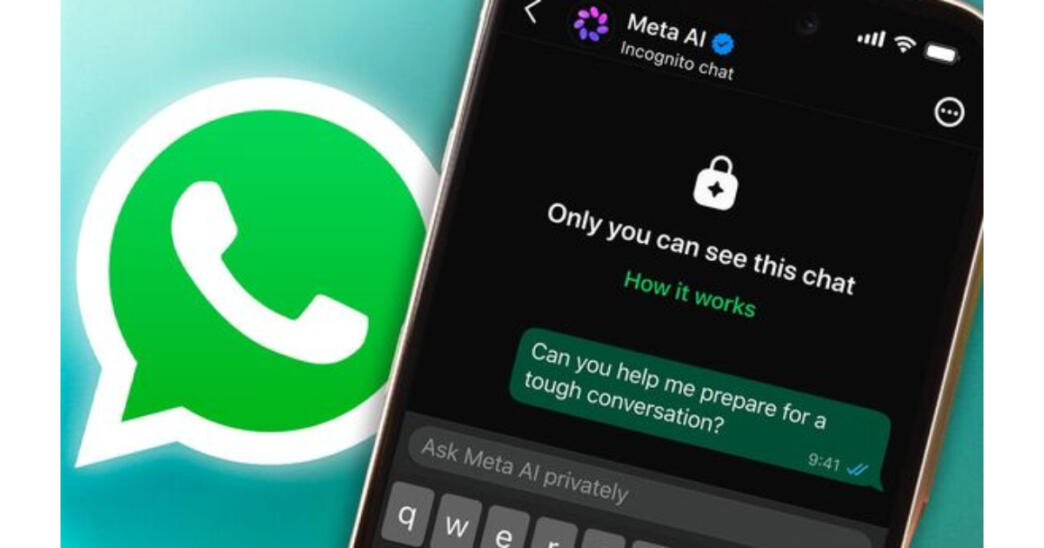
WhatsApp has introduced a new “incognito” mode for its AI chatbot, allowing users to hold private conversations that are designed to remain inaccessible even to the company itself, marking a major shift in how artificial intelligence interacts with user privacy.
The feature enables users to engage with WhatsApp’s AI assistant in a secure environment where messages are not stored, tracked, or used for training purposes. This development comes amid growing global concerns over how tech companies handle personal data, particularly in AI driven interactions where conversations can reveal sensitive information.
By embedding privacy at the core of its AI experience, Meta, the parent company of WhatsApp, is positioning itself to compete in an increasingly privacy conscious market. The move reflects a broader trend where users are demanding greater control over their data and more transparency in how it is used.

The incognito mode builds on WhatsApp’s existing end to end encryption framework, which already ensures that messages between users cannot be accessed by third parties. However, this new feature extends that philosophy to AI interactions, an area where privacy has often been less clear.
In practical terms, users can activate the incognito mode when interacting with the chatbot, ensuring that conversations are temporary and do not contribute to personalised advertising or AI model improvements. This is a significant departure from the typical AI model used by many platforms, where user interactions are often logged and analysed to improve system performance.
The introduction of private AI chats also highlights the growing tension between innovation and privacy in the tech industry. While companies are racing to deploy more advanced AI tools, they are simultaneously under pressure from regulators and users to ensure these tools do not compromise personal data.

For WhatsApp, the feature could strengthen user trust, particularly in regions where concerns about surveillance and data misuse are high. It also aligns with regulatory trends in markets such as the European Union, where stricter data protection laws are reshaping how digital platforms operate.
At the same time, the move raises important technical and business questions. AI systems typically rely on large volumes of data to improve accuracy and relevance. By limiting access to user conversations, platforms may face challenges in refining their models, potentially affecting the quality of responses over time.
However, the trade off appears intentional. Meta is betting that stronger privacy protections will attract more users to its AI ecosystem, even if it means slower model improvement compared to data intensive approaches used by competitors.
The feature also comes as messaging platforms evolve into multifunctional digital hubs, integrating communication, commerce, and AI assistance into a single interface. By ensuring that AI interactions remain private, WhatsApp is attempting to differentiate itself in a crowded market where trust is becoming a key competitive advantage.

Industry analysts view the introduction of incognito AI chats as a significant step toward redefining how artificial intelligence is deployed in consumer applications. It suggests that future AI tools may need to balance performance with privacy more carefully, rather than prioritising one at the expense of the other.
For users, the benefit is straightforward: greater confidence that their conversations, whether with other people or with AI, remain truly private. For the industry, it signals a shift toward more responsible AI deployment, where data protection is not an afterthought but a core feature.
As artificial intelligence becomes more deeply embedded in everyday digital experiences, the success of features like WhatsApp’s incognito mode could shape the next phase of innovation, where privacy is no longer optional but expected.