


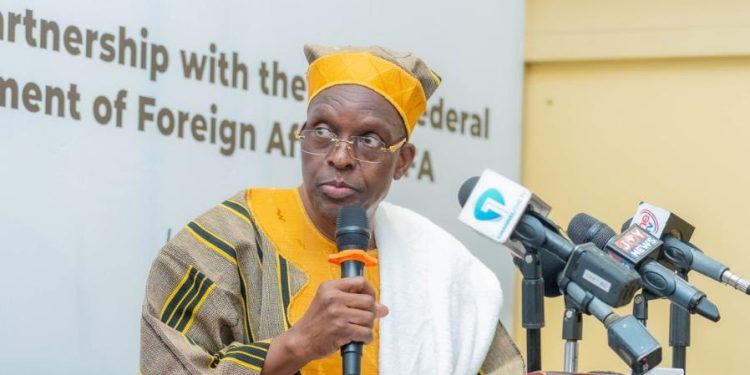
The Speaker of Parliament, Alban Sumana Kingsford Bagbin, has called for a decisive national shift that places Ghana’s local languages at the centre of education, governance, and everyday communication, warning that continued neglect could weaken cultural identity, reduce civic inclusion, and undermine long-term national cohesion.
His intervention has reopened a long-running national debate about the place of indigenous languages in Ghana’s development architecture, where English remains dominant across formal education, government administration, and professional communication. According to Bagbin, this imbalance is gradually disconnecting younger generations from their linguistic roots and weakening the cultural foundation that supports national identity.
Speaking on the role of language in shaping governance and identity, the Speaker stressed that local languages must no longer be treated as secondary instruments of communication. Instead, he argued they should be recognised as central pillars of national life, essential to how citizens understand policy, participate in democracy, and transmit cultural knowledge. He maintained that no country can meaningfully define its development path while marginalising the languages through which its people think and reason.
Bagbin’s position reflects a deeper concern about the gradual erosion of indigenous languages, particularly in urban centres where English has become the default medium in schools, workplaces, and social interactions. He warned that without deliberate and sustained policy intervention, several Ghanaian languages could lose relevance over time, along with the cultural knowledge systems embedded within them, including oral history, traditional governance practices, and indigenous knowledge frameworks.

The Speaker has consistently framed language not simply as a communication tool but as a matter of sovereignty and institutional identity. He has previously advocated for stronger integration of local languages within formal institutions, including Parliament, provided interpretation systems are strengthened to support multilingual deliberation. For him, the issue is not symbolic but structural, tied directly to how inclusive and representative governance truly is.
His latest remarks place renewed pressure on policymakers to reassess Ghana’s education structure, where local language instruction is often confined to early primary education before English becomes the dominant language of instruction. Education experts have long warned that this abrupt transition can affect comprehension levels, particularly among pupils in rural communities where English exposure outside the classroom is limited.
Bagbin’s call also highlights a broader governance challenge that extends beyond education policy. It reflects the persistent gap between policy design and implementation. Although Ghana’s curriculum formally includes local language instruction, its execution remains uneven due to limited teaching materials, insufficient trained teachers, and inconsistent enforcement across regions and school systems.
Beyond the classroom, the Speaker’s argument touches on civic participation and national integration. Language is a critical medium through which citizens access public services, understand government policies, and engage with democratic processes. When governance communication is concentrated in a language not universally understood, it risks excluding segments of the population and weakening participatory democracy.
The declining use of indigenous languages among younger generations, combined with their limited institutional presence beyond early education, continues to raise concern among cultural scholars and policy observers. They argue that Ghana’s linguistic diversity is gradually being reduced to cultural expression rather than a functioning part of national administration.

Bagbin’s intervention also aligns with a broader continental conversation about cultural preservation in the context of globalisation. Across Africa, governments continue to face the tension between adopting global languages for international competitiveness and preserving indigenous languages as carriers of identity, history, and social cohesion.
In Ghana’s case, the challenge is structural rather than symbolic. While multiple local languages are widely spoken across regions, there is no fully unified policy framework ensuring their consistent integration into governance, education, and public administration. This has created a dual system where local languages are culturally celebrated but institutionally underutilised.
The economic and social implications of this imbalance are significant. Stronger integration of local languages has the potential to improve learning outcomes, particularly at the foundational level of education, while also enhancing public understanding of policies and reducing communication barriers between the state and citizens. It could also strengthen social cohesion by making governance more accessible and inclusive.
However, achieving this shift would require more than political statements. It would demand sustained investment in curriculum reform, teacher training, educational materials, and institutional capacity building. It would also require long-term political commitment to treat language policy as a core development issue rather than a cultural afterthought.
Ultimately, Bagbin’s call underscores a fundamental governance question facing Ghana, whether development can be fully inclusive without linguistic inclusion. The answer to that question will determine not only the future of Ghana’s languages, but also the depth of its democratic participation and cultural resilience.
BoG gold deal losses expose weak safeguards in Ghana’s resource trading framework — Bright Simons