


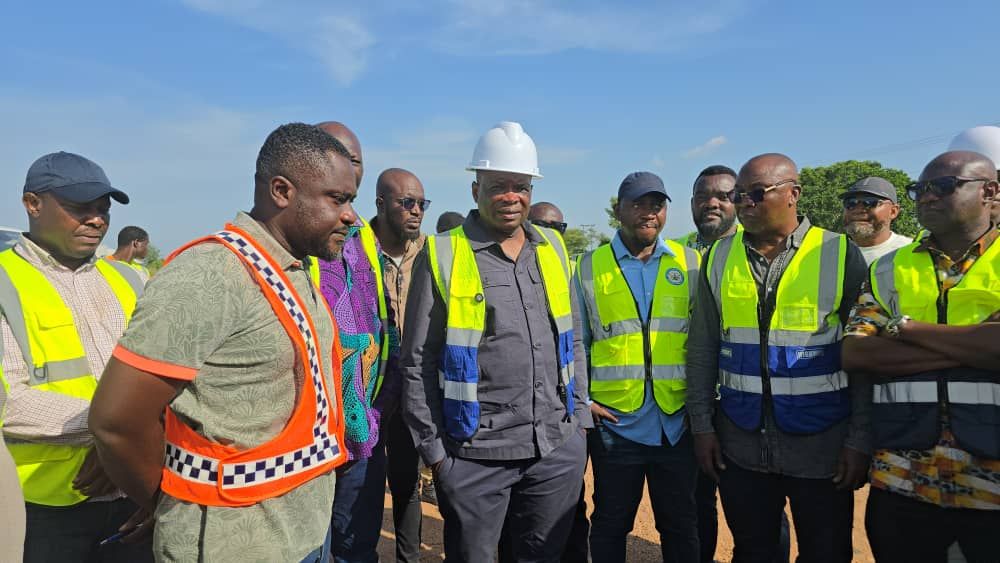
Ghana’s Roads and Highways Minister Hon Kwame Governs Agbodza has issued a firm warning to contractors under the government’s flagship “Big Push” infrastructure programme, signalling that underperforming firms risk having their contracts terminated if they fail to meet agreed timelines.
The directive comes as pressure mounts on the government to demonstrate progress on one of its most ambitious road development initiatives. The “Big Push” programme, designed to accelerate infrastructure delivery and improve road networks across the country, has faced scrutiny over delays, procurement concerns, and questions around execution capacity.
According to the minister, contractors engaged on various road projects must meet strict deadlines or face consequences, including possible termination of contracts. The warning reflects growing impatience within government over slow project delivery, particularly in cases where mobilisation has occurred but visible progress remains limited.
The intervention signals a shift from tolerance to enforcement. For months, concerns have been raised about the pace of work under the programme, with critics questioning whether the scale of contracts awarded aligns with the capacity of contractors to deliver within schedule. The latest stance suggests the ministry is now seeking to impose discipline on the execution phase of the programme.

At its core, the issue is not policy design but implementation. Ghana has consistently announced large scale infrastructure initiatives, but delivery has often lagged behind expectations. The “Big Push” programme, while ambitious in scope, now faces the same structural test that has affected previous projects, whether timelines can be enforced and outcomes delivered.
The economic implications are significant. Road infrastructure remains a critical enabler of trade, mobility, and regional integration. Delays in project completion not only increase costs but also limit the expected economic returns, particularly in areas where improved road access is linked to market expansion and productivity gains. For businesses and transport operators, stalled projects translate into higher operational costs and reduced efficiency.
The minister’s warning also highlights a broader governance concern within Ghana’s infrastructure sector. Contract enforcement has historically been inconsistent, with delays often tolerated without meaningful penalties. This has contributed to a cycle where project timelines are treated as flexible rather than binding. By threatening termination, the ministry is attempting to reset expectations and reinforce accountability within the contractor ecosystem.
However, the effectiveness of this approach will depend on follow through. Contract termination, while a strong signal, carries its own risks. Reassigning projects can introduce further delays, increase costs, and complicate project continuity. The challenge for government is to balance enforcement with practical delivery, ensuring that penalties do not inadvertently slow progress further.
There is also the question of procurement and contractor selection. Concerns raised in recent months about sole sourced contracts and the scale of awards under the programme have intensified scrutiny. Critics argue that ensuring transparency and aligning contract size with contractor capacity are essential to avoiding the very delays the ministry is now seeking to address.

Beyond the immediate programme, the development reflects a wider issue in Ghana’s public infrastructure management. Execution discipline remains a persistent weakness, often undermining otherwise well intentioned policy initiatives. Without consistent enforcement of timelines, clear performance benchmarks, and transparent oversight, infrastructure programmes risk underdelivering regardless of their scale or funding.
Regionally, the stakes are equally important. As African economies compete to attract investment and improve connectivity, the ability to deliver infrastructure efficiently has become a key differentiator. Ghana’s credibility in this space depends not only on the ambition of its projects but on its capacity to complete them on schedule.
The Roads Minister’s warning is therefore more than a routine directive. It is an acknowledgment that execution failures are no longer sustainable. Whether it translates into improved performance will depend on the consistency of enforcement and the willingness of authorities to act when deadlines are missed.
For contractors, the message is clear. Delivery is no longer optional. For government, the challenge is ensuring that this moment marks a shift in practice rather than another statement of intent.
Ghana’s finance minister and deputy publicly file tax returns to encourage compliance