

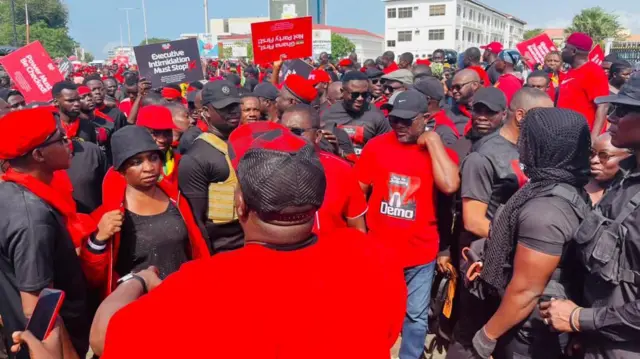
Ghana’s main opposition New Patriotic Party (NPP) has announced that it will stage another round of its “Yen Suro Ahunahuna” demonstration on Wednesday, April 22, 2026, as it escalates its campaign against what it describes as a systematic crackdown on its members by the John Dramani Mahama administration. The march, which translates from Akan as “we fear no intimidation,” is set to draw hundreds of party supporters, sympathisers, and senior executives onto the streets of Accra to protest what the NPP calls the weaponisation of state institutions against opposition voices.
The announcement comes at a time of heightened political tension between the NPP and the ruling National Democratic Congress (NDC), following a string of arrests of opposition figures and what the party views as judicial overreach in the handling of their cases. NPP General Secretary Justin Kodua Frimpong accused the Mahama government of trying to silence people who disagree with them. “The NDC government led by John Dramani Mahama has become so intolerable that it does not welcome divergent views or criticism. President Mahama seems to have forgotten that Ghana operates under constitutional rule,” he said.
The most recent incident fuelling the opposition’s anger is the case of Abubakar Yakubu, popularly known as Baba Amando, the NPP’s Sunyani East Communications Officer. The NPP described his arrest as a politically motivated abuse of state power and judicial overreach. According to the party, Baba Amando honoured a police invitation in Sunyani on April 13, 2026, in the company of his lawyer, Alfred Tuah Yeboah, but was subsequently transported to Accra under what officers reportedly described as “orders from above.” Although he was initially granted police bail and directed to report to the Police Headquarters the following day, he was instead taken to court upon reporting, without any new evidence or prosecutorial request for remand.
Yakubu was arrested on allegations of offensive conduct, false publication, and circulating statements likely to incite fear and panic. The investigation reportedly stems from alleged threats directed at an Adentan Circuit Court judge and the posting of derogatory images featuring the President and other government officials. He was eventually granted bail of GH¢30,000 (approximately $2,000) with two sureties by the High Court on April 17, 2026, after the NPP mounted a sustained public pressure campaign against his initial remand.

Equally contentious has been the raid on the home of former Asokwa Member of Parliament and former GIHOC Distilleries Managing Director Maxwell Kofi Jumah by the Economic and Organised Crime Office (EOCO). NPP National Organiser Henry Nana Boakye condemned EOCO over what he described as an unlawful raid. “We further condemn EOCO for the unlawful invasion without warrant, without cause, and without shame,” Boakye stated. “That raid was not investigation. It was intimidation.”
The raid reportedly occurred on April 15, when officers from EOCO stormed the property while Jumah was not present. According to sources, the officers presented documents indicating they were at the residence to conduct a search as part of official duties. A formal complaint was lodged at the Asokwa Divisional Police Command, while Jumah’s legal team also took steps to sue EOCO over the incident.
These incidents form part of a pattern that the NPP has been protesting since the NDC took office following the December 2024 elections. The party first staged the “Yen Suro Ahunahuna” demonstration on September 23, 2025, after the arrests of Bono Regional Chairman Kwame Baffoe, popularly known as Abronye DC, and Ashanti Regional Chairman Bernard Antwi-Boasiako, popularly known as Chairman Wontumi. Clad in red T-shirts and carrying placards with bold inscriptions, protesters converged at the Obra Spot near Kwame Nkrumah Circle as early as 8:00 am. Some of the placards read “EOCO Must Stop Dancing to NDC Drums” and “We Won’t Sit Quietly as Mahama Turns the Judiciary into a Kangaroo Court.”
Henry Nana Boakye, speaking during the September protest, accused the police of showing clear bias in their handling of political cases, asking: “Why do we have different laws for NPP and different laws for NDC? That is what we are protesting against, the weaponisation of State institutions against the opposition.”
For the upcoming April 22 march, the NPP is expected to follow a similar route through Accra’s principal streets, with the party’s national executives, youth wing, and parliamentary minority bloc all expected to participate. Boakye reinforced the party’s core grievance, saying: “When you cannot win the debate, you jail the debater. This government is building a conveyor belt of political persecution.” He also questioned what he described as inconsistencies in the application of justice. “What exactly is the striking difference between Abronye’s statement and that of President Mahama when he was an opposition leader?”

The NPP further accused the government of diverting attention from pressing national issues. “Ghanaians did not vote for vendettas. They voted for jobs, lights, water, and beds in hospitals,” Boakye stressed, urging the administration to focus on key challenges such as unemployment, rising living costs, energy supply issues, and illegal mining.
General Secretary Justin Kodua Frimpong warned the NDC to prepare to “swallow the bitter pill” when the political tables turn in 2029, reminding the ruling party that no condition is permanent. “Some of the arrests and prosecutions of New Patriotic Party members are politically motivated and are orchestrated by the John Dramani Mahama-led administration,” Frimpong stated.
The government has not publicly responded to the specific allegations raised about the latest arrests, and the Ghana Police Service has generally maintained that all operations are conducted in accordance with the law and are not politically motivated. For its part, the NDC has dismissed NPP protests as politically orchestrated noise from a party still struggling to come to terms with losing power.
Whether the April 22 demonstration produces a fresh set of concessions or simply deepens the divide between Ghana’s two dominant political parties remains to be seen. What is clear is that the NPP has settled on street protest as one of its primary tools of opposition, and that the tension between the two parties is unlikely to ease any time soon.
NPP denies involvement in alleged bee attack on NDC supporters