

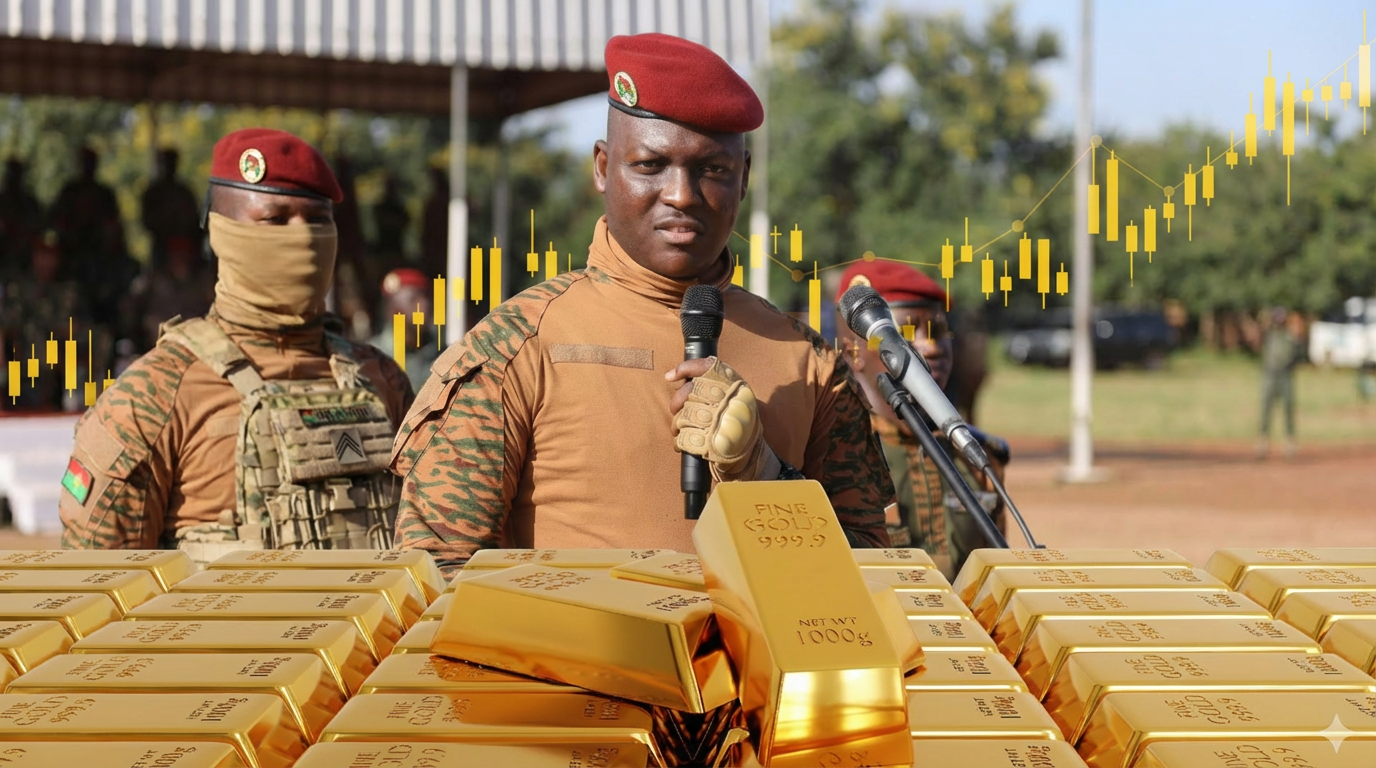
Burkina Faso is intensifying its push to assert greater control over its mining sector, formally seeking a 40 percent stake in the Kiaka gold project, a move that has rattled investors and forced the Australian operator to temporarily suspend trading of its shares.
The request, directed at West African Resources Limited, signals a deepening shift in policy under the country’s leadership, as authorities aim to secure a larger share of revenue from strategic natural resources. The Kiaka mine, located in the Centre-Est region, has rapidly emerged as one of the most significant gold projects in the country, making it a focal point of this broader economic strategy.
The company confirmed that trading of its shares on the Australian Securities Exchange was halted to allow time for clarification, stating the move was necessary to “ensure orderly trading and an informed market.” The suspension is expected to remain in place until further details are provided to investors.

Burkina Faso’s demand builds on a pattern of increasing state participation in mining ventures. The government had previously raised its stake in the Kiaka project from 10 percent to 15 percent at no cost, a move that already demonstrated its growing leverage in negotiations with foreign operators. Now, the proposed jump to 40 percent represents a significant escalation, with earlier signals suggesting authorities could even push for up to 50 percent ownership.
This approach is rooted in legislative reforms introduced in 2024, which were designed to strengthen national control over the mining sector. Officials argue that such measures are necessary to ensure that more of the wealth generated from the country’s vast gold reserves remains within its borders, supporting development priorities and reducing reliance on external partners.
Gold plays a central role in Burkina Faso’s economy, accounting for the majority of export earnings. With global gold prices supported by inflationary pressures and geopolitical uncertainty, the sector has become even more critical to national finances. The government’s strategy reflects a desire to capitalise on this favourable environment by increasing its share of profits.
At the same time, the Kiaka project is entering a phase of rapid growth. Production began in mid-2025, and the mine is now expected to contribute significantly to output in 2026. West African Resources has projected total production of between 430,000 and 490,000 ounces of gold this year, with Kiaka alone accounting for up to 280,000 ounces. This positions the mine as a cornerstone of the country’s industrial gold sector.
The company has described 2026 as a “landmark year,” highlighting the importance of Kiaka alongside its existing Sanbrado operations. It is also targeting relatively low production costs, aiming to maintain all-in sustaining costs below 1,900 dollars per ounce, which would allow for strong margins even if gold prices fluctuate.

However, the government’s demand has introduced a layer of uncertainty that could affect investor confidence. Mining projects require substantial capital investment and long-term planning, and sudden changes to ownership structures can alter the risk profile for foreign companies. The trading halt reflects the sensitivity of the situation, as investors await clarity on how the proposed stake increase will be implemented and whether compensation will be required.
The development is part of a broader trend across several African countries, where governments are seeking to renegotiate terms with foreign investors and increase state participation in resource sectors. Similar moves have been observed in countries such as Mali and Guinea, where authorities have revised mining codes and pushed for higher equity stakes in major projects.
Supporters of Burkina Faso’s policy argue that it is a necessary step toward economic sovereignty. By increasing its stake in key assets, the government can generate more revenue to fund infrastructure, social services, and security efforts. This is particularly important in a country facing significant economic and security challenges.
Critics, however, caution that aggressive state intervention could deter investment at a time when the country needs external capital and expertise to develop its resources. Mining companies may become more cautious about committing funds if they perceive regulatory risks as too high.
The situation also highlights the delicate balance between national interests and investor confidence. While the government seeks to maximise returns from its resources, it must also ensure that the investment environment remains attractive enough to sustain long-term growth in the sector.
For West African Resources, the immediate priority is to assess the implications of the government’s request and engage in negotiations. The outcome will likely set a precedent for future dealings between the state and mining companies, not only in Burkina Faso but across the region.
As gold production continues to surge and global demand remains strong, the stakes are high for all parties involved. The government’s push for a larger share of the Kiaka project reflects a broader ambition to reshape the country’s economic model, placing greater emphasis on state ownership and control.
Whether this strategy delivers the intended benefits will depend on how effectively it is implemented and how it is received by investors. For now, the Kiaka project stands at the centre of a critical moment in Burkina Faso’s economic evolution, where policy, production, and investor sentiment are converging in a rapidly changing landscape.
Burkina Faso Criminalizes Homosexuality Under Sweeping Junta Reforms