


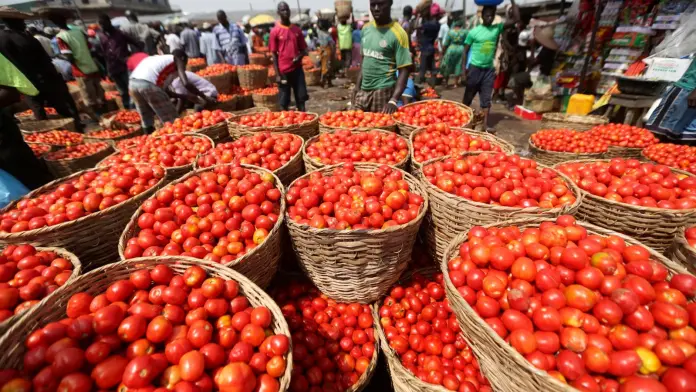
Claims that Ghana has signed a partnership with FarmMate Ltd to produce 600,000 tons of tomatoes annually require serious scrutiny, because available credible data suggests a very different scale of operations currently underway in the country’s tomato sector.
Existing verified reports show that collaboration between the Government of Ghana, through the West Africa Food System Resilience Project, and FarmMate Ltd is already in place, but the production targets are far smaller than the widely circulated figure. Current programmes under this partnership aim to produce about 6,000 metric tonnes of tomatoes, not 600,000.
This is not a small discrepancy. It is a difference of nearly one hundred times, and that matters when assessing the credibility of the claim.

The ongoing partnership is part of a broader strategy to address Ghana’s long standing tomato deficit. The country consumes roughly 1.4 million tonnes of tomatoes annually, yet local production covers only about 34 percent of that demand, forcing heavy reliance on imports, especially during the dry season.
That gap is exactly what the FarmMate collaboration is trying to close, but it is doing so gradually. The project currently covers about 200 acres across multiple regions and involves around 1,500 farmers, using improved seeds, irrigation techniques, and digital agronomy tools to boost yields.
Early results show modest but important progress. Initial harvests have reached about 240 tonnes in pilot phases, with yields expected to rise to around 15 tonnes per hectare as the programme matures.
So where does the 600,000 tonnes figure come from?
If Ghana were to produce 600,000 tonnes annually under a single partnership, it would represent nearly half of the country’s total tomato demand. That would require massive land expansion, large scale irrigation infrastructure, advanced logistics systems, and billions in investment. Nothing in the current verified programme indicates that level of scale yet.
To put it plainly, jumping from a 6,000 tonne target to 600,000 tonnes is not an incremental upgrade. It is a full scale agricultural transformation that would rival some of the largest tomato producing systems in Africa.
That does not mean Ghana is not moving in that direction. There are signs of growing ambition. Separate investments, such as large scale tomato farming projects in areas like the Afram Plains, indicate increasing private sector interest in boosting local production and reducing imports.
But even those projects are still in early stages and nowhere near the scale suggested by the viral claim.
What is more realistic is that Ghana is building a layered strategy. Instead of one massive production scheme, the country is combining multiple smaller interventions, public private partnerships, irrigation schemes, and agritech solutions to gradually close the supply gap.
The FarmMate partnership plays a key role in this approach, particularly in solving one of the biggest problems farmers face: market access. By providing guaranteed offtake, FarmMate ensures that farmers can sell their produce quickly, reducing post harvest losses that can reach up to 60 percent in Ghana’s tomato value chain.
This is actually more important than raw production numbers. Increasing output without fixing distribution and storage would simply lead to waste.
So the real story here is not about a sudden jump to 600,000 tonnes. It is about a structured effort to rebuild Ghana’s tomato industry from the ground up, starting with efficiency, farmer support, and gradual scaling.
If Ghana eventually reaches hundreds of thousands of tonnes in annual production through partnerships like this, it will be the result of sustained investment over years, not a single deal announcement.
Bottom line: the FarmMate partnership is real, and it is significant. But the 600,000 tonnes figure being circulated does not align with current verified data and should be treated with caution until officially confirmed by credible sources.

Ghana tomato self-sufficiency gap fuels price pressure